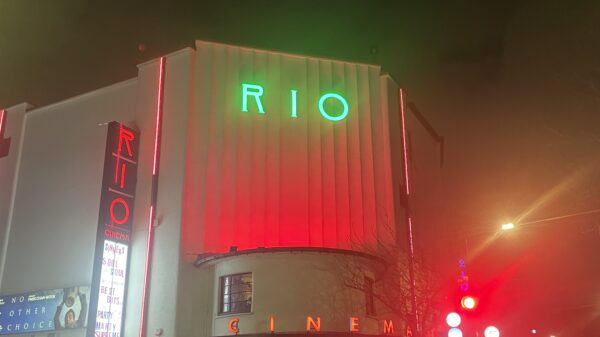
Culture Editor Thomas Deakin praises Dalston’s Rio Cinema and the success of its ‘Rio Forever’ campaign, celebrating 50 years of the historic independent cinema.
For a film student like myself and the ever-growing film community at KCL, one of the best things about London is the diversity of its film scene. Ranging from major chains like the Odeon Luxe Leicester Square, to world-renowned independent venues like the Prince Charles Cinema, there is a place for every level of film lover in central London.
Yet, in my opinion, the most interesting, wide-ranging, and friendly cinema in the city is the Rio Cinema: a small independent Art Deco cinema in Dalston, East London. Showing a multitude of pictures from niche horror films to recent wide releases, the Rio feels more than just a simple cinema – it operates as a community for cinephiles within a building that is as inspiring as the films that are shown on its screens.
The History of the Rio
Whilst the Rio Cinema has only been known by its current name for 50 years, its history dates back to 1909, making it one of the UK’s longest continuously running cinemas. Businesswoman Clara Ludski transformed this former auctioneering shop into one of London’s first cinemas in 1909, naming it the Kingsland Palace of Animated Pictures. The venue soon expanded into the Kingsland Empire cinema in 1915. In 1937, the building received an Art Deco redesign that closely resembles the modern building, despite suffering damage during WWII.
Over the next couple of decades, the cinema continued to evolve, becoming the Classic Cartoon Cinema in 1959. It then transitioned into an arthouse cinema in 1960 before it became one of the UK’s most popular adult cinemas in 1970, the Tatler. This period of the Rio’s history was explored in a recent talk on 18 October 2026 at the Rio, hosted by curator Andrew Woodyatt, titled ‘The Return of the Tatler’. The talk noted that the Tatler was initially highly profitable, drawing 10,000 members in its first week, though the rise of VHS led to its closure by 1975.
After a year of screening Kung-Fu, Elvis, and Bollywood films, the Rio was founded as a fully independent cinema run by the community. Becoming a charity in 1979, the Rio has since maintained its status as a non-profit organisation and established itself as a cultural touchstone of life in Hackney. This growing prominence allowed it to add a second screen in its unused basement space in 2017 with help provided by the RioGeneration campaign, and the venue has expanded and renovated further over the last nine years.
Rio Forever

To celebrate its 50th anniversary, the Rio Cinema launched its ongoing ‘Rio Forever‘ programme in April 2026, consisting of numerous screenings, events, and Q&As to help raise funds so it can remain a key community space for Hackney in the future. I was lucky enough to attend the first of these events on 18 April 2026 – a 35mm print of Sally Potter’s ‘Orlando’, accompanied by a Q&A with the director herself. Although I was embarrassingly shy when asking Potter a question, the warmth of the Rio lent a communal beauty to the director’s eclectic masterpiece.
This personalism has also been clear in the other Rio Forever screenings I have attended over the last couple of months. These included Paul Thomas Anderson’s ‘Punch-Drunk Love’ on 19 May 2026, introduced by director Molly Manning Walker, and Bette Gordon’s ‘Variety’ on 18 October 2026 following ‘The Return of the Tatler’ discussion.
Promoted across the city via billboards, from around the corner in Dalston as far as Crouch End in North London, Rio Forever has done a brilliant job so far of spreading the power of the cinema all across London. The Rio’s role as a pinnacle of both Hackney’s sociocultural life and London’s broader cinema scene was formally recognised on 26 August 2026, when the National Lottery Heritage Fund awarded the cinema a £192,855 grant – a fantastic achievement that will hopefully allow the venue to operate for decades to come.
Pink Palace

Alongside ‘Rio Forever’, the Rio Cinema also hosts numerous ongoing film seasons, anchored by a group of dedicated film programmers. These include the horror film club ‘Category H Film Club‘, run by programmers Claire Harrison (Scary Claire) and KCL alumnus Molly Miles, and the queer film club ‘Pink Palace‘, run by Andrew Woodyatt, which serves as the UK’s only weekly queer cinema club hosted at an in-person venue.
Predominantly based in a previously unused basement space beneath the main screen of the Rio and next to the tiny Screen 2, Pink Palace attendees gather around a TV screen on folding chairs to watch a series of niche and seldom-seen masterpieces of queer cinema. Resembling the old-school cinema clubs that once dominated the London film scene, there is a sense of communal intimacy to these screenings that allows for the beauty of queerness to flourish in a small space that makes us queer film lovers feel truly comfortable in ourselves.
The success of Pink Palace has also enabled it to occasionally occupy Screen 1, the main large screen at the Rio. Such was the case for a screening I attended on 19 October 2026 of David Cronenberg’s ‘Crash‘, a highly controversial adaptation of J.G. Ballard’s novel that remains banned in Central London by Westminster City Council. Thankfully, it can be screened in the London Borough of Hackney, where Cronenberg’s masterpiece was perfectly accompanied by a series of trailers and Woodyatt’s electrifying passion for their craft.
Interview with Claire Harrison and Molly Miles
Roar was lucky enough to visit the Rio on 1 October 2026 to discuss some information about the cinema with two of their staff members: Audiences Manager Claire Harrison and Front of House/film programmer Molly Miles, the duo also behind Category H Film Club.
Elaborating on the organisation and history of the Rio, Harrison explained that the programming of mainstream films and big releases is primarily run by the cinema’s Executive Director, Rosie Greatorex, who also has final say on most films programmed. Yet Harrison also clarified that the beauty of the Rio’s programming is found in its “socialist” ethos, noting that every worker at the cinema had programmed something over the past two years. Harrison also emphasised the Rio’s positive working relationship with neighbouring Hackney venues, such as the Castle Cinema, expressing her hope that, despite numerous Save Our Rio campaigns, the community’s support will ensure the cinema’s survival for decades to come.
A similar sentiment was evoked by Miles, who discussed their recent start-up of ‘Frowzy Films‘, a new film programme for microbudget genre cinema. On 17 September 2026, I was lucky enough to catch the season’s debut with a screening of ‘Showgirls 2: Penny’s From Heaven‘ at the Prince Charles Cinema. Miles went on to establish how being asked by Woodyatt to program a film while still a film student, combined with their friendship with Harrison, eventually led to their job at the Rio and the brilliant creation of Category H Film Club.
The Future of The Rio
In a time when cinemas are gradually dying out in favour of the impersonal yet accessible role of streaming, I find my love for film reignited by the humanity and diversity abundant in cinemas like the Rio. As Harrison noted during our interview, it is comforting that the Rio has survived through so many states of being to reach its 117th anniversary as a cinema and 50th anniversary as the Rio this year. Such a long-lasting and inspiring history fuels me with hope that the Rio will last forever as the gem of the finest independent cinema scene in Europe.
About the author