New Scientist Live 2026 (NSLive 2026) featured talks and exhibitions from scientists who specialise in a wide range of fields, from brain health to mathematics to cosmology.
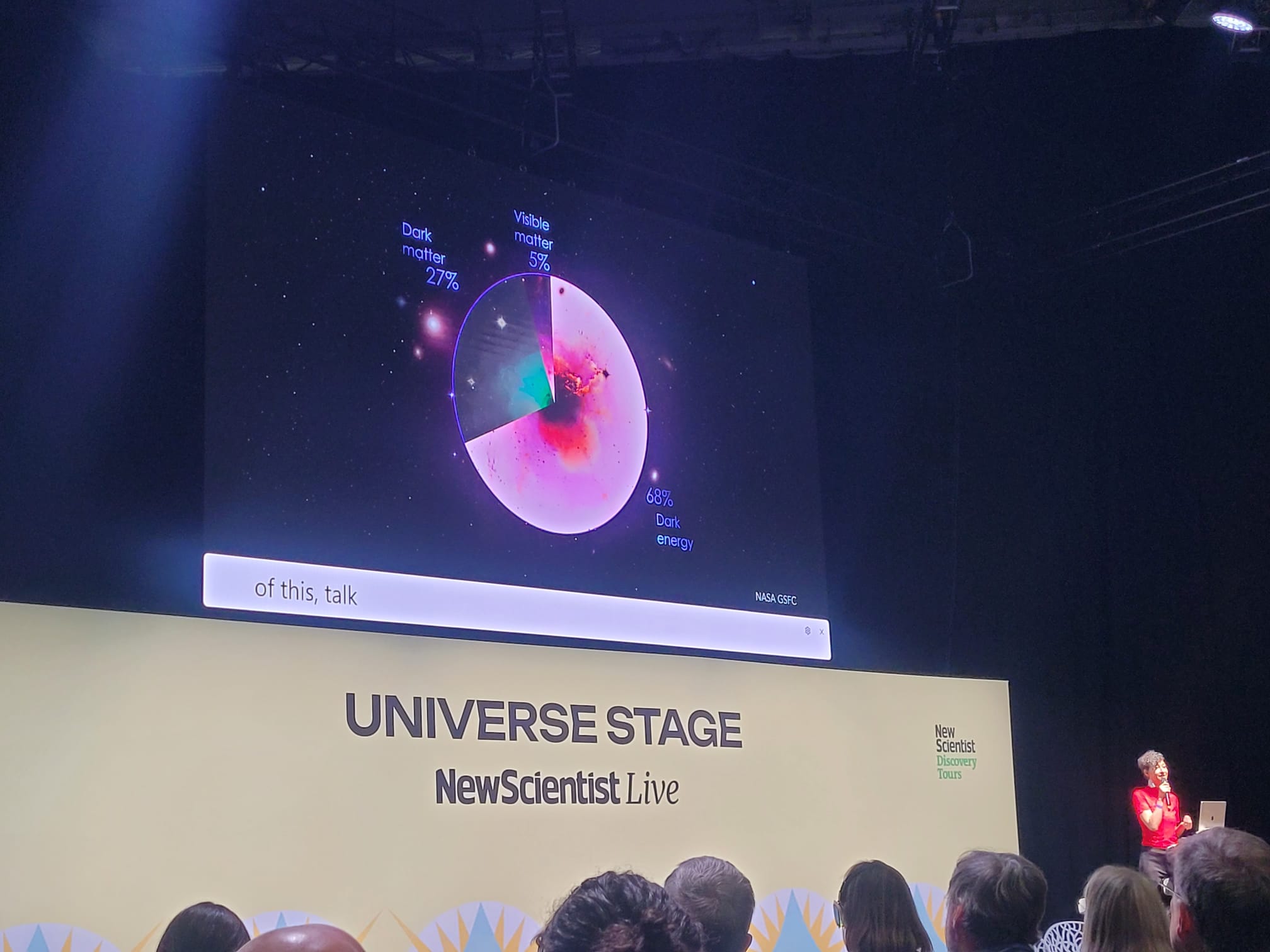
At the Universe Stage, cosmologist and particle physicist Chanda Prescod-Weinstein explained what dark matter and dark energy are and why humans should care about them at all.
In her day-to-day research, her job is “essentially to come up with a mathematical analysis” of the Universe.
As a cosmological particle physicist, that means using the parts of the Universe we can see to understand the parts we cannot (dark matter and dark energy). Cosmology generally aims to provide answers as to how the Universe began and where it might be headed next.
Prescod-Weinstein commenced her speech by highlighting that, in Physics, ‘dark’ essentially means, “we don’t know what that is”.
This area of Physics is weird and wonderful – and if history is any indicator, it tells us that prying into the weird and wonderful definitely pays off.
Let’s start with dark energy
Albert Einstein’s theory of General Relativity predicted a dynamic Universe in 1917. Edwin Hubble’s work in the following years found that the further a galaxy is from us, the faster it is travelling away from us.
The Universe is expanding; we have known that for quite a while now. In fact, the rate at which it is expanding is accelerating.
The phenomenon pushing and accelerating the Universe on all sides is what we refer to as dark energy.
Dark energy can also influence the shape of the Universe; is it flat, closed or open?
Our Universe today is observed to be flat, but may have had a different shape in the past.
The shape of the early Universe is still hotly debated, with the rate of expansion central to the discussion.
“I’m hoping if I don’t figure it out, or if one of my colleagues doesn’t figure it out, one of the young people in the audience might.”
Dr Chanda Prescod-Weinstein, Physicist and Author, NSLive 2026
Prescod-Weinstein emphasised the importance of dark energy because the Universe’s “acceleration phenomenon plays a governing role in galaxy formation” and “cosmological history is our history”.
What about dark matter?
Is dark matter different from dark energy?
Yes!
“Dark matter was in the room before we were… it’s okay, it’s safe!”
Dr Chanda Prescod-Weinstein, Physicist and Author, NSLive 2026
Dark energy pushes the boundaries of the Universe. Dark matter hides in plain sight.
To quote Prescod-Weinstein, one must imagine an “invisible non-binary person”; we see the suit, the hat, the monocle. But we cannot see the person themselves.
That is exactly how dark matter behaves. It bends space around it, without showing itself at all. From Earth, we can see ‘gravitational lensing’ due to dark matter. Gravity causes light to bend around dark matter in galaxy clusters. There is not enough visible matter to produce the gravitational effects seen.
“The invisible matter tells the visible matter where to be… the visible matter is sitting on the invisible matter.”
Dr Chanda Prescod-Weinstein, Physicist and Author, NSLive 2026
Prescod-Weinstein made sure to touch on the neutrino research that had won the Physics Nobel Prize earlier that week, as well as the budget cuts plaguing Physicists in 2026.
“Cosmology is a multi-generational project,” she said. “This isn’t just for me, it’s for the next generation and hopefully for their grandchildren as well”.
Cosmology drives curiosity and teaches young minds to think critically. Many scientists leave this “training ground” for thinking about the Universe and go on to excel in other careers.
About the author