The 2026 Nobel Prize in Physics was announced on 6 October 2026. Roar sat down to talk with Dr Teppei Katori about the prize and his experience working with the person who won, Francis Halzen.
Francis Halzen, of the University of Wisconsin was recognised “for decisive contributions to the IceCube Neutrino Observatory and the discovery of high-energy neutrinos of astrophysical origin”.
Neutrinos are fundamental particles produced during radioactive decay of nuclei (subatomic particles called protons and neutrons).
Their existence was first proposed by Wolfgang Pauli in 1931.
Pauli was studying the law of conservation of energy during beta decay; the process by which nuclei decay into other nuclei. He initially referred to the mysterious by-products of the reaction as neutrons, due to their lack of an electric charge (neutrality).
In 1933, Enrico Fermi named this mystery particle ‘neutrino’, owing to its extremely small mass. Physicists often refer to neutrino masses as negligible, with a rest mass one-million times smaller than an electron’s.
In 1956, Clyde L. Cowan and Frederick Reines used a nuclear reactor to produce and detect neutrinos. They were awarded the 1995 Nobel Prize in Physics for their contributions to the field.
Since then, neutrino research has grown, with several of the Physicists at King’s specialising in neutrino research.
Roar spoke to Dr Teppei Katori about his work in neutrino research, particularly his experience at the IceCube Neutrino Observatory and with Francis Halzen.
He explained that the IceCube Observatory “is using the South Pole ice itself as the observatory”.
Neutrinos from deep space are rare; originating from high energy events billions of lightyears away.
“In order to see neutrinos, you directly dig a hole in the South Pole ice and then put in a photon (light) sensor so that we can see when the neutrinos interact with the ice molecules, which happens very rarely.”
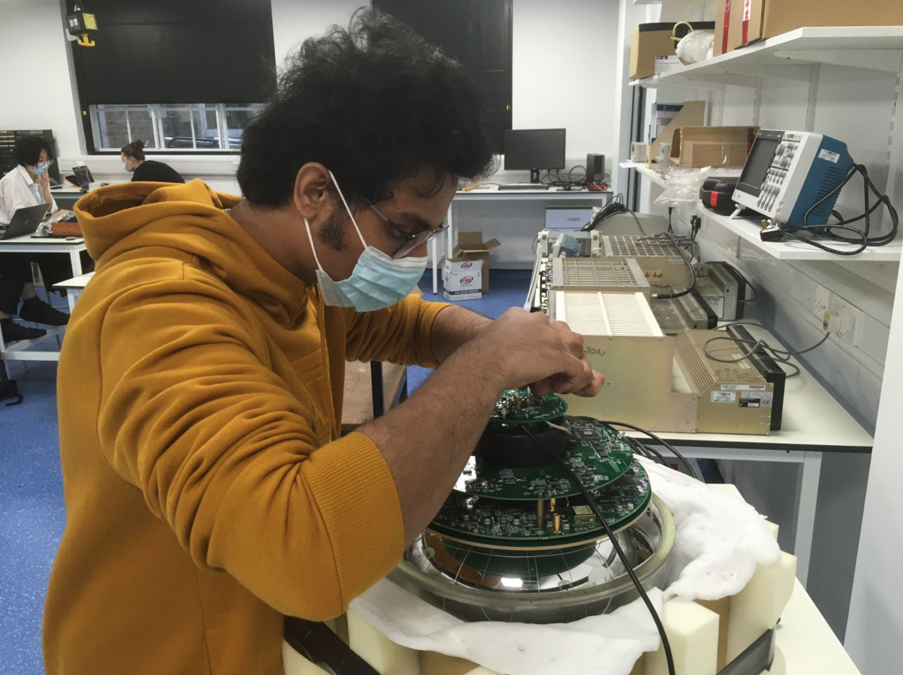
From his time working at the IceCube Neutrino Observatory, Teppei has a spare detector, which he often brings into classes to share with the students. This Digital Optical Module (DOM) a detects light particles (photons).
Over 5000 DOMs are sent deep into the hole in the ice at the South Pole to find photons released during high energy neutrino interactions with the ice.
“These neutrinos don’t interact with any atom in general” but occasionally they do and “that generates another subatomic particle which emits light”.
“So the neutrino itself is invisible, but the neutrinos collide and produce another particle and this emits light”.
Neutrino research is a popular and growing area of research, with six Nobel Prizes having been awarded to neutrino researchers.
“People are still studying this and some theorists, they predict this property of neutrino mass may be relevant for explaining some of the evolution of the universe, especially why everything universe is matter, not antimatter”
Dr Teppei Katori, Reader in Particle Physics at King’s College London
Teppei explained that the neutrinos detected at the South Pole are from the “highest energy objects in the Universe” like supermassive Black Holes.
“By seeing a neutrino coming from supermassive Black Holes or Active Galactic Nuclei, you understand the structure of these highest energy objects in the Universe”
Dr Teppei Katori, Reader in Particle Physics at King’s College London
Teppei himself works mainly on the Super-Kamiokande (Super-K) and Hyper-Kamiokande (Hyper-K) neutrino observatories in Japan. These observatories are specialised to detect more common, lower energy neutrinos from the Sun, nuclear reactors, or supernovae.
He described himself as working 100% on Hyper-K, 50% on Super-K and 10% on the IceCube Neutrino Observatory.
When asked about his relationship with this years winners, he said he has known Francis Halzen for over ten years and “he’s very loved”.
“He’s very nice, very funny and super smart”
Dr Teppei Katori, Reader in Particle Physics at King’s College London
“Everyone likes him, he’s just a great person”
Dr Teppei Katori, Reader in Particle Physics at King’s College London
About the author