I understand the desire to debate the far right until they see the errors of their ways. It’s comforting to believe convincing arguments can dismantle their views. Perhaps all the far right needs is a particularly persuasive second-year politics student to set them straight. But not every political disagreement can be resolved through debate.
The prompts posed by Turning Point UK (TPUK) are not abstract. The communities discussed are actively experiencing violence encouraged by far-right rhetoric. The moment we agree to debate whether certain communities deserve to belong in Britain, we concede that their belonging is something open to questioning. It isn’t.
TPUK is not setting up stalls for good-faith discussions. We have to be serious here. Is an organisation that thrives on provoking students and circulating confrontations online, interested in what you have to say about migration? Or are you auditioning to be the next ‘stubborn, know-it-all’ leftist for their latest Instagram reel? An audience committed to watching their views be defended by a man with a microphone and his endless supply of fallacies is unlikely to be swayed by seminar points.
There is nothing intellectually courageous about putting the humanity of vulnerable communities up for debate. Students seizing the microphone to defeat the far right with superior arguments sounds admirable. But why should we have to deliver a perfect closing argument about our right to belong, hoping Nick Tenconi (and crucially, his audience) will finally realise: “Oh, they’re actually people too!”
Even when students are perfectly dignified and informed, there is no guarantee their arguments will be well represented. We cannot assume our opponents will portray us fairly to the wider audience simply because we conduct ourselves politely. Who actually controls the microphone? TPUK chooses the questions and controls which clips reach its online audience. A student might ‘win’ an argument on the Strand but lose control of how that exchange appears online.
Clips of Tenconi being covered in yoghurt show how easily these confrontations become a media game. If TPUK arrives intent on finding a ‘far-left thug’ to own, best believe they will find one, yoghurt thrown or not.
Our resistance should not depend on the impossible task of earning the approval of those seeking to discredit us. When students protest, they are branded thugs. When they debate, their words can be repackaged. Either way, TPUK gets its content.
As a law student, I value open conversation and challenging our convictions. But there is a difference between openness and naivety. Meaningful dialogue requires more than just two people with opposing views. It requires willingness to engage with the argument, rather than trying to humiliate your opponent. We shouldn’t pretend every debate is in good faith or that an audience largely there for the spectacle is patiently waiting for you to ‘change their mind’.
As a Muslim woman, a British Muslim woman, hostile rhetoric directed towards Muslims by the far right is not theoretical to me. When Islam is portrayed as a threat, why on earth should I entertain those ideas as another intellectual exercise to occupy an afternoon on the Strand? Why should I debate someone who has already decided that people like me are a threat to the country I call home? Who regards my hijab as incompatible with Britain’s ‘Christian’ values, although the Virgin Mary herself is traditionally depicted as veiled? I have no interest in convincing the far right that my humanity requires their deliberation. It was never theirs to question in the first place.
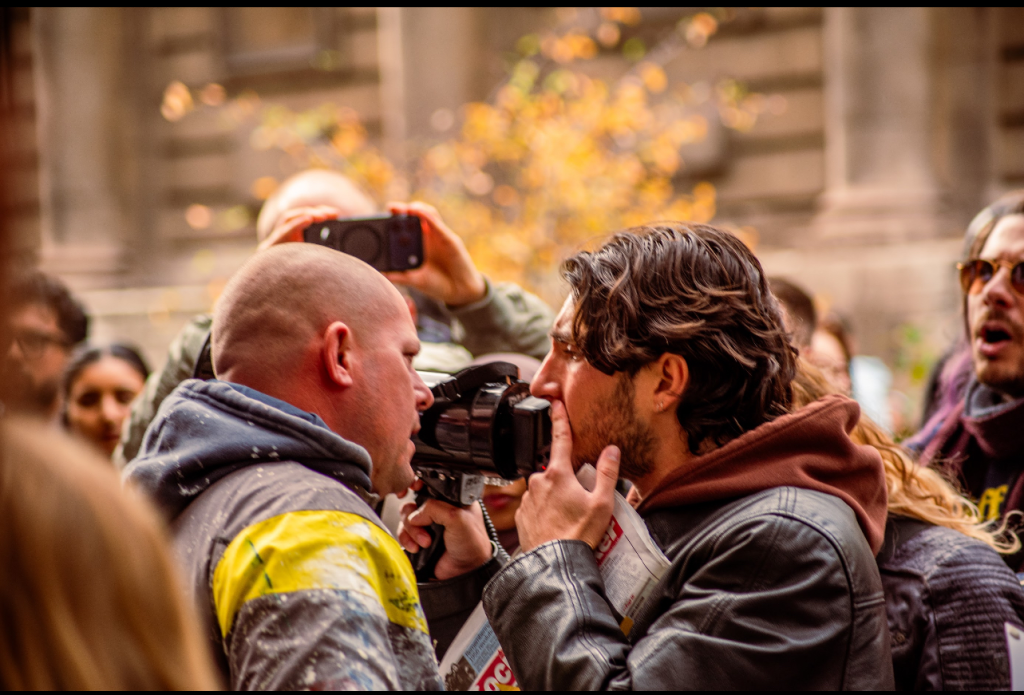
Of course, this is not a direct endorsement of yoghurting the far right. Throwing objects is no substitute for sustained organising. But why has yoghurt attracted more scrutiny than the politics being protested? At the Strand confrontation, a man was filmed appearing to perform a Nazi salute before police led him away. Tenconi himself displayed a sign proclaiming British cultural superiority.
And yet, the conversation keeps returning to why students did not debate like polite intellectuals. As though protest isn’t a powerful form of political expression in its own right.
None of this means outright abandoning debate or demanding TPUK be silenced. They have a right to freedom of expression, just as students have a right to protest. But freedom of speech is not an entitlement to an audience, much less a conversation. Debate matters with those open to reconsideration. That is not the same as participating in a confrontation orchestrated with an established political agenda.
If we are serious about defeating the far right, our efforts shouldn’t need to include winning arguments for a fifteen-second Instagram reel. Political education, collective organising, solidarity with marginalised communities and refusing to normalise dehumanising rhetoric offer more substantial foundations for resistance.
Students do not owe TPUK a debate. Perhaps we should spend less time crying over spilt yoghurt and more time recognising we have better things to do than convince a stranger with a microphone that we belong in this country.
About the author