After Freshers’ Week, none of us probably want to hear the question “What are you studying?” ever again. Yet my answer to that exact question has led me into a longer inquiry about what exactly I am studying and how I should think about it.
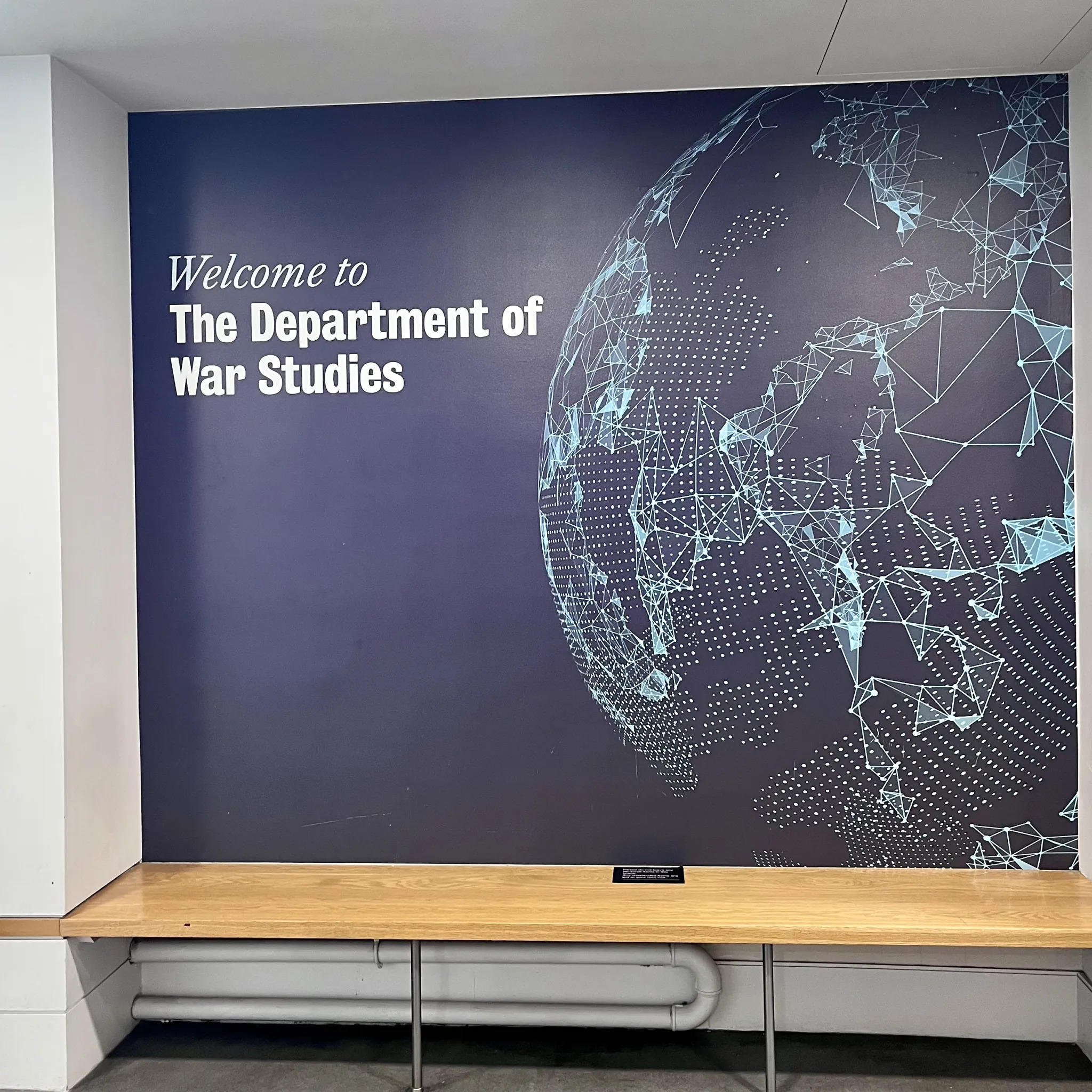
My answer is usually: “I am in Terrorism”. What I mean is, “I am in the MA Terrorism, Security & Society in the Department of War Studies.” To be clear, I have no ambition to become a terrorist or start a war, and neither do any of my classmates I spoke to for this article.
Still, studying within the Department of War Studies does raise moral and ethical questions for many, and some have concerns about the direction of the field. Cole, a student in the MA Conflict Resolution in Divided Societies, voices what many probably feel: “I constantly have those thoughts about the morality, ethics about it, and challenging some of the key concepts.”
Constant Exposure
All three students I interviewed share the view that studying war and conflict does make you more detached from, and less sensitive to, certain content. Some professors give trigger warnings and invite students to take a break if they feel uncomfortable with certain content, yet in my experience, nobody actually ever stepped outside. Or as Lisa (name changed for anonymity) puts it: “Anyone who cares about the issue and interacts with it [war and conflict], is desensitised to some degree.”
For Cole, this detachment is built into the field: “I think many of the major security approaches take out the ethics.” For Lisa, this recognition is more gradual. She admits that “there are so many moral questions [she] had no idea about.” Reading about topics such as colonialism, she says, changed this. War becomes something that “makes you constantly think about it”, and, in her words, “it is not only content anymore […] but an object of analysis.”
Detachment or Ignorance?
Does this detachment make us better scholars? Or does it simply make us ignorant? It is certainly important not to dehumanise the victims of the violence we study, and Cole offers a rather unusual perspective within academia: “I don’t think it should be desired that you should stay [objective].” He also asks: “What can I provide that someone else can’t provide, whose life has been intertwined with it?”, which is an important reminder for all of us in this field that those who study conflict often do so from a distance and with a certain (perhaps biased) perspective. Mona (name changed for anonymity) reminds us that “it is important to recognise the bias.”
What is Missing?
The Department of War Studies at King’s is regarded as one of the best in the world, if not the best. Many students, including my interviewees and me, chose to come here because of the department’s reputation, resources, and academic integrity. However, this should not stop us from asking what is missing and what could be done better.
Cole raises the point that the Department of War Studies concentrates on the conflict and may accept a certain baseline of violence as given. For those of you who do not spend your days speaking about war: in my interviewees’ and my own experience, nobody who studies it actually loves war. However, some students and professors may accept a higher level of violence as acceptable than others, for example, by evoking, as Lisa does, that war has always been part of human life. Instead of asking “Why is any level of violence acceptable?”, war studies often start from “When does violence stop being acceptable?” In most of our classes, we discuss wars and conflicts every day without imagining a different, non-violent world. Instead, we end up constructing something like a hierarchy of accepted violence, starting with state violence, moving to violence against oppressive regimes, and ending with torture (because yes, we do discuss why and when torture could be acceptable). And without being a pacifist myself, I believe that it is important to recognise that the baseline of accepted violence appears to be higher among students and scholars of war than among those of other studies, such as negotiation or peace.
Dear Department of War Studies, …
Finally, some of my interviewees and I would like to invite the Department of War Studies at King’s to reflect on how it presents itself. As Mona puts it: “Just that it is called the department of War Studies […] sets a tone.” Sometimes, a name is just a name. Yet, for some students, it is confusing, and perhaps even limiting, that degrees such as the MA in Political and Strategic Communication or the MA in International Relations sit under the “war” umbrella. Personally, I chose this department and value what it offers, and it already includes programmes and modules that look beyond traditional security approaches. Opinions on the name itself differ, but one theme emerged from my conversations: students are eager to engage with a wider range of perspectives on war and conflict, and would welcome seeing these more visibly reflected in the department’s teaching and identity.
For more Comments and Feature pieces click here.
About the author