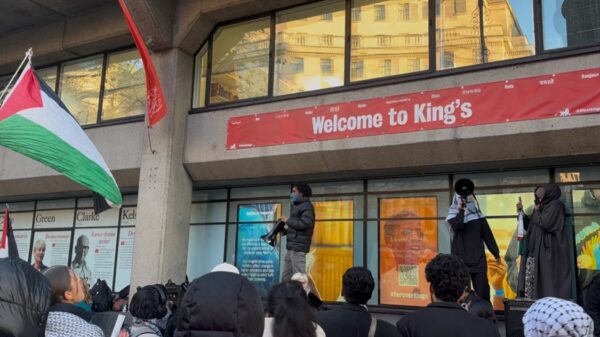
King’s students could have been barred from attending on-campus protests, societies and sports events under a shake-up of misconduct rules that King’s says was uploaded in an “administrative error”, despite also appearing in papers put to its academic board, Roar can reveal.
A series of changes to King’s misconduct policy would have handed administrators explicit powers to attach conditions to a student’s continued enrolment, including possible bans on posting online content referencing staff or students.
Version 3.1 of the misconduct policy took effect from September 2025 and was originally due for a review in 2028. Whilst it noted “conditions for the continuation of student status” as a possible restriction, it did not mention any specific examples.
But on 23 September the policy was updated – with the same effective date and no signs it had been changed – to include new subclauses that included possible prohibitions on attending protests on university grounds, participating in societies, attending sports events, and posting online content targeting students or staff.
The 23 September version did not clarify what is classified as a “protest” and explicitly named KCLSU-run groups such as KCL Football. It did not specify how the university would police the restrictions.
A similar version was put to the Academic Board “for confirmation” in October, which King’s told Roar was also released in error after a mix-up between the senior and governance teams.
But after extensive discussion on the changes at the October board meeting – which Roar understands was expected to be a nod-through acceptance – vice-chancellor Shitij Kapur agreed to a fast-tracked review of the policy, with the indicated changes being placed on hold. KCLSU president Luqmaan Waqar had requested an intervention to the chair’s action.
Attendees at the meeting, including the vice-chancellor, expressed apparent confusion about what version of the policy was in effect, with some suggestions that the version shown did not reflect the approved policy.
Waqar told Roar that he and fellow board members were “alarmed to discover” that the amendments were being presented through a chair’s action “without an opportunity for proper discussion and scrutiny”, and that the circulation of multiple versions made it unclear which one members were being asked to note.

In a comment to Roar, King’s said that there are “no mentions of protest activity in the university’s non-academic misconduct policy, and we do not issue blanket restrictions.”
But the version uploaded in September 2026 and dated to 2025, seen by Roar, contained a “prohibition from attending protest activities on University campus grounds”, and remained online until 20 October.
Waqar said members also found that several of the amended provisions had appeared on the University’s Policy Hub, in a version dated September 2026, before Academic Board approval, which the University records as 14 October.
He said this “raises serious questions about the transparency and integrity of the policy-development and approval process”.
‘Administrative error’ blamed
The controversial clauses have now been removed from the version of the policy available online, and King’s says that no cases were considered under the revised document and that no students were affected.
In information released under freedom of information laws, King’s said that “fewer than five” students in each category had been the subject of protest, online posting and society restrictions, without saying under which version of the policy.
King’s has since told Roar that “fewer than five” is a standard categorisation for FOI responses, and that the number of students who had conditions restricting societies, online posting or protest attendance is zero.
Waqar said the information disclosed “appears to raise questions” about King’s statement that the amendments were never applied, and called for “a clear, evidence-based explanation” of which provisions were in force.
King’s told Roar that an unspecified version of the policy was uploaded online due to an “administrative error” and since corrected, though a King’s document seen by Roar also says some proposed provisions were reverted “following the governance process”. Similar clauses appeared in papers put to the Academic Board.
They say that the policy was approved after a senior team meeting on 8 September by vice-chancellor Kapur – the chair of the academic board – to reflect changes set by the Office for Students (OfS). A King’s document cites OfS condition E6, on harassment and sexual misconduct.

King’s also says that the clauses on protests, societies and online posting were not part of the approved policy and were not considered by the senior team and that the current policy aligns with condition E6 and Office of the Independent Adjudicator best practice guidance on supporting students to return to study.
The new condition required university’s investigations into those topics to be “credible and fair”, with balanced rights for all parties and clearer processes and timescales.
But condition E6 came into effect on 1 August 2025, and the senior team meeting was only held on 8 September 2026. Other policies, such as the Bullying, Harassment & Sexual Misconduct Policy, were updated to explicitly comply with the condition in July 2025.
King’s says that there was no academic board meeting between the identification of the need for the amendments and the start of the new academic year, calling the decision to rely on a chair’s action “a legitimate governance process” required to comply with the requirements.
Conflicting policy versions
Three versions of the Non-Academic Misconduct Policy have been uploaded to King’s website since September this year, alongside a fourth put to the Academic Board, some with little notification of change and each with changes.
The now-approved version of the policy – version 4.1 which was uploaded on 27 October and which King’s gives an effective date of 14 October – has removed all mention of protest and society restrictions, reverting to the wording of version 3.1. King’s says section 4.7 was reverted to v3.1 wording to allow further time for review in 2026/7.
Not all changes were removed from the updated policy: one revised clause now allows a review panel to replace an interim suspension or exclusion with a “no-contact order” or mandatory conditions – King’s data shows it has not been used since September.
In addition to existing restrictions, possible “cease-and-desist” orders have been introduced: these offer a “proportionate alternative to suspension or exclusion”, according to internal board documents. Released information says that “fewer than five” students have been subject to the orders.
Changes have also been made to the “precautionary” measure review process – students are now guaranteed a communicated appeal outcome within five working days of their request and mandatory reviews of the measures occur every 28 days.
However, students have lost the ability to ask for a review at any time, and may only do so when there is a “material change in circumstances”, and such a request can only be made once every three months.
Full review
King’s has committed to a full review of the policy, including participation from KCLSU, which Roar understands is expected to be ready for the next Academic Board meeting in December.
Waqar welcomed the decision to pause some of the most controversial amendments and expedite the review, in which he will participate, but said these steps “alone do not resolve the underlying concerns”.
He said the independent inquiry he and KCLSU have called for into King’s handling of non-academic misconduct cases had become “even more urgent”, pointing to an Al Jazeera and Liberty Investigates’ report published in July that found that at least 26 King’s students had faced disciplinary investigations connected with pro-Palestine protest activity.
King’s has said it does not discipline students for lawful political expression or protest, and that disciplinary measures are taken in response to behaviour that threatens safety or the rights of others, or constitutes abuse or harassment.
King’s says that the basis of this report is inaccurate.
A spokesperson for King’s College London said:
“Our non-academic misconduct policy is a safeguarding measure that helps to keep our community safe and well. It is designed to help students to move forward with their studies positively and minimise risks of harm if they are found to have breached the King’s Community Charter which they signed upon enrolment.
“There are no mentions of protest activity in the university’s non-academic misconduct policy, and we do not issue blanket restrictions. Instead, each case is assessed on an individual basis, focusing on what is best for the student and their circumstances.
“The policy was recently updated to reflect changes set by the Office for Students, and in line with best practice safeguarding advice. As with all our policies, it has been subject to extensive governance and approval processes – it is regularly reviewed, and is an important part of our duty of care for our whole community.”
About the author