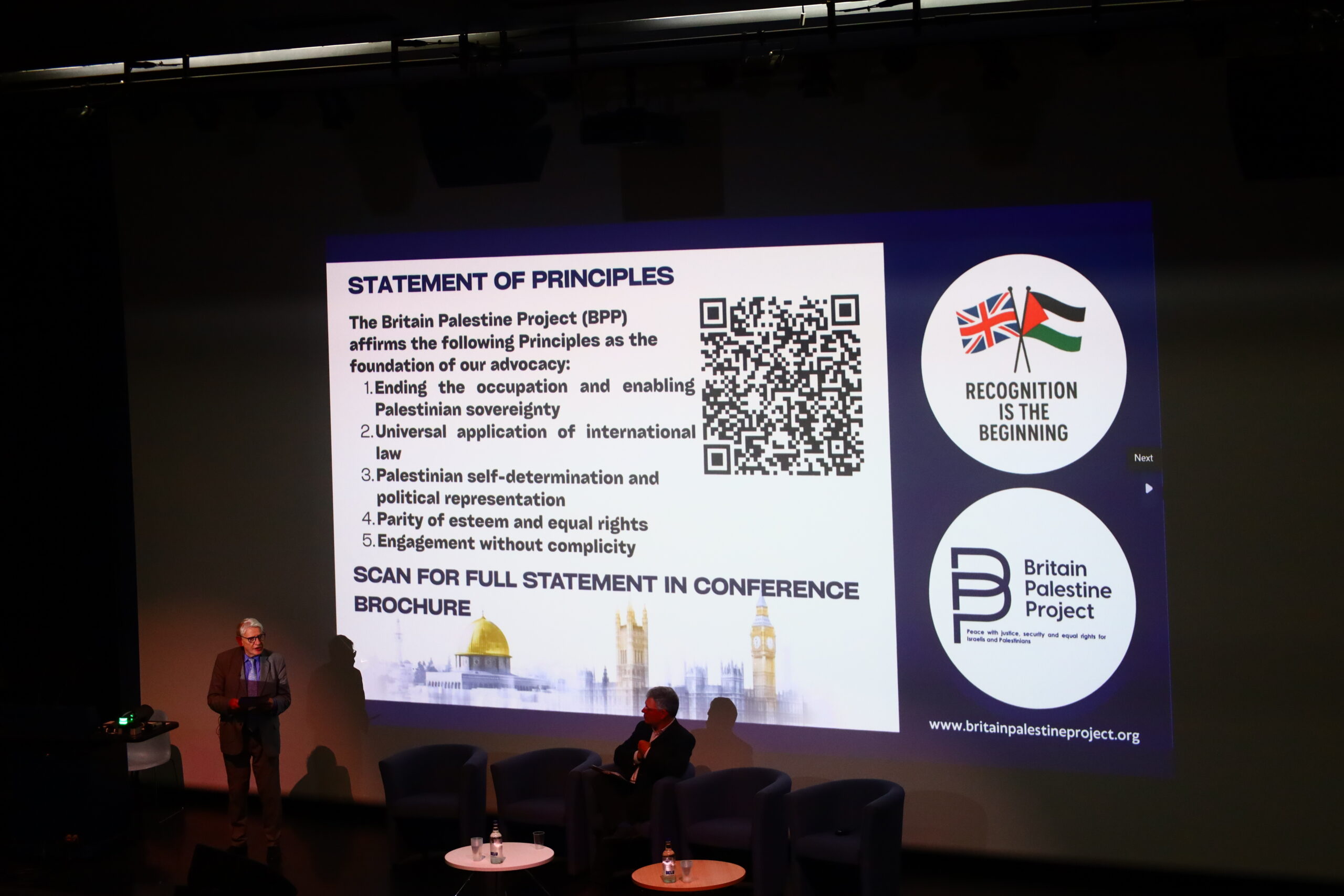
The Britain Palestine Project’s annual conference brought together diplomats, historians, and politicians at King’s College London – but not without controversy.
The Britain Palestine Project (BPP), a UK charity focused on policy engagement and advocacy relating to Israel-Palestine, hosted its Recognition Is The Beginning conference at the Greenwood Theatre on 2 June, in partnership with KCL’s Department of History.
Formerly known as the Balfour Project, BPP has hosted annual conferences on Palestine and international law since 2014 and has previously partnered with King’s on related events.
Hosted by KCL’s Professor of European History, Adam Sutcliffe, the conference featured many distinguished guest speakers and academics from a wide range of disciplines and institutions.
Notable speakers include the Palestinian Ambassador to the UK, His Excellency (H.E.) Dr Husam Zomlot and the Jordanian Ambassador to the UK, His Excellency (H.E.) Manar Dabbas.
The conference also welcomed best-selling historian William Dalrymple and Dame Emily Thornberry MP, the Chair of the UK Foreign Affairs Committee.
Leading academics made further contributions from universities across the UK, including Professor Avi Shlaim from the University of Oxford and both Dr Anne Irfan and Dr Julie Norman from UCL.
Together, these speakers formed part of the wider lineup discussing the UK’s recognition of Palestine, the current humanitarian crisis in Gaza and steps forward for the UK Government on Palestine.
The conference kicked off with an opening speech by Professor Sutcliffe and the Chair of the BPP Trustees, Andrew Whipp, discussing the key theme of this year’s conference: “recognition”.
Whilst condemning Israel for “accelerating annexation” and “making a Palestinian state impossible”, Whipp opened the conference with the BPP’s statement of principles, which include:
- Ending the occupation and enabling Palestinian sovereignty,
- Universal application of international law,
- Palestinian self-determination and political representation,
- Parity of esteem and equal rights
- Engagement without complicity
Concluding his opening remarks, Whipp, on behalf of the BPP, called for Prime Minister Sir Keir Starmer to accept the ruling of the International Court of Justice (ICJ) of genocide caused by Israel.
The UK Government has responded to the ICJ ruling, stating that whilst they “respect the role and independence of the ICJ”, they also believe that “Israel’s actions in Gaza cannot be described as a genocide, which is why we thought South Africa’s decision to bring the case was wrong and provocative”.
The second discussion panel introduced both the Palestinian and Jordanian Ambassadors to the UK, H.E. Dr Husam Zomlot and Manar Dabbas. Opening the second panel, Dr Zomlot drew attention to Israel’s violation of the Gaza ceasefire, stating that Israel is “accelerating its campaign on ethnic cleansing, annexation and displacement of the Palestinian people”.
Ending his keynote speech, Dr Zomlot spoke about the recognition of Palestine by the British government, arguing that whilst “recognition is an important step”, recognition is a “foundation for freedom, accountability and a long-lasting peace”.
Following Dr Zomlot’s speech, Dabbas drew attention to rising levels of settler violence against Palestinians in the occupied West Bank and the closure of Al-Aqsa Mosque for worshippers during the holy month of Ramadan. Both speakers’ emphasis on the recognition of Palestine reflected the conference’s key theme, “recognition” and its significance in the international order today.

The event next welcomed historian William Dalrymple, discussing Britain’s historical intervention in Palestine, claiming that the Nakba did not occur in a “vacuum” and it was Britain who “designed the architecture for it to occur”. Dalrymple further critiqued the 1917 Balfour Declaration, stating that this was the “original sin of Britain”.
Similar sentiment was reflected in the speech made by Professor Avi Shlaim from the University of Oxford, stating that Britain was “the original sponsor of Zionism and settler colonialism” and the Balfour declaration “enabled the systematic Zionist takeover of Palestine”.
Both speakers concluded their speeches by discussing the current role of the Labour government and its promotion of what Professor Shlaim described as “pro-Zionist policies”.

The event also featured a presentation by Professor Dr Nick Maynard, a surgeon and chair of Medical Aid for Palestine (MAP), discussing his experience operating in the Al-Aqsa hospital and emergency rooms in Nasser in 2024.
Dr Maynard asserted that the Gaza healthcare system was “completely disabled” and healthcare workers in Gaza were “three times more likely to be killed than civilians.”
He described the experience of other doctors, highlighting one testimony:
“Gaza was the first time I held the brain of a baby, the first of many.”
Dr Maynard ended his speech by condemning academics and medical institutions who are “complicit”, which received a standing ovation from the audience.

Towards the end of the conference, tensions began to emerge amongst the panellists and the audience. During the panel, MP Dame Emily Thornberry stated that she was “probably a Zionist” and believed that the “British people believed in an Israeli state that behaves in an acceptable way”.
This was met with audience heckling from some members, stating “Zionism is apartheid” and “you’re gaslighting your constituents”.
In response to Thornberry, Shawan Jabarin, director of Al Haq, argued that the “Zionist movement is racist”, further questioning Thornberry on the actions of the government.
He concluded, “Without action, things will continue, this is an encouragement for Israel to continue.”
Shawan’s arguments were later echoed by British-Israeli political analyst Daniel Levy, who stated that “what we heard from Emily is our fault”, and that Zionism was “incompatible with Palestinian wellbeing and Jewish safety and wellbeing.”
This was met with audience applause, highlighting the differences of opinions on the panel causing conflict.

An audience member speaking to Roar said that the conference was “brilliant” and a “good reminder for British people”, further describing their experience visiting Hebron in the West Bank as “very oppressive”.
Speaking to Roar, Professor Adam Sutcliffe of King’s College London’s Department of History emphasised the importance of bringing together a diverse range of voices in discussions on Palestine.
“It’s really important to have expert voices, but especially Palestinian voices, joining us from Palestine. We had the pleasure of having the Palestinian ambassador speak to us today,” he said.
Professor Sutcliffe also highlighted the significance of the conference taking place at King’s:
“I also believe it to be important that such a high-level debate is happening at King’s and I am really proud of King’s College, in fact, for hosting the event.”
A recurring theme throughout the conference was the role of institutions in responding to the crisis in Palestine. Speakers repeatedly emphasised the importance of academic institutions, medical institutions, governments and civil society organisations in shaping public understanding, with several praising King’s College London for hosting and facilitating the conference.
However, for some attendees, this praise highlighted a broader contradiction. While KCL’s involvement in the conference was welcomed by many speakers, students, and activists have previously criticised the university over its investment portfolio and links to companies connected to the arms industry.
An anonymous attendee told Roar, “Conferences and public discussions risk becoming mere symbolic gestures if they are not accompanied by substantive institutional action.”
They continued, “You cannot bask in the praise of hosting a conference that puts the Palestinian cause on its forefront while also having ongoing disputes over investments and shady institutional ties.”
A King’s spokesperson said:
“We are proud to hold events where different ideas and views can be shared, debated and examined with civility, and welcome discussions that stretch our understanding of the world around us.
“King’s maintains an ethical investment policy and specifically invests in funds that proactively screen to avoid controversial and unethical sectors and industries – like tobacco, controversial weapons and fossil fuels as well as investing in funds that actively target positive social and green investments.”
About the authors