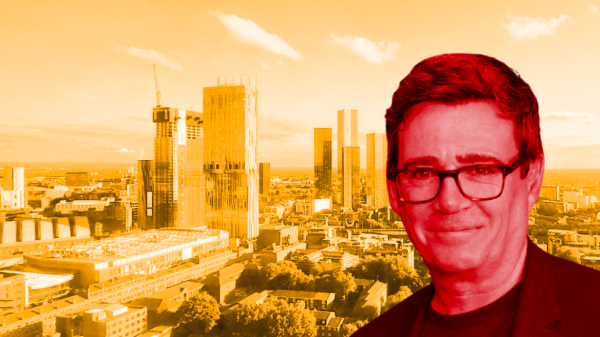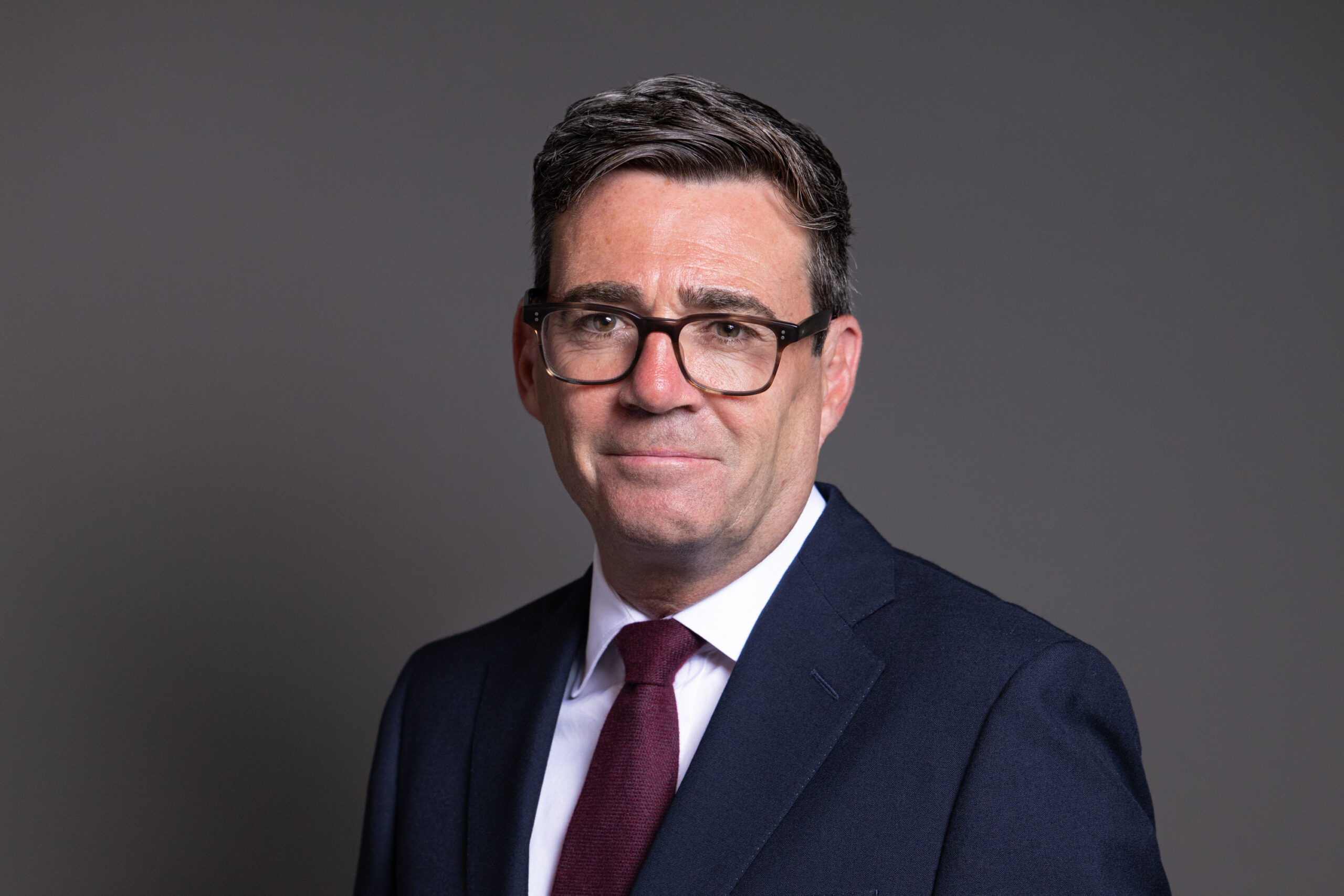
Guest Writer Tom Turner reflects on past and recent British politics as Andy Burnham becomes the new prime minister.
Twenty-two years of spectacle
Nine prime ministers dancin’
Five Olympic rings!
Four ‘once-in-a-generation’ crises
Three referendums
Two monarchs
And a politician talking to a tree!
Those are the lyrics to the final verse of the soundtrack to my political lifetime: On the First Day of Burnham…
Also, my two pennies’ worth for next year’s Eurovision, by the way. My inbox is open.
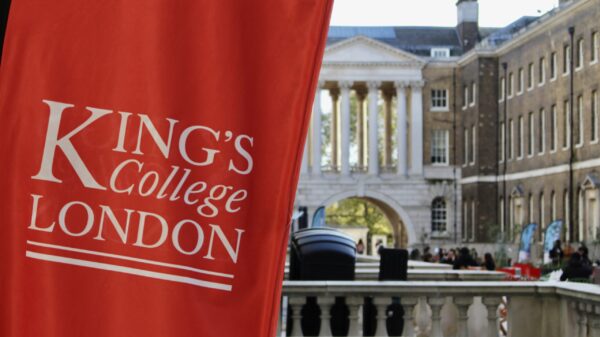
Since September of last year, I’ve had the pleasure of taking the Strand Group’s flagship Government Studies MA, hosted by King’s College London’s Policy Institute, which guides students through the contemporary history of the British government since World War II.
In a bid to make the most of the Strand Group experience, Fion Cudmore and I have made an interview series – In a State – in which I speak to four people who have worked in and around the centre of government during the 21st century. Lucky them! Each of them also teaches the course:
- Ed Balls – former Shadow Chancellor (2011-2015) turned broadcaster and KCL Professor of Political Economy.
- John Rentoul – Chief Political Commentator at The Independent.
- Baroness Catherine MacLeod – Special Adviser to the Chancellor (2007-2010) and Labour Peer.
- Lord Simon Case – Cabinet Secretary and Head of the Civil Service (2020-2024).
At a recent post-event drinks, I reflected to Professor Jon Davis (Director of the Strand Group) about how chaotic British politics has felt of late.
Jon’s response began with words to the effect of: “I think that has always been the case.”
Listening to the interviews back whilst preparing the episodes for release left me slowly but surely accepting Jon’s position.
‘Andy Burnham is my ninth prime minister; Tony Blair was my first.’
That statement is true for anyone born between 2 May 1997 and 27 June 2007.
In just over nineteen years, then, Britain has had nine prime ministers.
Nine prime ministers before Tony Blair? One Winston Churchill – whose final stint in No. 10 Downing Street ended in April 1955!
So, those of us in Gen Z can be forgiven if we feel as though events in our lifetime have been unprecedented.
We have good reason to think so

2007-2009: the global financial crisis. Ed Balls (also a student of history, I should add) told me that this was economically equivalent to a World War.

2016-2020: the Brexit vote and negotiations. The repercussions of the decision and how Britain should progress remain the subject of intense debate.

January 2020: the first Covid-19 case was detected in the UK, a nationwide lockdown was introduced two months later. The last domestic restriction was not lifted until February 2022.

February 2022: Russia’s full-scale invasion of Ukraine, speeding up the European debate about defence spending and disrupting global energy markets.

2016-2026: six British prime ministers announce their resignations within a decade.
Though, Jon’s case is convincing
Consider the nineteen years before June 2007.

November 1989: the Berlin Wall fell, opening the border between East and West Germany and catalysing European integration.
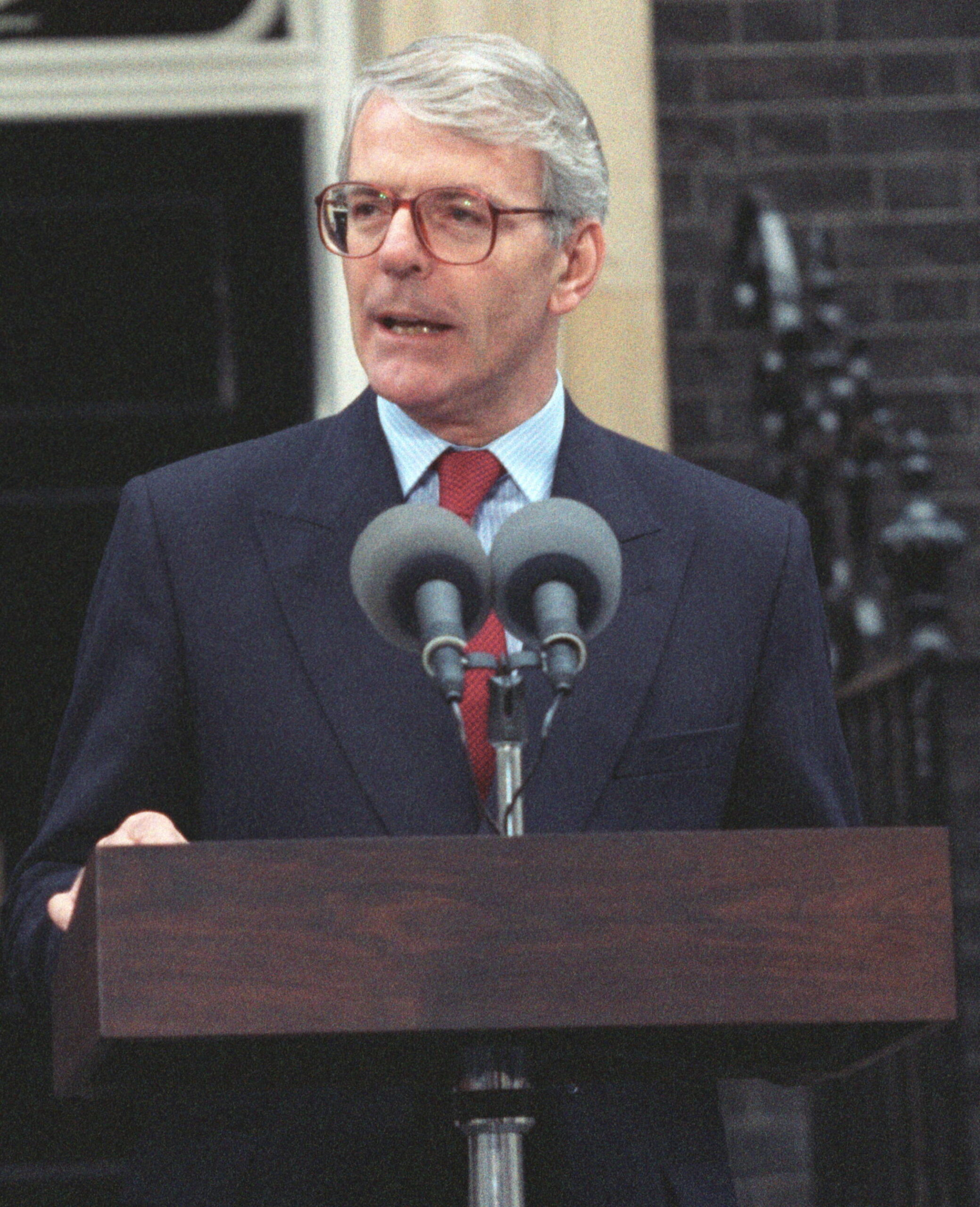
September 1992: the pound crashed out of Europe’s Exchange Rate Mechanism, severely damaging the Conservative Party’s reputation for economic competence.

April 1998: the Good Friday Agreement was signed, paving a way for decades of violence in Northern Ireland to subside.

11 September 2001: al-Qaeda’s infamous attack on the United States, which triggered the ‘War on Terror’.

February 2003: well over a million people marched in London against the Iraq War, the largest political demonstration in Britain to date. The war began the following month.
Of course, keen news observers and political spectators have been getting whiplash trying to keep an eye on things, as events this past decade have unfolded in ways which could not have been predicted.
What can be predicted, though, is that this will continue to happen, because it has always happened.
It is blindingly obvious that Andy Burnham’s time in No. 10 will be challenging. It is also clear that his (short-term) popularity with the public will fall.
He inherits a lethargic economy and a fed-up population.
The poorer half of non-pensioner households have seen incomes rise by an average of just half a percentage point per year since the mid-noughties, against the backdrop to ongoing cost-of-living pressures.
On top of this, Britain continues to face serious fiscal constraints, limiting what the government can sensibly do.
It’s not all doom and gloom, though.
Stars aligned unusually for the interview series: my conversation with Lord Case dropped the week after Starmer resigned.
As Cabinet Secretary, the buck ultimately stopped with him to handle the transitions of power from one PM to another. He welcomed Liz Truss, Rishi Sunak and Keir Starmer into No. 10 Downing Street on their first day in the new office (and gaff).
He told me the essence of the reality check he delivered to each of them:
“Congratulations, good news, you’re prime minister. Bad news is that your job is now to make decisions.”
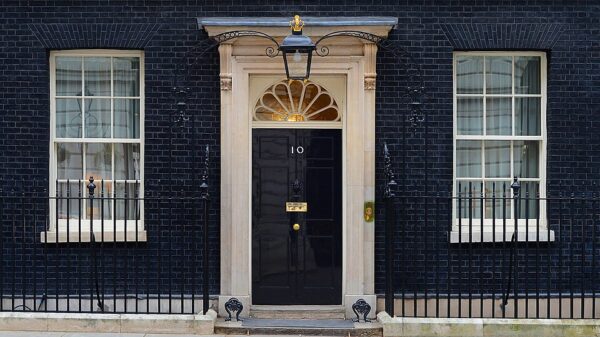
Today, after singing Oasis’ Half the World Away to the King at Buckingham Palace, Andy Burnham will walk through the famous black door and will be greeted by the now Cabinet Secretary, Antonia Romeo.
It is very likely that they will have a similar chat.
Case explained, “The thing which is particularly complicated about being prime minister, is if it was an easy decision, somebody else would have taken it. Being prime minister is about taking difficult decisions.
“Prime ministers who understand and are comfortable with fundamentally being the person sitting at the top who has to take those difficult decisions, that’s what you need a prime minister to do.
“If you can’t take a decision, because there’s no perfect answer, you’re going to struggle as prime minister, and that’s terrible for the [government] machine and that’s also terrible for the country.”
Andy Burnham has a real opportunity here
It is likely that Labour MPs will be more disciplined under their new leader: they will know that rebelling is not in their interest if they are to convince the country that Labour can change things in a short space of time.
Furthermore, voting against the person whom they have just allowed to be their uncontested leader would look, frankly, ridiculous.
This means that Burnham has the political capital to force through legislation which Starmer did not.
He also snatches the baton at a time when Reform UK is in a pickle, to be polite.

Nigel Farage has expertly positioned himself as the establishment candidate against a bin with a cape and a sense of humour.
Whilst the pair trash-talk over summer, journalists and officials will continue to examine Reform’s money stream. Which, for a growing chunk of the electorate, looks increasingly like one of the streams off Channel 4’s Dirty Business.
Looking toward the future
A week may well be a long time in politics, but there is no time at all until the next general election – which has to be called within three years.
Just as recent British governments have thought too short-term about policy, recent British prime ministers have thought too short-term about their popularity.
If Andy Burnham wants to go down in history with an ironed t-shirt and fluttery eyelashes, he had better be prepared to get his hands dirty whilst in office.
So, on the first day of Burnham, circumstances have sent him: a genuinely exciting opportunity! One which must not be squandered.
About the author