Comment Editor Biraj Khadka argues that Manchester’s musical past holds lessons for Britain’s current political moment.
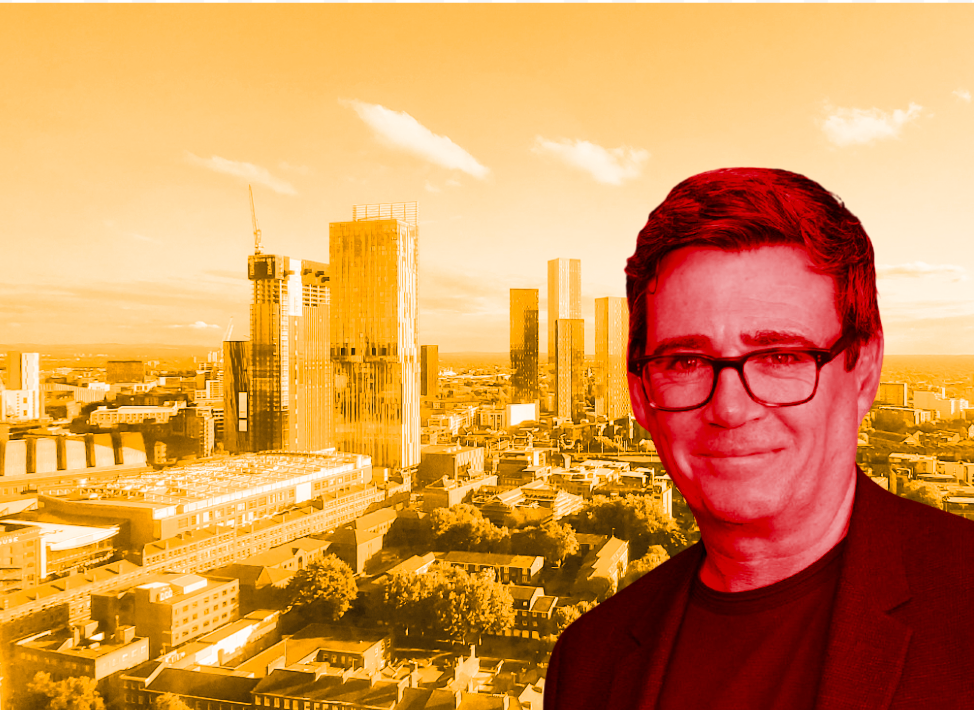
It’s not coming home after all. Regardless, in recent weeks, many in England—in packed pubs, zealous watch parties, and restless living rooms—will surely have been busy cheering on the Three Lions at the World Cup. Courtesy of this frenzy and subsequent heartbreak, one would be forgiven for failing to detect that a certain city in the North is, by any measure, having its fifteen minutes of fame. Perhaps more, depending on how long one thinks the newly minted Prime Minister Andy Burnham will last at No. 10.
Amidst the political theatre in Westminster, a curious coincidence is not to be missed: the very week Britain gets its first (adopted) Mancunian Prime Minister, “Wonderwall” by Manchester’s homegrown Oasis soars to re-peak at number two in the UK Singles Chart, 30 years after it first cemented its place as a Britpop classic. Some shrewd manoeuvring by the gods of Burnage it must have taken for this moment to align. Of course, Wonderwall’s resurgence has come about as a result of the song becoming England’s unofficial World Cup anthem, and not, as some politics watchers may have hoped, because of Burnham. Nonetheless, the concurrence isn’t lost on this writer.
Manchester, it seems, is everywhere for those who look. For one, there is much talk of Manchesterism, Burnham’s blueprint for his city as mayor. Amongst other things, it has included bringing Manchester’s buses and trams under public control, and a construction boom for new homes and work spaces.
When Burnham took over as mayor of Greater Manchester in 2017, he built steadily on policies masterminded in the 1990s by Richard Leese, then-Labour leader of Manchester City Council, and Howard Bernstein, the former Chief Executive of the Council, which set in motion the city’s rebirth from post-industrial decline into a Northern economic powerhouse. Under Burnham, Greater Manchester has seen its productivity continue to grow steadily, rivalling and “outperforming” London on several criteria, even as much of the country has been mired in stagnation since 2008.
And now, regardless of the verdict one holds on Burnham’s time as mayor, a simple truth must be grappled with: Manchesterism looks all set to go national. Burnham plans to apply his Manchester playbook to the rest of the UK, and has already announced a £2 cap on single bus fares in England, coming into effect this January. Burnham touched on his plans in his first speech as Labour leader, arguing that many of Britain’s maladies can be traced back to aggressive privatisation in the 1980s.
In this searing rejection of Thatcherism, and of any remnants that have remained in governments since—both Tory and Labour—the Prime Minister promised to turn a corner and deliver “the most significant change” seen in Britain since that time. This includes establishing a “No. 10 North” in Manchester, where Burnham has stated he will spend part of each week.
But most telling about what tone one can expect from Burnham’s premiership wasn’t the content of his speech, but rather what came after: he chose to end his speech to “True Faith” by Mancunian band New Order, dancing as his colleagues rose to their feet for a standing ovation. The feverish 1980s, it turns out, delivered more than just Thatcherism: the decade gave birth to the very band Burnham danced to, and with it, a wave of euphoria emanating from Manchester—aptly dubbed ‘Madchester’—that eventually paved the way for Britpop bands like Oasis to soar in the 1990s.
Especially fitting in relation to this summer’s political shakeup is that Madchester replaced the moody post-punk and rock that previously burgeoned out of Manchester with something else entirely: euphoric, transcendent music that signalled, above all, that it was ok to dance. In fact, mere months before Burnham’s bogeywoman Thatcher won a second term with a landslide victory in the summer of 1983, New Order released “Blue Monday,” a song which fused club beats with post-punk and functioned as a crucial bridge between rock and electronic dance.
In the years after, Mancunian bands such as The Stone Roses and Happy Mondays followed suit with similar themes in their music, cementing Manchester’s role as a city confidently setting the national register.
So, just as Britain was in the midst of what Burnham has called “a series of wrong turns” politically, music emanating from Manchester was in the throes of its own transition, one to an era of defiant energy and renewal. Renewal, which Burnham and his party can borrow a thing or two from as they set about bringing the transformations voters have been promised, and as they pin their central theme on Hope, while hoping, in the meantime, to engineer a turnaround for Labour’s fortunes.
Perhaps none of this was lost on Burnham when he decided to end his first speech as party leader with New Order blaring through the speakers. The name of the band, after all, literally signals a paradigm shift taking shape—an idea Burnham was keen to underscore throughout his speech.
“The North of England has given me so much,” Burnham remarked during his address. Well now, it has given us a new Prime Minister, a song soaring up the charts, and, just maybe, an exercise in renewal from the past that would suit today’s Labour party well.
To read more Comment and Feature pieces, click here.
About the author