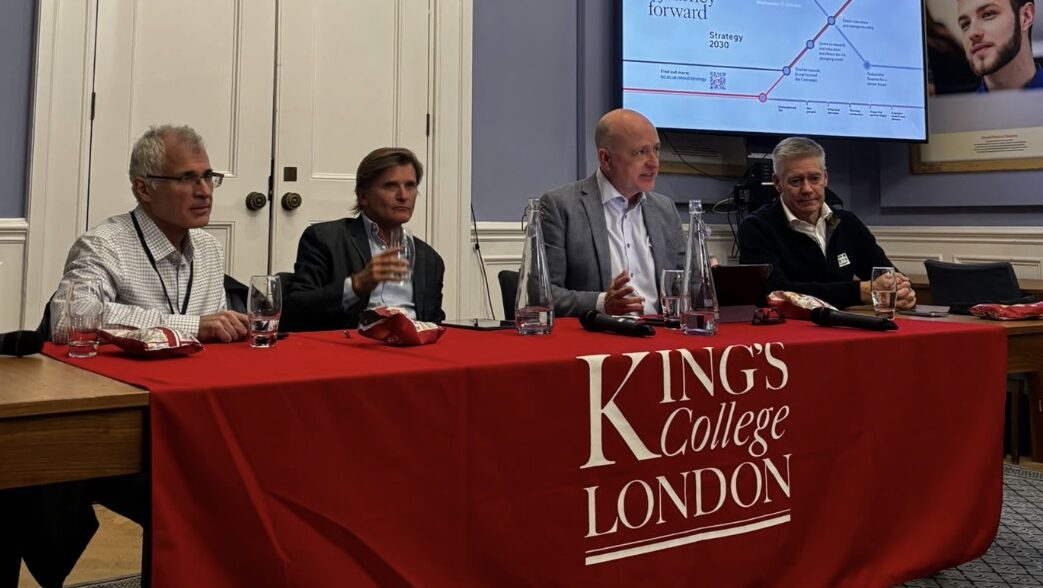
A King’s College London Think Tank Society panel of economists and political advisers debated what the upcoming budget should do about youth unemployment, defence spending, tax and the housing crisis.
On 21 October, King’s College London Think Tank Society, alongside King’s student and former member Haayat Ahmed, hosted a panel discussion exploring key policy issues that the upcoming UK government budget will likely address. Their discussion ranged from defence spending to tax re-structuring, as we face a volatile geopolitical climate, high youth unemployment, rising government borrowing costs and a housing crisis.
The discussion brought together a panel of experts in politics, economics and public policy to explore what a successful budget may look like. This included Andrew Allum, former Westminster councillor and trustee of the Jobs Foundation; Sam White, former chief of staff of Keir Starmer and senior political advisor; Richard Farleigh, economist and former Dragons’ Den investor; and Professor Jonathan Portes, former chief economist at the Cabinet Office and the Department for Work and Pensions (DWP), now professor of economics and public policy at King’s College London.
Richard Farleigh highlighted how a growing despondency amongst young people is one of the biggest “demons facing the UK economy” followed by “housing, limited productivity growth, government waste and incompetence and taxes and debt”.
Farleigh argued that Andy Burnham “has a unique chance” to tackle these difficult issues now in the upcoming budget, while “running on this honeymoon period” where the Labour government is relatively “popular”.
“Cash gives you security, investment builds the future” – Andrew Allum
During the discussion, Andrew Allum highlighted how across the UK “around 1 in 6 young people are unemployed or NEET”. NEET refers to “the number of young Britons who are not in education, employment or training”, which in 2026 “has topped 1 million for the first time since 2013.”
Allum proposed a tax change to tackle this. Under current rules, businesses are exempt from paying 15% national insurance on earnings up to £50,268 per year for workers under the age of 21 in the UK. Allum suggested increasing this exemption up until the age of 25, “in order to make it more attractive, cheaper and easier for businesses to hire young people, so they can get that first run on the ladder”.
He went on to emphasise the importance of giving young people the opportunity to build financial independence, equipping them with financial literacy and teaching them about the “risk of not investing”.
According to a study by consultancy Oxford Economics the UK is estimated to be £2 trillion behind in capital invested by businesses since the turn of the century. Meanwhile, Allum highlighted how the British public holds close to £2.3 trillion in cash savings, which is being “eaten by inflation”. He therefore argued that the budget should consider improving the accessibility of “interesting investments that only the rich see” and emphasised the need for “some changes to regulations and mild reforms around lower risk and higher return all designed to attract capital into the economy”.
“More productivity investment can give our generation more freedom to think, build, invest and to keep the golden age going.”
Andrew Allum
Defence Spending and Tax
Sam White, explained how our current “golden age” has “worrying clouds on the horizon”, given the UK National Armament Directors recent warnings of “a grave risk of us being at war by 2030”.
White argued that there needs to be an active cultural shift to recognise external military threats in order to deter this aggression and to commit a “higher portion of our GDP on defence”.
White explained how in order to get back to “a Cold War level of defence and resilience”, we cannot just “tax the existing economy” or “just borrow” but need to “expand the existing economy” by re-industrialising jobs, increasing investment in infrastructure (both by the government and private sector), and revising the amount of “leisure time and leave we are entitled to”.
He also argued that a restructuring of incentives through the British tax system is necessary to enable these changes, emphasising how the current tax and benefit system “is littered with disincentives to work”.
Richard Farleigh, highlighted how “productivity growth has the biggest effect on wages growth” and therefore praised new Cabinet Secretary to Prime Minister Andy Burnham, Dame Antonia Romeo, and her “mission to get productivity improvement in the public sector”.
Farleigh also argued that with “taxes being at the highest level they have been since WW2”, we cannot just “keep taxing and trying to spend the money”.
In contrast, Jonathan Portes, argued in favour of a tax reform oriented around “higher taxes, at least over the medium term” in order to tackle the UK’s fiscal constraints and support healthcare and defence, saying “there is no serious alternative to that”.
Portes highlighted how while “there is a serious problem with people not being in work” this is “not really a public finance problem, it’s a social economic problem…we spend about the same proportion of national income on benefits for working age people as we did 15 years ago” and instead explained that what we are spending more on is pensions and healthcare due to aging but “most importantly due to preferences”. He said that “if we try to suppress that, then that it is economically irrational and most importantly its welfare decreasing”. Portes went on to cite the ‘Milburn Review‘ as a good foundation to structure welfare reform around.
Farleigh later critiqued Portes view on increasing taxation arguing that: “All academics love to say pay more tax, because they are not paying it. It is the businesses, the people who start businesses, who are paying it”.
Richard Farleigh and Jonathan Portes on the Housing Crisis and Immigration:
Portes also argued that the government needs to show that it has a credible plan for growth which will move towards “a more sensible, liberal and flexible immigration policy”. He argued that “immigration is too low at the moment”, emphasising how “immigration is broadly good for growth and public finances”.
Richard Farleigh disagreed, highlighting how “you cannot have immigration without housing” He argued that “recent work on housing in the government has been moronic…they have made it so difficult for landlords” and “for young people” highlighting how “we are six and a half million homes short of what we need”, while house prices are now “8 to 12 times your salary”.
Farleigh went on to say that in order to support the UK’s growing population, which “in the last five years has gone up by three million”, and since the turn of the century increased from roughly 60 to 70 million, there needs to be sufficient housing:
“You can’t just have people coming in. It’s nothing about race or anything else, it’s just a simple fact, you have to build the houses. So you can support immigration if you like, but then you have to support housing”.
Richard Farleigh
The discussion also raised concerns over growing polarisation and extremism across the UK and globally. Farleigh commented that “with politics, the answer is probably in the middle. If you go too far left or too far right, you probably won’t bring people along with you”.
Following the panel King’s Think Tank said:
“One of the things we really wanted from the panel was to bring together different perspectives on such an important and timely issue. Whether we agree or disagree with those views, we think it is important that students have the opportunity to hear them, question them and engage with them directly. The Budget affects people in very different ways, and we wanted the event to create space for an open discussion around those differences.”
About the author