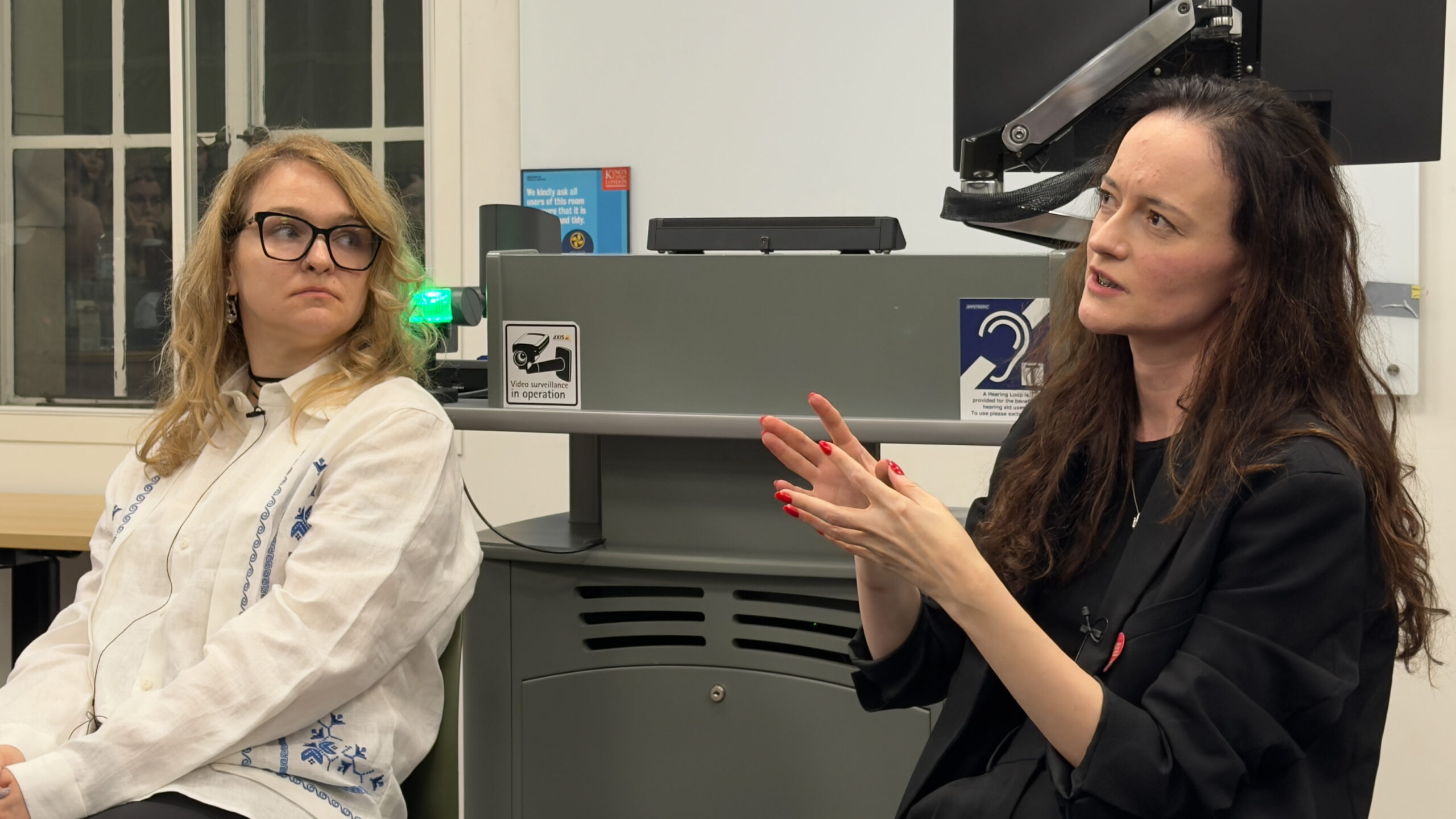
On 30 September, King’s College London’s Ukrainian Society and Roar welcomed The Kyiv Independent CEO Daryna Shevchenko and Editor-in-Chief Olga Rudenko to discuss media development during war time, the importance of independent journalism and give insights into frontline journalism in Ukraine.
The Kyiv Independent is an English-language media outlet that was formed in November 2021 (three months before Russia’s full scale invasion of Ukraine) by journalists who were fired from the Kyiv Post for refusing to give up their editorial independence. Since then, global membership has reached 36,000 people.
During the discussion, both Shevchenko and Rudenko emphasised the importance of transparency in journalism, with Rudenko commenting that the Kyiv Independent is not a “PR service for Ukraine” and that “we don’t sweep anything under the cover”.
Kyiv Independent’s Mission Amidst War and the Rise of Disinformation
The Kyiv Independent has maintained ongoing criticism of Zelensky’s presidency since before Russia’s invasion. Most notoriously, the Kyiv Independent has uncovered corruption scandals within the administration through their International Legion series of investigations. Reporters Anna Myroniuk and Alexander Khrebet investigated a Zelensky-initiated unit for foreign volunteers, in a three-part series (2022–2024) that exposed alleged suicide missions, abuse, and weapons misappropriation by commanders.
In August 2025, the Kyiv Independent revealed that Ukraine’s anti-corruption bureau was investigating Fire Point, the country’s biggest drone and missile maker, over possible price inflation and alleged ties to Zelensky’s associate Timur Mindich, despite threats from the company to report the newsroom for treason.
Rudenko explained that “it’s our Roman empire to make our audience understand that it’s not Zelensky fighting the war, it’s Ukraine fighting the war” and raise awareness regarding the role of the Ukrainian people – civil servants, soldiers and workers – in combating Russia. She highlighted the importance of not romanticising leaders during wartime and criticising Zelensky when he needs to be criticised, something that is especially crucial now due to the rise in Zelensky’s concentration of power since the introduction of martial law in Ukraine.
Rudenko also discussed the importance of developing critical thinking skills in order to challenge corrupt media outlets that peddle false narratives which are often exacerbated by distorted historical context, such as the idea that the invasion of Ukraine is a denazification and that “Ukraine is temporary”, a narrative Rudenko says Russia has been spreading for decades.
Telegram
The discussion went on to criticise cloud-based social media platform Telegram, which has been dubbed “the dark web in your pocket” by cybersecurity podcaster, Patrick Gray. Rudenko described the app as a “ticking time bomb” where people can pay for certain “news stories” to be placed on major Telegram channels with hundreds of thousands of subscribers, enabling the spread of disinformation and in some cases Russian state propaganda.
In August 2024, the CEO of Telegram, Pavel Durov, was arrested in France after being “accused of failing to take steps to curb criminal uses of Telegram“, he has since been allowed to return to his home in Dubai, but investigations are still ongoing.
Rudenko explained that “Telegram, by design, is a very irresponsible platform because it allows anonymity”. She emphasised the importance of having well-established news sources that are transparent about who they are in order for readers to make a judgement and be critical about the news they are consuming given the biases of sources. She explained how Telegram channels, differing from typical media sources, have “no standards to adhere to” while “they claim to be the source of truth,” meanwhile in media channels, “there is some accountability”. She went on to say that “you build trust by not trying to write what people want to read, but by writing what is true”.
“Horror can still impress people” (Shevchenko): Frontline Journalism and Global Engagement with the War in Ukraine
When asked how the Kyiv Independent can increase global engagement with the war in Ukraine, particularly the Global South, Shevchenko emphasised the importance of making the world aware that “the risk and danger is not just Ukrainian, it’s a danger to the world”. Shevchenko also said that this responsibility cannot just be the task of one media platform:
“I think it is the task of a lot of actors…a way to do this is to go beyond the news and publish books, documentaries, feature films and fiction…this brings the stories closer to the audience.”
This is something that frontline journalism can also help to convey, albeit at high risk.
Francis Farrell, a senior reporter for the Kyiv Independent, who has been providing frontline coverage in Ukraine for the last four years, talked about the importance of providing readers with specific details regarding what is changing on the frontlines, as opposed to vague overviews that only provide a “surface-level picture” of what is happening in Ukraine, reducing the war to “tiny movements on a map”.
One of the biggest concerns in war reporting is the normalisation of violent imagery. Farrell acknowledged how hard it is to hold the world’s attention on Ukraine after coverage has “overwhelmed the world with all sorts of horrible pictures”. “Naturally,” he said, “people tend to look away.”
He mentioned how the Kyiv Independent, to help ease this concern, has moved beyond news articles and into documentary filmmaking. The outlet set up a dedicated unit to investigate war crimes in Ukraine, which has so far produced thirteen documentaries. Its films also cover the torture of prisoners of war, repression in occupied territories and crackdowns on religious communities.
He went on to say: “…whether you’re a young activist, a young journalist or a journalist in local legacy media here in the UK or you’re in our position, we just have to always think about how we can be smarter and more effective in that communication task”.
About the authors