Roar writer Allegra Boreham on the ‘Making History: Shakespeare and the Royal Family’ exhibition.
Shakespeare is royalty to English literature. He is not a ‘he’; he is an era, a language, an entire subsection of literature. The name ‘Shakespeare’ has overcome the humanness of a living being. He is his narratives, his stories, his infamy. When we hear ‘Shakespeare’, we don’t think of a person as much as we do the infamy of his name that proceeds any personness. And this phenomenon is paralleled by the royal family.
Shakespeare and the Royal Family are united by this phenomenon of depersonalisation. Neither are thought of first as what they simply are: people. They are grand. They inhabit so many more spaces than that of a living being. In this grandeur, they overlap. This exhibition examines this overlap and displays a crafted array of examples where said overlap works to make history.
The exhibition goes further than the obvious cross-over points between Shakespeare and the Royal Family. It doesn’t focus on Queen Elizabeth I and various accounts of her watching his plays. It quickly dismisses this, claiming she “never actually went to the globe”. Instead, it focuses on a deeper connection, one which explores how the narratives of Shakespeare and the lives of various monarchs bleed into one another.
However, I feel that the exhibition doesn’t ask what they have ‘done’ for one another. In the words of Shakespeare himself, “what’s done, is done”. The relationship that is presented throughout this exhibition is not an incident or interaction that occurred and ended. It is symbiotic, and in this, it is active and ongoing. I feel that the exhibition instead asks how Shakespeare shapes the Royal Family – and how the Royal Family shapes Shakespeare.
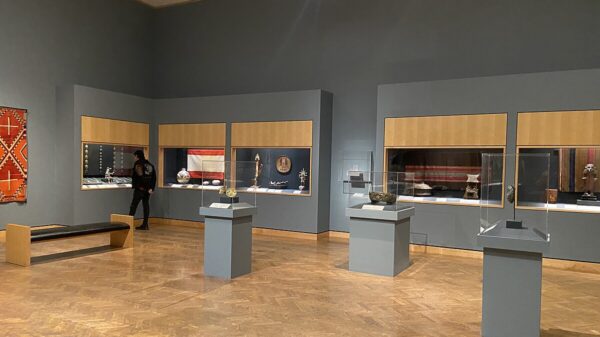
The exhibition dives into various examples in which the narratives of Shakespeare’s plays and the lives of Royal Family members collide and intertwine. It does this through three different sections, which are then divided further into rooms. In these rooms, artefacts are displayed with guided tours, which analyse them in depth, and short videos, that discuss them in detail.
One room explores the love affair that began after George, Prince of Wales, watched Mary Robinson play Perdita in “The Winter’s Tale”. George would sign his love letters ‘Florizel’, who in “The Winter’s Tale” is a Prince that masquerades as a shepherd in order to woo Perdita.
For George, the story of Florizel and Perdita offered a way to express their relationship to one another. This example is not alone: Queen Katherine’s speeches in “Henry VIII” have been used in various art pieces to voice the perspective of Queen Caroline. The transformation of a rebellious Prince Hal into a heroic king was used by Prince Charles in 2018 as an example of “the change that can take place”.
The stories of Shakespeare have been elevated to a level of national mythology. In this unanimity of recognition, these stories have become a language through which the Royal Family can speak. ‘Shakespeare’ is more than the name of someone who wrote plays. In being more than this, in being infamous and unanimous, his narratives give voice to the human experiences – the love affairs and the declines into madness – of the Royal Family.
These are ideas that long for the tall ceilings and hushed voices of an in-person exhibition. I hope that all the research and curation that has gone into “Making History: Shakespeare and the Royal Family” has a chance to materialise into a physical exhibition. It is truly thought-provoking and deserves to be romanticised with the electricity of being experienced in the flesh.
The exhibition can be accessed from this link: https://sharc.kcl.ac.uk/exhibition
About the author