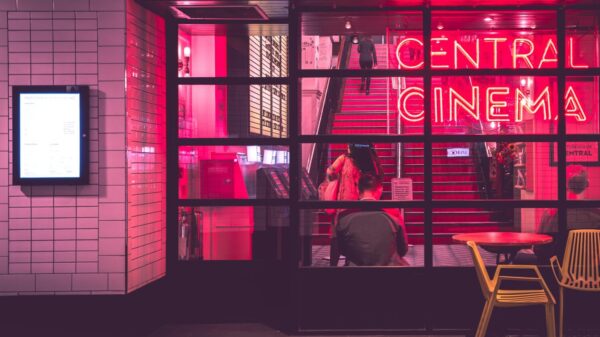
Staff Writer Emilia Kutz Santillan analyses how A24’s ‘Backrooms’ fails to understand how liminal spaces represent the increasing isolation of public spaces by the internet.
What are liminal spaces?
The A24 movie ‘Backrooms’ directed by Kane Parsons, sparked controversies from all sides of the spectrum. To many it came as a surprise, as they had never before encountered the genre. Some of the viewers left the cinemas disappointed, some believed they understood something others missed.
The internet label “the backrooms” or the larger umbrella term “liminal spaces” are broadly understood though a collection of images depicting man-made environments associated with passage, transition or temporary use. These generally contain motifs of eeriness, solitude and nostalgia, such as: abandoned malls, play areas or poorly lit corporate spaces.
Resembling dream-like spaces, it provides a sense of disorientation or repetition, of something not being quite right, and is mostly encountered in the spaces our mind creates when we sleep. Our brains mesh and understand these unnatural spaces we interact with and replicate their uncanniness in the subconscious.
What are the origins of the ‘backrooms’?
The backrooms surged on the online platform 4chan in 2019, when an anonymous individual posted the infamous picture associated with the backrooms aesthetic. This sparked an entire narrative, encapsulating the cosmic horror of infinite spaces. This included a range of short stories and video games, including Parson’s own YouTube mini series.
“If you’re not careful and you noclip out of reality in the wrong areas, you’ll end up in the Backrooms, where it’s nothing but the stink of old moist carpet, the madness of mono-yellow, the endless background noise of fluorescent lights at maximum hum-buzz. God help you if you hear something wandering around nearby, because it sure to hell has heard you.” – Anonymous
The backrooms resemble the SPC Foundation, a fictional secret organisation launched in 2008 which secures, protects and contains (hence the acronym) anomalies, like SCP-643 (cannibal chocolates), SCP-2852 (‘Cousin Jonny’), and SCP-173 (The Sculpture). They emerge on the internet as collective writing projects which bring together communities of like-minded and creative individuals working together to create digital urban legends.
At its most shallow, the backrooms reached the mainstream in the form of memes. At a social level the backrooms also served as a type of dog whistle, where one would make an allusion to them, the comment would pass under the radar of most and reach those who had interacted with the network to some degree.
In more ways than one, these collective stories have become a sort of digital folklore. Unlike traditional media, they are not a fixed and finished product, but instead a process of collective deliberation. People create lore, writing about different levels, how to enter, and how they emerged.
In large part the backrooms sparks debates about survival, challenges you may encounter, and how to find a large enough supply of almond water and backshrooms for sustenance. This process is ongoing, it changes and morphs the lore as more people comment, add and disagree across platforms, sparking different branches and interpretations.
The digital back room
Some talk about the old internet days, when “the internet used to be a place”, referring to the medium niche internet subcultures flourished in the early days of the internet through personal websites, chatrooms and forums.Though they have not disappeared, modern interactions have switched from surfing the web to algorithmic consumption.
Digital life has become synonymous with social life. As mainstream platforms further entangle themselves with our social dynamics, not only does it become inescapable, it also becomes harder to manoeuvre the internet beyond these algorithmic mediums. Kyle Chayka’s ‘Filterworld’ explains: “Under algorithmic feeds, the popular becomes more popular, and the obscure becomes even less visible”. In many ways, this has killed our curiosity and digital exploration, as it has further isolated the internet dynamics of the early days from the digital mainstream.
The increasing presence of AI-generated content and bots has also transformed a social space into an impersonal and skeptical back and forth. Bots on platforms like X, Instagram and Facebook have ‘organically’ created pockets of the internet which have no real human intervention.
How the Backrooms typifies the ‘Dead Internet Theory’
The current state of the internet thus feels as alien as ever, bringing back the ‘Dead Internet Theory’, speculating that bots produce and interact with the majority of digital content. As the distance between real and digital life shrinks, the theory takes on a more existential proposition.
In its early days, the internet was not creating ‘necessary’ folklore, but it was connecting individuals across the globe. These stories sprung up naturally and organically in accordance with these mediums: “[The internet is] a hotbed for creating, reframing, and disseminating folklore”. Whereas today, the content we consume is detached from social interaction. The internet has transformed from a ‘Digital town square‘ and a ‘Marketplace of ideas‘ into a bulletin board for product branding.
This shift happened slowly: content became more easily digestible until reaching into short-forms. At some point brands were able to capture the financial gain of digital platforms and began invading our social landscape. On the internet, their personification makes them feel relatable, but only through the superficial lens of their commercial profit.
The value of the backrooms comes from its creativity and its community. But at the end of the day it’s free to be creative, so how can corporations possibly cash in on the transaction? How will they make money off us to reach a quarterly margin?
For the youth the spaces they interact with inspire reflection, contemplations about who we are and used to be. Digital spaces are no different: they can make us question not only who we are becoming but who we want to become. In many ways, by abandoning the social aspect of digital mediums, and replacing our interactions with shallow simulacra we vaguely relate to, has separated us from a natural process of self discovery.
How A24 Butchered Kane Parsons’ Original ‘Backrooms’
Take the discussions on ‘Backrooms’, a large enough part of it was centred on if the 20-year old deserved, and actually had directed a feature film. The comparison between him and Curry Barker, YouTuber turned director of ‘Obsession’, heightened the prominence of these debates even further.
Parsons was able to deliver a much more compelling story at 16 on the internet than when he was under studio constraints. It is impossible not to wonder how much influence A24 had over the final product. Apart from the amazing visuals and the short run time of the Gen-Z actors, the movie delivers an undercooked plot with unexplored character development. Despite its potential, the movie’s biggest downfall is that A24 doesn’t understand its demographic, the medium or the concept it’s attempting (and failing) to explore.
The horror element of the backrooms, and what makes them an interesting concept to explore, is the endlessness of the space itself. The concept of liminal spaces could have been made into a critique of the loneliness crisis or AI, but it falls flat when the story ignores the parallels between these and the backrooms. There is something about the cinematic medium that is antonymous with the fluid dynamics of the internet. Not all topics, stories or collections of lore need to be explored through traditional mediums. Parsons himself echoed this belief by praising different mediums in an interview with YouTuber Patrick Tomasso.
Beyond its consequences for social interaction, modern digital mediums have alienated us from ourselves. They limit our capacity to interact with different things, people and opinions, and to question where and how we fit within them. Loneliness, loss of personal identity, and the flattened discourse craft an individual battle against an ocean of slop.
Surviving the Backrooms
The critical thing that the backrooms teach us about space, is that we must analyse them beyond our context, to see what lies underneath. Increasingly, both our digital and physical realities, which have become inextricable from each other, reject human dynamics. The spaces we are creating for ourselves are being constantly overrun and invaded by corporations and shallow politics. They pull us away from each other and from ourselves, which has alienated us from the inherently social nature of humanity.
Perhaps this explains why the younger generations reject modern technology, and embrace more traditional modes of communication. The backlash on AI, social media and corporate power invading the social sphere has led a counter cultural movement: re-adoption of physical media and mono-purpose devices. ‘Lived in’, ‘handmade’, wood and colour are all a call back to design congruent with social-dynamics, and if we are not careful it too will be co-opted into artificial corporate slop.
As our society continues to mature, the spaces we create and the infrastructure we develop will follow the evolution of our values. Not only has this commercialisation and flattening of our social spaces lead to further isolation, but an individual misunderstanding of what it means to exist in society. This desolate backroom we are traversing, in both our digital and physical realities, has an escape.
As creative young individuals we must begin to set boundaries and reclaim our spaces. This process needs to happen collaboratively. Not only must we develop tolerance, we must also exercise our need to play, imagine and create beyond materialistic constraints. Keeping in mind the legacies we leave behind to the generations beyond, we must facilitate the context and dynamics that construct human-forward values by shaping the spaces we inhabit accordingly.
About the author