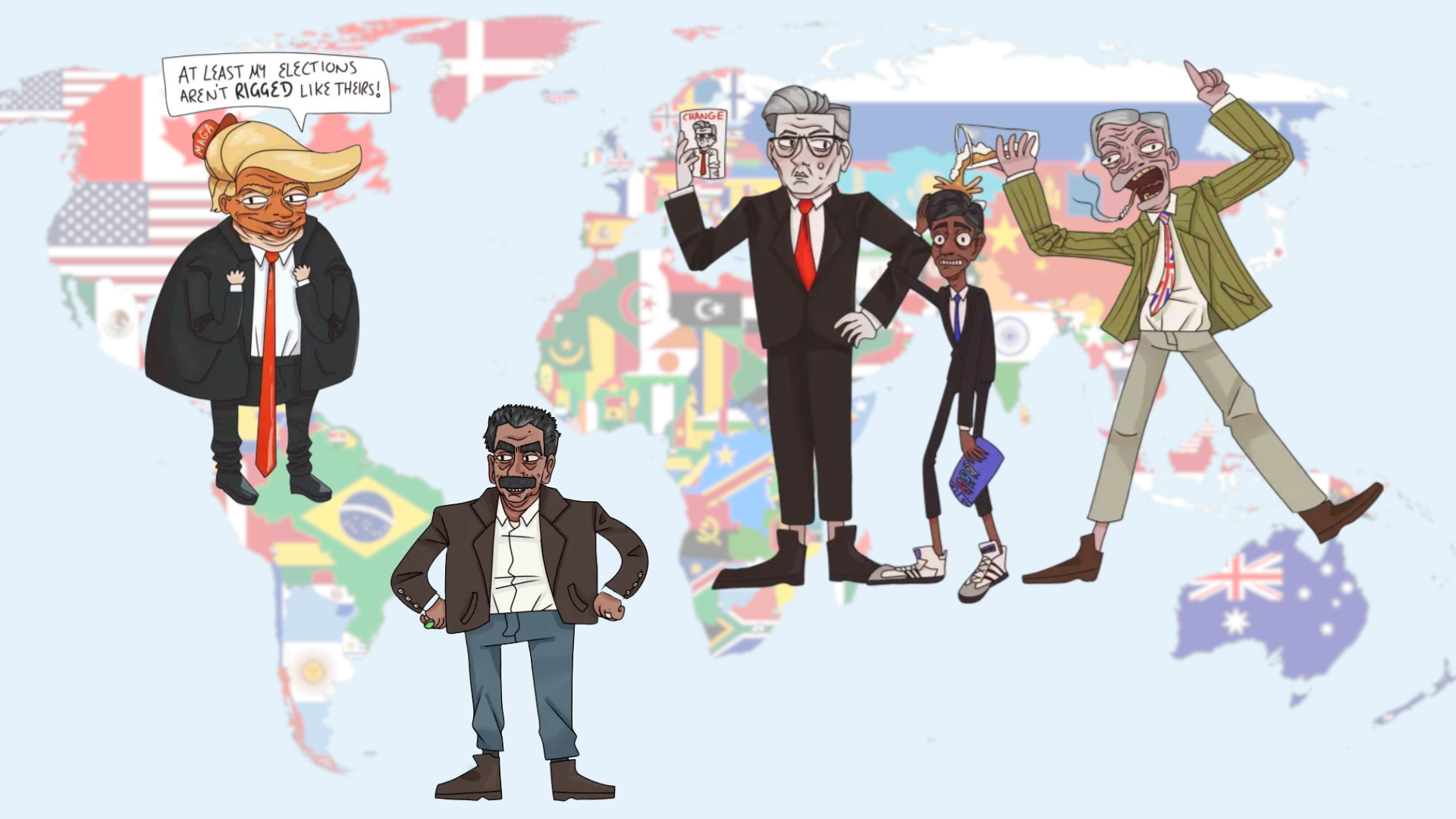
The year 2024 has been hailed as the ‘Year of Elections’ by many across the media. Roar reflects on a series of these votes from all corners of the globe.
This article was originally published in print on 28 November 2024.

US Election, Cadence Barker
Until the election, a Trump victory seemed incomprehensible. With public opinion split almost evenly in every poll, Harris supporters had a sense of cautious optimism that her campaign of hope would prevail. In a race against a convicted felon, sex offender, and authoritarian sympathiser, whose policies promised to send America back decades and language employed racist and misogynistic tropes, that belief didn’t seem entirely misplaced.
Yet, in the end, the American people chose hatred and fear. Trump secured the presidency by fabricating countless enemies against whom he would ‘protect’ the country. From transgender people to immigrants, to the media, to the entire Democratic party, Trump voters were led to believe that their very being was at risk.
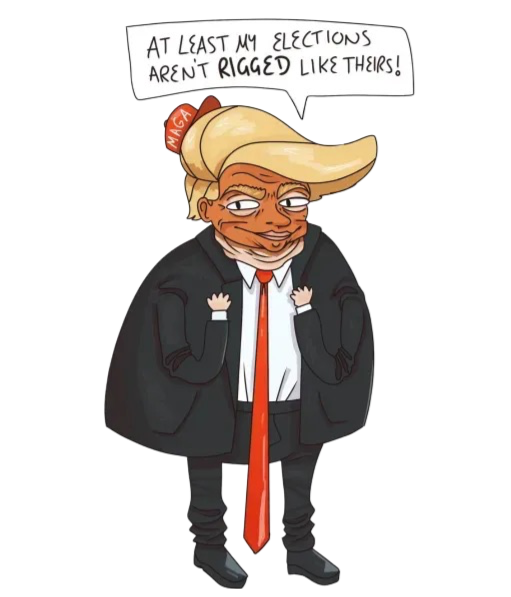
Now bolstered by a Republican Congress, the Trump administration will have free reign to roll out their policies of: mass deportations, abortion restrictions, tax cuts for the wealthy, tariffs on foreign goods, relaxed gun controls, climate change denial, attacks on LGBTQ+ rights, and beyond. Harris was not the only one who lost this election. All Americans, including those who decided this outcome, have lost our rights, our planet, and our democracy. Autocracies aren’t made overnight, but the fear that Trump depends so heavily on, and derives his power from, is certainly here to stay.

Venezuela, Ruth Otim
Venezuela held its elections on 28 July 2024, with the National Electoral Council (CNE) certifying a third win for the incumbent, President Nicolas Maduro, since 2013. The CNE claims that Maduro won by 51.2%% over the opposition candidate, Edmundo González, who garnered 44.2% of the votes. The opposition rejects Maduro’s re-election, offering 83% of the voting machine tally sheets as evidence of Maduro receiving just 30% of votes, compared to González’s 67%, with “independent domestic and international observers” concurring according to a UK government press release.

Maduro is the political successor of Hugo Chávez, meaning that Maduro and Chávez’s party, The United Socialist Party, has held power for 25 years. Maduro’s government has been accused of human rights abuses from suppressing dissent to violence by observer organisations according to Al Jazeera.
Disputes against the presidential elections turned into widespread protests that have resulted in political repression, including killings by security forces. After the elections, González fled to Spain when Venezuela’s attorney-general office issued a warrant for his arrest. The Financial Times reports that numerous Latin American countries from Brazil to Uruguay, the US, and the EU do not recognise Maduro’s re-election. As Venezuela grows increasingly isolated in Latin America, and on the world stage, political contestation and protest are of growing importance for the nation’s domestic and international politics.

UK General Election 2024, Ben Evans
On 4 July 2024, the United Kingdom elected its first Labour government after 14 years of Conservative rule as Sir Keir Starmer defeated Rishi Sunak. This was a historic moment, Labour won 412 seats, their best result outside of the Blair years, and the Conservatives suffered their worst defeat since the party’s inception in 1832.
Even the Liberal Democrats, following years of wanting to reform first-past-the-post, managed to manipulate the electoral system to win 72 seats on just 12% of the vote. The night wasn’t all fun and games for Labour, who lost key shadow ministers to a resurgent Green Party and an effective independent movement running on a Pro-Palestinian platform – early warnings for a government that won with slim margins nationwide.
However, though these movements were historic, they were not unforeseen; Labour had been ahead in the polls for over two years and, despite his best efforts, Sunak failed to break through the dire Johnson-Truss political inheritance. No, the true lessons of the night revealed themselves through the remarkable success of Reform UK, Nigel Farage’s far-right populist party. Reform won over 4 million votes, yet received just five seats, coming second in 98 constituencies nationwide.

The success of Reform, and suppressed turnout of just 60%, demonstrate a dire frustration with politics in the UK. Stagnation breeds apathy and apathy can easily succumb to the poison of populist promises.
The new government must demonstrate that mainstream politics can produce positive outcomes across the nation to stand any hope of success in its mission to rebuild the faith this country so desperately needs.

Mozambique, Ruth Otim
On 9 October, Mozambique held its Presidential and Parliamentary elections, culminating in the incumbent party’s candidate, Daniel Chapo, winning the election by more than 70% according to the national electoral council. Chapo’s presidency continues the Frelimo Party’s political hold on the country since its independence from Portugal in 1975. After 49 years of party rule, many Mozambicans have shifted support to the opposition candidate, Venancio Mondlane – ultimately joining his call for widespread protests following the contested results. Mondlane’s party, Podemos, claimed to have secured 53% of the votes with “300 kg worth of documents [as evidence] in support of a 100-page legal challenge” according to The Guardian.
Podemos’ accusations of election rigging are not unfounded. The EU Election Observation Mission (EU EOM) notes that polling stations and district-level voting patterns suggest election tampering, with the EOM urging Mozambique to uphold “transparent” and “credible” results according to Al Jazeera. In response to the widely contested elections, protestors assembled across Mozambique’s largest cities from Maputo to Nampula, and have been met with a brutal government crackdown that Amnesty International records to have killed “at least ten people” as of 31 October. The freedom of peaceful assembly is an unassailable right, election disputes should never be the government’s reason to breach it.

Iran, Dahlia Farzi
Following the unexpected death in a helicopter crash of incumbent President Sayyid Ebrahim Raisolsadati (known as ‘Raisi’), both the Islamic government and many conservative Iranians were left devastated. Raisi was a hardline conservative, nicknamed the ‘butcher of Tehran’, following his notorious crackdown on opposing political prisoners.
Iran’s snap presidential elections were held on 28 June and 5 July, with the lowest voter turnout since the 1979 takeover at 40%. Only four contestants battled in the first round including one reformist, Masoud Pezeshkian, who won with 44% of the vote. He failed to secure the 50% required to avoid a run-off, so the second round was held on 5 July against ‘ultra-conservative’ Saeed Jalili.
Masoud Pezeshkian, the winner, arguably has some appealing ideas such as restoring the 2015 nuclear deal and amending the way the state deals with protests following Masha Amini’s horrific murder for failing to wear her hijab. However, many Iranians are aware that his victory isn’t going to vastly change the current government’s practices or aims. Since the Supreme Leader, Ayatollah Ali Khamenei, has the final say on all policy changes, any sense of hope within the repressive government is nearly impossible. Iran’s 2024 snap election was seen by many as nothing to look forward to.

Japan, Tzen-Wei Ryan Ng
Japan’s Prime Minister, Shigeru Ishiba, who recently assumed the premiership from Fumio Kishida, called for a snap election to be held on 27 October 2024. The tide of politics may be shifting away from Liberal Democratic Party (LDP) dominance, as the LDP-Komeito coalition lost its Parliamentary majority following a year where its opinion poll ratings fell below 20%. Within the coming month, the Diet’s lower house will be given time to form coalitions and decide who to elect as the prime minister. For most of post-war history, Japanese politics has been dominated by the LDP – ruling almost continuously since 1955.
The election was a “severe judgement” said Shigeru Ishiba in a press conference following the election. Now the LDP and the Democratic Party for the People (DPP), a centre-left group recently gaining a lot of traction, are in talks of a coalition which may keep the LDP in a majority government, but strengthen the DPP for future elections. The world should be watching Tokyo, especially as the leading party has not kept its dreams of rewriting the pacifist constitution a secret, especially in response to a more aggressive North Korea and increasingly dominant China.
Illustrations by Ruth Otim and Abi.
About the authors