Guest Writer Isabel Hodson examines Culture Secretary Lisa Nandy’s response to warnings of deepening “culture wars” in Britain, arguing that good policy alone is no longer enough in an information landscape shaped by outrage, polarisation, and democratic distrust.
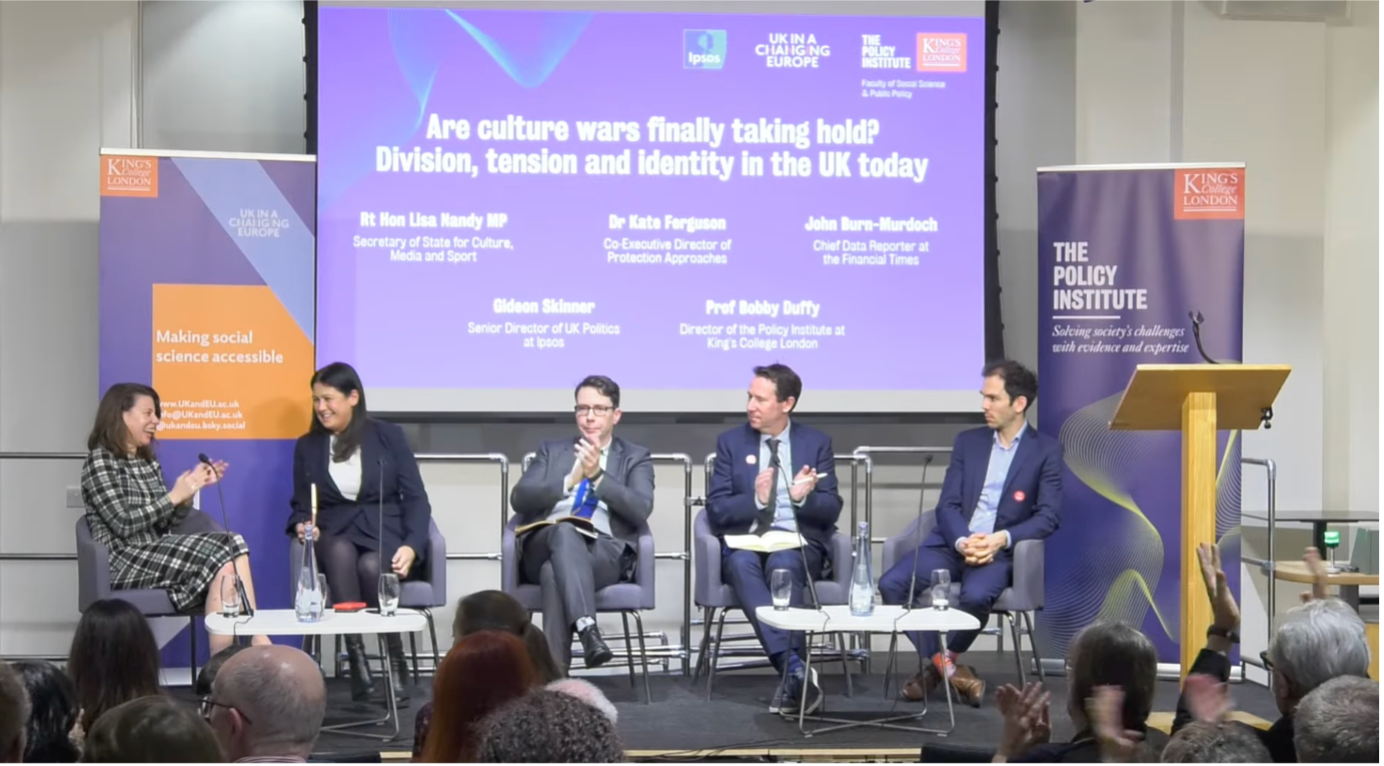
The Right Honourable Lisa Nandy, Secretary of State for Culture, Media, and Sport, is last to speak on a panel of five hosted by KCL’s Policy Institute. Four highly informed experts on electoral polling and identity politics have delivered the room a bleak message – that the UK is more culturally and politically divided than it ever has been.
Social media has fundamentally altered the information ecosystem; it is cheaper for our adversaries to tear at the democratic consensus online than to breach our borders with tanks. It is a moment of historical singularity. Now over to you, Minister.
Clearly the event was not choreographed in Nandy’s favour. Perhaps she had no choice but to take the line she did – that ‘despite the evidence… there is a ceiling on the amount of division and chaos that people can tolerate.’ She acknowledged the scale of the challenge put to her, but ultimately struck an optimistic tone.
Of course there are things we all agree on. Remember the 2012 Olympic Games? Remember national treasure David Attenborough? Nandy depicted a latent but shared identity amongst Britons which lies dormant, if only we can resurrect it and give voice to it.
But how? The government’s ‘National Youth Strategy’ is seeking to create the spaces and facilities necessary to prevent young people retreating into unhealthy online relationships. Through youth clubs, drama, music, and mentoring programmes, Labour is hoping to tackle the rise of the ‘manosphere,’ a brand of oppressive and often violent misogyny propagated online to isolated young men. By investing in ‘the civic realm’ and creating jobs around the country, the government will fight back against a ‘geography of discontent’ which sees people turn to populist extremism in despair at the lack of progress from the centre.
How spiriting. But does it fit the bill for Nandy’s self-described ‘route out from the severity of the moment’? It’s worth dwelling on what exactly ‘the moment’ is.
Firstly, while a deep and persistent discontent with the state of the country has existed arguably since the financial crash, voters are becoming increasingly unlikely to understand and sympathise with each other. Senior Director of UK Politics at polling giant IPSOS, Gideon Skinner, told the panel that a majority of Green, Liberal Democrat, and Labour voters say they find it hard to be friends with a Reform voter. 55% of people believe the divisions between opposing political views in the UK are so vast that they endanger the fabric of society – up from 31% in 2018.
Secondly, the ‘informational ecosystem’ is changing more rapidly than democratic institutions are keeping up. Chief Data Reporter at the Financial Times, John Burn-Murdoch, pointed to a shift in the last five years: social media algorithms have pivoted to maximising ‘eyes on screens,’ rather than ‘likes’ and ‘shares.’ In the race to keep your attention, algorithms now deliberately promote content which outrages and disgusts. It is a media landscape in which everyone is aware of their stance on an issue – shown in a lessened percentage of ‘I don’t know’ answers to polls – but there is no middle ground, no nuance, no conversation. Just outrage and disgust.
Finally, Dr Kate Ferguson of Protection Approaches – a charity tackling identity-based violence – delivered the icing on this cake of malcontent and discord. ‘We are in a moment of deep strategic competition for the rules, standards, influence, and values of our world.’ Identity-based grievances are being mobilised by domestic actors on the far right, by foreign actors in the Kremlin, and by anti-democratic disruptors across the globe in the form of the ‘tech-bros’ at the wheel of those pesky social media algorithms. These are adversaries who have woken up to this moment of ‘competition’ far quicker than democratic governments have, and without systems-wide change, they will win.
It is this final point which reveals Nandy – and ultimately all advocates of the democratic governing consensus – to be fundamentally behind the curve.
The new ‘information ecosystem’ described above has arguably gone un-conquered by all British governments to date. Simply ‘doing good policy’ is no longer enough, as even the most well-funded civic culture must now fight for oxygen in a media environment optimised for outrage.
It is generous to suggest that this government’s failings are ones of communication rather than substance – that positive changes are happening, we just don’t know about them. But even if we suppose that this is true, it is a failure which reflects a lack of understanding that communication, presentation, and active defence of ‘good’ policy is now the bread and butter of politics, more than it ever has been. If voters cannot see, feel, or be persuaded of the benefits of democratic governance, then the communications failure is the policy failure.
When poised with pencil in hand at the ballot box, the electorate must associate their prosperity with the measures and institutions which produced it. It is not enough to launch the National Youth Strategy into the ether and expect it to speak for itself, when faith in democratic policymaking is being deliberately and actively eroded online in a way which simply has no historical precedent.
The policy measures Nandy describes are of course honourable in themselves. No-one is suggesting that arts funding is pointless, quite the opposite. But these initiatives fail to reconcile with the magnitude of the problem, and Nandy’s retreat to a cluster of domestic policy proposals, disparate and with little rhetorical linkage, was disappointing.
Politics is storytelling; this has always been true. But the scale of the challenge demands more. It demands a radically new approach to government communications, and an active, eyes-open defence against the forces mobilising identity-based grievances. The way politicians tell stories must change.
About the author