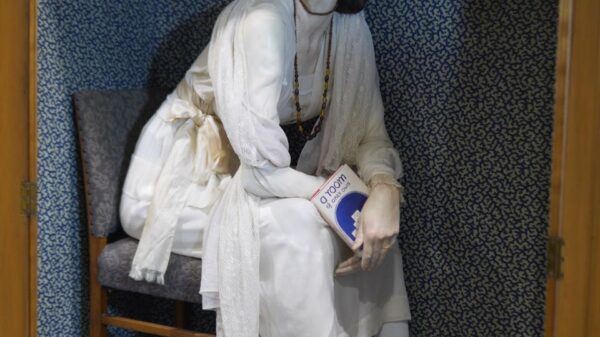
An old, coverless volume titled ‘Really and Truly: A Book of Literary Confessions’ may reveal possible beef between two of King’s most distinguished alumni: Virginia Woolf and Thomas Hardy. The book, recently unearthed from the papers of novelist Margaret Kennedy by her grandchildren, is basically a gossipy Q&A inviting some of the biggest literary names of the 1920s to fire shots at each other. William Mackesy, one of the grandchildren, detailed his findings in The Independent.
The entries– signed by the likes of Hilaire Belloc and Rebecca West, in addition to Woolf and Kennedy– were dated between 1923 and 1927 and sealed for posterity. There were 39 questions in total.

A waxwork of Virginia Woolf by the artist Eleanor Crook, commissioned by King’s in 2015
What’s the tea?
In response to both best and worst living English novelist, Virginia Woolf wrote Thomas Hardy. There was also some friendly fire among the contributors, with Woolf listing Belloc as “Most overrated English writer living” and Kennedy listing Woolf in the same category.
Not all entries were so denigrating, however. In response to “a deceased man of letter whose character you most dislike”, KCL’s wax-sculptured alumna stated “I like all dead men of letters”.
Roar reached out to Mr Mackesy, who was unable to provide further context to Woolf’s burn. “While there are some amusing esprits, they mainly just wrote names in response to the questions asked,” stated Mr Mackesy.
He continued, “I’d love to know if Woolf’s double whammy on Hardy was primarily playful, or (more likely with her?) basically serious…”
A Woolf in sheep’s clothing
Apparently Woolf exhibited different attitudes about Hardy in public than in private. She wrote a glowing essay on his novels shortly after his death in 1928, beginning, “When we say that the death of Thomas Hardy leaves English fiction without a leader, we mean that there is no other writer whose supremacy would be generally accepted, none to whom it seems so fitting and natural to pay homage.”
Woolf also notes having tea with Mr and Mrs Hardy in a diary entry dated July 25, 1926. Here she describes Hardy as a “little puffy cheeked cheerful old man” and asked him to sign her copy of The Mayor of Casterbridge, in which he spelled her name “Wolff”. Perhaps we have identified the source of her ambivalence about the man.
Thomas Hardy first came to London in 1862 after training as an architect’s apprentice in Dorset. During his time in London, he attended evening classes at King’s, before returning home in 1867 for health reasons.
Virginia Woolf enrolled in the ‘Ladies’ Department’ of King’s College London from 1897, at the age of 15, until 1902. While at King’s, she studied classical languages, German, and history, but was never awarded a degree. King’s has since honoured her with a waxwork and a building in her name.
About the author