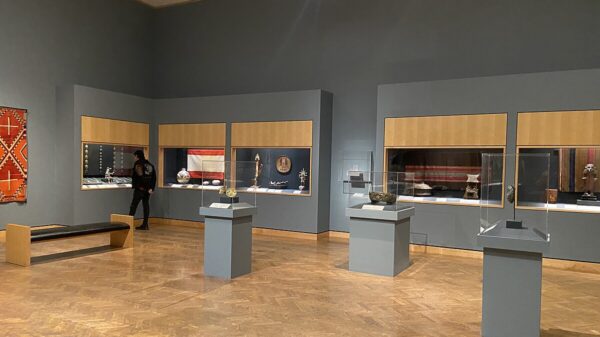
Hooked: When Want Becomes Need is this season’s theme of Science Gallery London, which is no longer vagabond but hosted in the new and bright permanent space in Guy’s campus. A member of the fascinating global Science Gallery network, this branch seeks to merge the freshest and inspiring artwork with the most extraordinary research which takes place across King’s College London. Hooked is an exploration of addictions and its various manifestations, thematically focusing on substance abuse, dependence on technology and the personal and societal consequences of such misuses. The artwork is done in close collaboration with members of the scientific community, especially from the Institute of Psychiatry, Psychology and Neuroscience (IoPPN). The result is unsettling and thought-provoking without being necessarily moralistic.
Stepping in the exhibition space, one first encounters a video installation by Richard Billingham named Playstation. A compelling depiction of addiction, boredom and class, it focuses on the manic and obsessive moments of the fingers of the artist’s brother while holding a PlayStation console, while coming down from speed. The rapid and compulsive movement of his fingers is a gripping indication of the nothingness which arises from the drug use. On the thematic arc of substance abuse, a visitor will also witness a virtual reality of mice in an experimental environment who are supplied with alcohol. Detecting alcoholism, Not just us, Small addicts by the artist duo Varvara & Mar, and Dr Mario de la Fuente from the Virginia Commonwealth University, allows us to detach ourselves from a situation of alcohol consumption and observe its impact. Addiction to sugary substances is a central motif and though not as obviously potent as addiction to drugs it is a pervasive element in our society. This is especially highlighted by Sugar Rush by Atelier 010, developed in collaboration with the Technical University of Delft, illustrates the disruptive power of a substance as fine and seemingly fragile as sugar in the form of a broken table, symbolic of everyday life.
The section centring around the addictive prowess of technology may be described as Black Mirror meets Wes Anderson. Bright neon lights and soft pastel hues, they create a sensory overload which leaves a visitor overwhelmed and uncomfortable. In Yole Quintero’s Me. You. Limbo the addiction to technology is communicated as a series of heartbreak and loss, to emphasize how entangled our lives are with technology. The message might not be new, but witnessing a more and more disorderly system, interjected with retro-futuristic effects, leaves you with a feeling of emptiness and nothingness.

Still from Me. You. Limbo by Yole Quintero
The meandering exhibition slowly assumes a more menacing and foreboding tone as it delves deeper into the impact of addiction in the human psyche and interpersonal relationships. The questions become more esoteric, less about the immediate effects. The Curtain of Broken Dreams and Divorce Index by Natasha Caruana depict the destruction of relationships of love and core societal values around family. Society might be quick to ostracize addiction, but to what extent is society responsible for that addiction, to begin with?

The Curtain of Broken Dreams by Natasha Caruana. On the background is a still of Divorce Index.
The Hashish Club by Joachim Koester tries to recreate drug dens from France in the 1840s frequented by intellectuals and people of the arts to raise the debate on legislation and destigmatizing marijuana use. Though The Hashish Club is persuasive, the question on legalization lingers and more arise. Why must creativity be tied with addiction and suffering, and seen as a central part of the process? The questions don’t seem to follow through in this exhibition.
To reach catharsis, one must truly feel the suffering. Hooked operates in that way, and the final part of it centres around the tipping point when addiction causes tangible harm. This truly comes out in Melanie Manchot’s Twelve a series of stories about addiction and recovery in rehabilitation communities. As the visitor reaches the exit there is definitely a sense of hope for individual struggles.

Still from Twelve by Melanie Manchot
Addiction is a topic that is simultaneously demonized and romanticized, by societal and individual forces alike. What Hooked achieves, and Science Gallery pledges to do, is to take a medium as introspective and subjective as art and present it through the more indisputable and unbiased lens of scientific research. The exhibition is not a diatribe or a wagging finger on a difficult subject, but instead a road to unabashed and uncensored conversations that are rooted in scientific proof. The point is to be able to see beyond the flashing colours, shocking images, and inventive media in order to demystify and stop hiding behind contemporary mythologies. Instead, one can finally face a harsh and often unfair reality that is inherently human. Whether this will lead to self- reflection or not is purely up to the visitor.
Hooked: When Want Becomes Need runs until January 6th.
Science Gallery London, SE1 9GU
Pictures are courtesy of Science Gallery London.Â
About the author