Staff writer Ishaq Hussain describes the chemistry behind ancient art and the work toward sustainable resources for artists today.
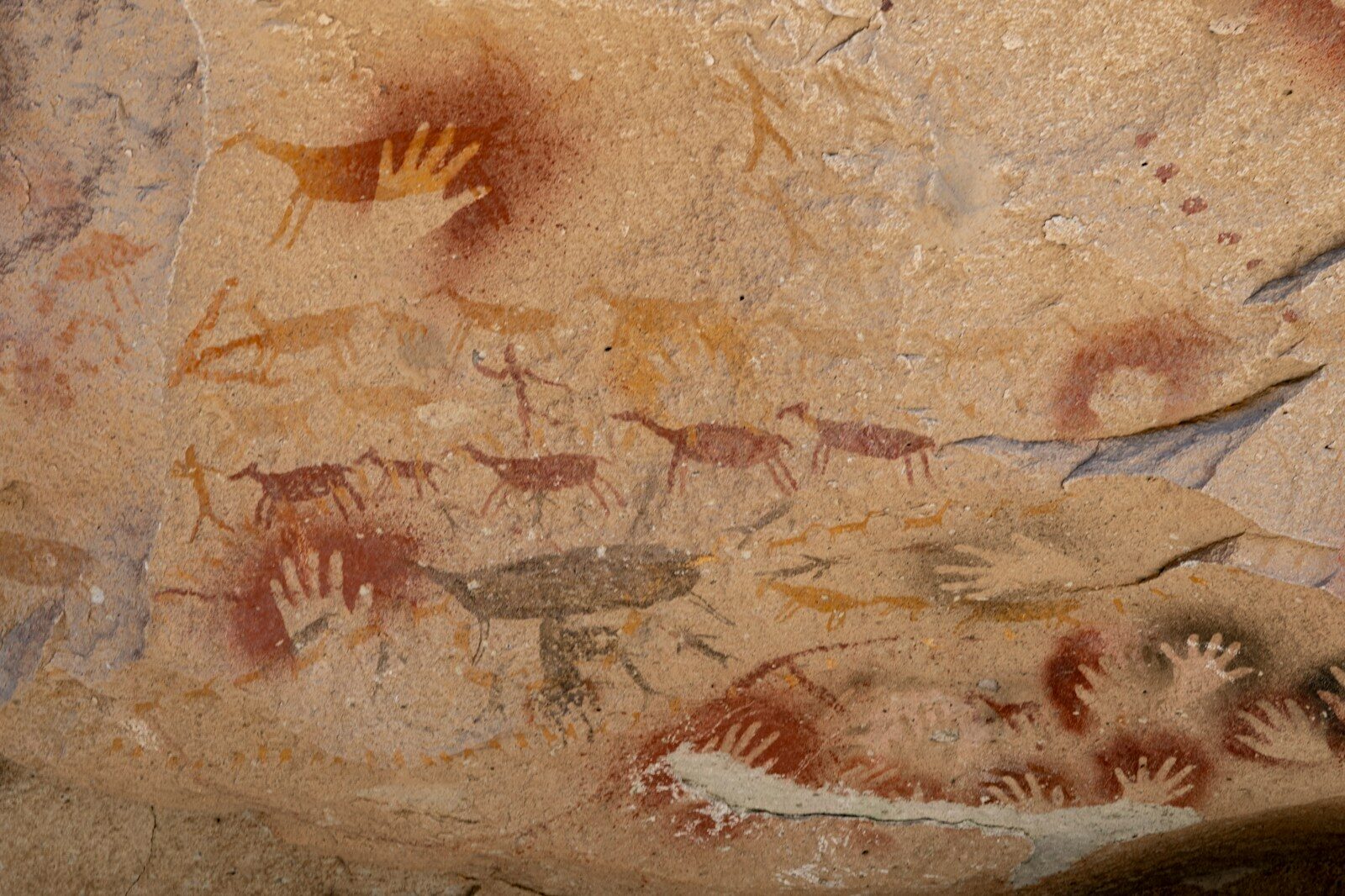
Cave paintings reveal how art remains one of, if not the longest standing threads weaved throughout every culture and every heart. We can credit this form of expression to Chemistry.
The colours used in cave paintings not only depict the artist’s perspective but also are indicative of a society that had less recourses than us but just as much to say.
Without art, cultures and experiences would eventually be forgotten.
The most meaningful and singular ideas would remain mere thoughts.
Fortunately, our Earth rejects this grim reality and provides natural resources to form paint. For example, one way to achieve a brown pigment, like the one seen above, is when iron goes through a naturally occurring chemical reaction known as oxidation, reacting with the oxygen in the air.
It’s this chemical mechanism we can thank, as it is the basis of the mass scale production of paint that we use today. Synthetic brown is the product of this, where natural reactions have been adapted to produce the perfect pigment.
This, however, creates an issue of waste. For example, when introduced to bodies of water, the binding agents that hold the paint together and the dyes needed for colour can be toxic.
Brown represents the connection to the Earth but today its construct now results in its destruction.
Yet our natural connection is not all lost and neither is our creativity.
Gamblin, an American art-house, promises their desire to “give artists colour at its maximum with a luscious texture”.
Their means to do so stems from the cleanup of the Ohio and Mississippi rivers.
Being highly polluted from the industrial revolution and coal mining, the area was left abandoned for thousands of square miles, littered with improper sealed mines.
Rainwater, as a result, seeps its way into these abandoned caverns and becomes contaminated with acidity and heavy (high density) metals. These then flow into streams and rivers where the water, which contains iron, undergoes a chemical reaction.
When exposed to the air, the metals in the water oxidise into hues of yellow, orange and red. This residual sludge (scientifically referred to as “Acid Mine Drainage”) results in the death of an ecosystem around it.
This issue demands a sustainable solution. Gamblin found it.
Artist John Sabraw, Engineer Guy Riefler, Environmentalist Michelle Shively, and a team of students at Ohio University , created a small team of 25 to tackle this issue.
Their solution only started off as an idea, yet it gained quick traction due to its promise of the hope to recover the ecosystem. With a Kickstarter exceeding $30,000 and with public interest increasingly growing, Gamblin caught the attention of the Ohio Department of Natural Resources.
The department helped submit a proposal for a multi-million-dollar plant that would generate local jobs and produce over 5,000 lbs of pigment every day.
As aforementioned, the water is contaminated with heavy metals and acidity.
To purify this, Gamblin collect the contaminated water by hand, before transferring to large tanks. Then to neutralize the acidity, they add an alkaline base and oxygen. As a result, the dissolved metals are able to come together and crystalise. Thereby causing a clean separation of water on the top and nontoxic iron oxides on the bottom.
The clean water can be returned safely to the river and the iron oxides are dried into lightfast (resistance to fading or colour change on exposure to light) and safe artist pigments. These can then be manipulated with heat to produce multiple colours; a reclaimed pigment of “Rust Red”, “Brown Ochre” and “Iron Violet” from the earth itself.
Gamblin’s mission is to oppose the toxic metals and environmentally harmful practises traditionally used in paint production. Instead, they transform toxic sludge into colours, they claim, are developed to their “highest emotional resonance“.
Humans deserve a way of expression that rejects toxicity and embraces sustainability.
Paint has been a subject of critique for containing toxic substances that pose a threat to humans and natures.
Cobalt blue used to contain the Cobalt metal that is highly poisoning. Now, brands sell that same colour using a safer, synthetic pigment.
In contrast, the paint used by cavemen where genrally safe due to their reliance on Earth’s natural pigments directly from the ground.
But what practices should we continue? Experimenting with new potentially dangerous pigments or sticking to what the Earth provides?
Gamblins ethos states paint should be “as they ought to be, not just as they have been”. They present a third solution, one where we take from our mistakes and apply the principles of the Earth we once capitalised on to make something new.
About the author