This cosy season, staff writer Ishaq Hussain brings you an interesting question about the (quite literal) consumption of literature. Let’s hope you’re sat in a café or bookshop while you read this!
Take a glass and fill it with a beverage of your choosing. Before you take a drink, convince yourself that the liquid in said glass is now a liquified book.
Then take a sip.
To the average onlooker, you would look like a person who was in deep thought before drinking. To you, theoretically, you have now successfully consumed a book in liquid form, without causing any internal harm.
But conforming to that experimental conclusion is boring, what if we could take that one step further?
Walk into a coffee shop and you will be overwhelmed with the scent of, well coffee. But there is another scent, lingering amongst the prior. This faint aroma is what causes people to associate the scent of coffee with “old books” and bookstores.
The fragrance of chocolate, vanilla, cocoa, almond and coffee all share a similar chemical origin, to what is found in compounds released in old books over time.
But first of all, how does smell even work?
Some chemicals are volatile; this defines the ease on which chemicals vaporise, the more volatile of which exist as airborne molecules. Odorants (airborne odor molecules) then enter the nose and bind with receptors found inside. These then transfer a signal through the olfactory system, which is responsible for scent detection.
Through a system of sensors, the odorant interacts with regions of the brain, allowing us to recognise them.
Old books emit an array of scents, to such an extent scientists have constructed a wheel explaining their origin. In short, books are made of a wood pulp, some containing a natural fibre called lignin.
As time passes, paper degrades and the lignin breakdown releases a variety of VOCs – volatile organic compounds. Here, organic defines compounds containing carbon.
Different VOCs present different scents.
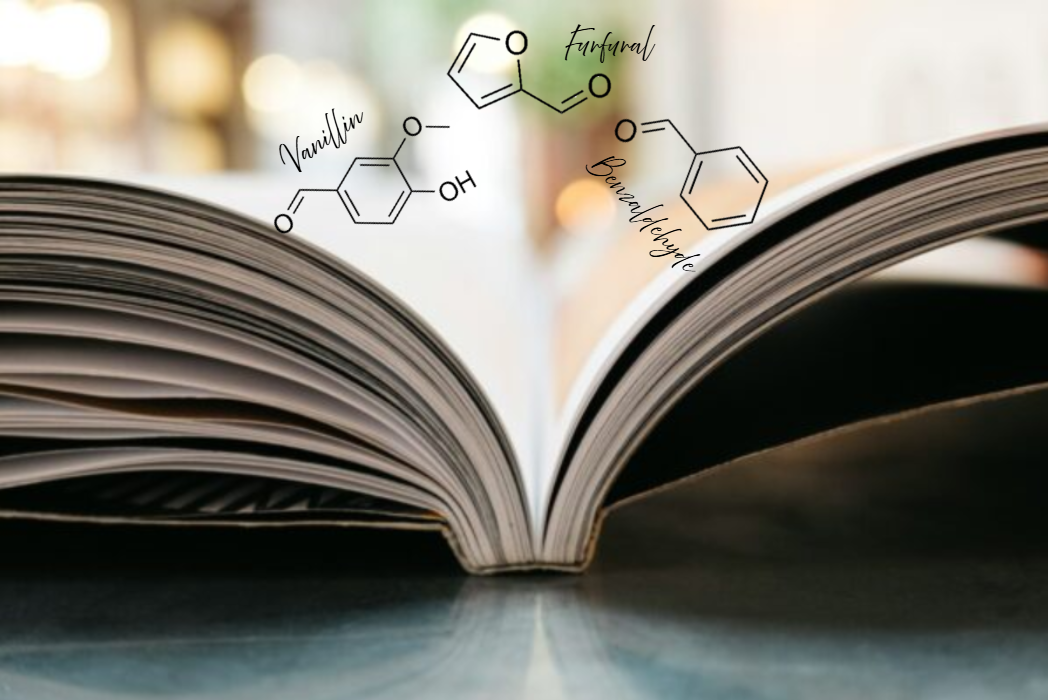
Lignin can produce substances such as Vanillin (the scent of vanilla), Benzaldehyde (that smells of almonds) and Furfural (which smells of caramel/biscuits).
Coffee is made up of these substances, explaining why old books smell like coffee shops.
With that, you can derive that coffee itself shares compounds books can produce over time.
So back to our original problem. Yes, coffee and books share a scent, but how do we drink this hypothetical book? The next step is to analyse how taste works.
Taste and smell are unarguably intertwined.
Despite being separate sensory systems, they help our brain perceive chemicals in food and the air. While yes, you cannot ingest a book safely you can, however, smell one. That brings us a step closer, in comparison to our original route of using our imagination.
So, now we draw the conclusion that a hypothetical liquid book would share similarities to what is found in coffee, specifically the smell.
Scent and smell are integral to food consumption, almost acting as a 50/50 split to taste.
From this, we could establish the following string of logic.
First, a liquid book is like coffee via scent and second, scent is important to consumption.
This means some of the most important elements to edibility are present.
But not all.
Paper itself can, in large quantities, cause internal blockage and stomach issues. This is made worse by the toxicity found in ink and page bindings that would be present in this book. Taste and digestion are just as important as smell is. Thus, there are a great variety of health issues found in this hypothetical challenge.
So yes, you cannot drink a book safely in actuality. However, indirectly, your morning coffee is surprisingly similar.
About the author