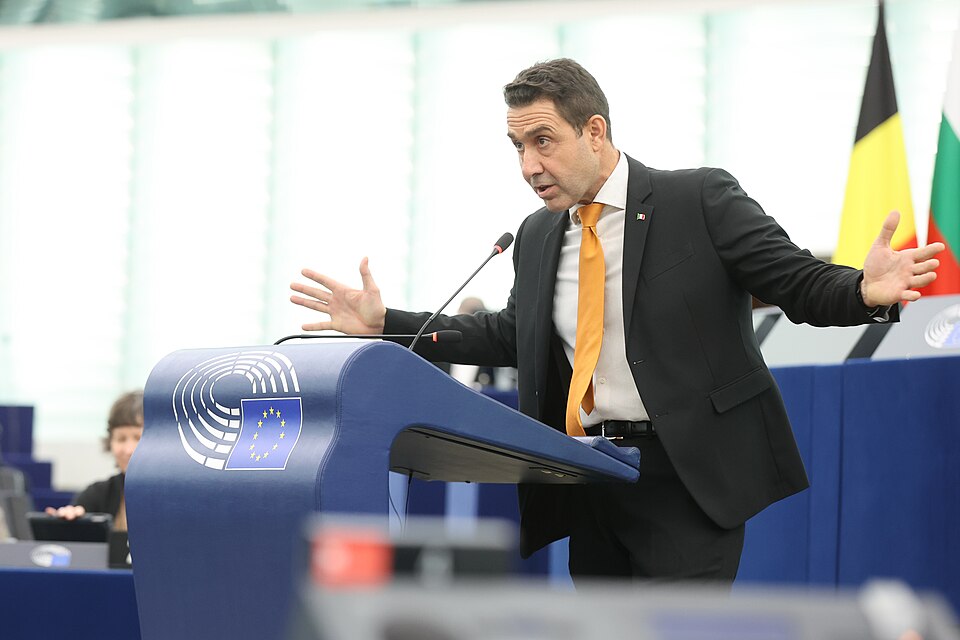
Staff Writer Tommaso Paolucci unpacks how Italian politician Roberto Vannacci uses dictionary definitions to legitimise extremist rhetoric.
Italian Party Futuro Nazionale (FN) held its first party convention, attended by about 1,500 delegates, on 13 and 14 June 2026. Since then, polls in Italy have already shown that support for party leader and Member of European Parliament Roberto Vannacci is not lacking. According to POLITICO, as of 1 August 2026, FN polls at 7% – a full one point ahead of Lega, the party where the former general’s political career began.
In fact, Vannacci entered politics in 2024 as a candidate on Matteo Salvini’s Lega ticket where he gathered over 530,000 preference votes; the second most-voted individual candidate in Italy. Salvini rewarded his success by appointing him deputy secretary of the Lega in May 2025. It was precisely this platform that gave Vannacci the popularity and visibility to break away and establish FN.
The Split
Vannacci’s decision to leave Lega did not come without controversy. Leader Matteo Salvini stated that Vannacci’s actions were “disappointing”, adding that he expected a military man to show more “respect” and the ability to “keep his word”. The far-right general, for his part, has attacked Lega’s members, calling them “traitors” and referring to their hypocrisy as one of the main reasons for his exit. In particular, Vannacci mentioned the party’s decision to sign the decree for the delivery of weapons to Ukraine and claimed that the party members “say one thing, and vote for another”.
However, despite these pronounced tensions, Vannacci claims he is “ready for an alliance” which would likely include Lega as a part of the right-wing coalition. It is clear that Salvini’s bitterness is not simply driven by resentment over personal betrayal, but a recognition that Vannacci is a genuine political rival – one whose choice holds significant power over how the right-wing coalition will perform in the 2027 general election. Will he join, or will he go alone?
Futuro Nazionale’s policies have yet to be set out, as the party’s current manifesto contains populist right-wing hooks, but no real substance. However, some of the leader’s ideals have become clear via his speeches and interviews.
Social issues, as for many new far-right parties, are the key focus. Vannacci does not believe that abortion is a woman’s right and claims that it is “an unfortunate necessity which women are forced to resort to”. Surprisingly, FN’s leader, by his own words, is not particularly religious, but asserts that religious traditions such as the presence of the crucifix in schools are important cultural symbols. The framing of religion as ‘culture’ is important – it allows Vannacci to invoke Christian identity politics, without claiming personal religious belief (which usually invites further scrutiny).
Vannacci’s campaigns focus strongly on the issue of immigration. He has claimed that Italians “have white skin” according to “statistics”. The choice of the words used by the general will be discussed further below. In an interview for Italian program ‘Otto e mezzo’, Vannacci explained his views on remigration. “The ones who have no reason or right to stay in Italy should be the first to go”, claimed the general.
For Vannacci, this also includes immigrants with an expired residence and work permit. Host Lili Gruber questioned the politician regarding the feasibility of his claims, arguing that Italian Prime Minister Giorgia Meloni had promised the same change, without success. Vannacci’s response focused on the bilateral agreements which he claims already exist with nearly every country, but simply aren’t being acted on. This is a clear deflection which leaves Gruber’s question unanswered, and raises another – does he have a plan?
Vannacci also wants to build many more ‘Permanence Centers for Repatriation’ (CPR in Italian) arguing that illegal migrants should “no longer be roaming the streets”. The FN leader concluded by saying that “the important thing is that they are not here”, and provocatively asked whether Gruber liked this solution. Gruber responded that she was in favour of addressing immigration through real policy, and not “empty slogans with unachievable promises”.
The Elephant in the Room
It is now important to address the elephant in the room within Italian politics – fascism. In an April 2024 interview for Newspaper La Stampa, when asked whether he likes antifascism, Vannacci said that he “does not like to be “anti”” and that Fascism ended “almost 100 years ago”.
Furthermore, Vannacci has claimed that fascist dictator Benito Mussolini was simply a “statesman” according to dictionary definition. Finally, when asked to give a judgement on fascism, he responded that “history is factual, it does not accept moral judgements and therefore I do not make any judgement”. It is clear that Vannacci, much like Matteo Salvini and Giorgia Meloni have previously done, appears to be aiming to attract votes from far-right Neo-fascist groups and philo-fascists.
The Dictionary as a Weapon
Finally, it is important to return to one of the main areas of Vannacci’s political communication – the choice of words he uses, and the following explanation he provides. The political leader is aiming to normalize and legitimize words by using literal dictionary definitions.
We have already explored the examples of ‘statistics’ demonstrating that “Italians have white skin”, and that Mussolini was simply a statesman according to the dictionary definition. Vannacci goes further. He often states that homosexuals are “not normal”. He justifies this by saying that he is referring to the definition of the word ‘normality’. He then says that they are not just abnormal to him, but to “the Italian dictionary”. He argues that this does not have any “negative or positive connotation” as it is just a “statistical matter”.
Vannacci knows what he is doing – legitimizing and incentivizing hateful and harmful language, whilst claiming to be using definitions which are unassailable.
By hiding behind dictionary definitions, Vannacci creates plausible deniability for language that would otherwise be condemned outright. This is exactly what makes him more dangerous than conventional far-right agitators: he does not need to shout hateful slogans when he can simply recite a definition and let his audience draw their own conclusions. The strategy works precisely because it is deniable.
This tactic is important beyond Vannacci because it offers a dangerously reusable template for other far-right movements. Overt slogans invite scrutiny and sanction, but ‘technically correct’ language doesn’t. As a result, exclusionary ideas spread and critics are left arguing against a dictionary rather than the speaker’s clear intent.
Conclusion
FN is testing how far the boundaries of acceptable political speech in Italy can be pushed. If Vannacci’s poll numbers continue to climb, Italy will find out exactly what it is willing to tolerate.
But the consequences will not stop at Italy’s borders. If Vannacci’s rhetoric proves to be a winning strategy, it will become a play-book other far-right parties can copy. The real question is not just whether Vannacci will join the coalition or go alone in 2027, but whether he is actively rewriting the rules for what the far-right across Europe can say out loud, without facing any consequence.
For more Comments and Feature pieces click here.
About the author