Staff Writer Tommaso Paolucci interviews FC Basel assistant coach Luigi Nocentini about his career and his future in the game.
Nocentini’s path into coaching did not begin as a calculated pursuit. In his final season as a player at Poliziana Calcio, an amateur club near Empoli, he was handed informal control of the team by the head coach. “He gave me full authority”, recalls Nocentini. It was, he says, the first concrete signal that coaching was “the dream I wanted to try to build my future around”.
By then, he had already spent a year and a half collaborating with Maurizio Sarri‘s Empoli remotely. “I was already working with Sarri’s staff at Empoli, helping from a distance as there wasn’t a way in to work there directly at that point”, he says.
The Call to Napoli

The distance finally closed in 2015, when Sarri was appointed head coach of Napoli and looked to expand his staff. Sarri’s assistant coach, who had known Nocentini through those informal years, asked him whether he would want to follow. “He asked me straight: would you feel like coming with us to Napoli?”, Nocentini remembers. He was working a regular job and still playing amateur football at the time. He said yes, and left both behind.
At Napoli, his title was technical collaborator, a tier below assistant coach, the role he now occupies at Basel. The job spanned opposition scouting, video preparation and in-match analysis relayed to the bench. “I dealt with studying the opponents’ attacking phase specifically, prepared the videos shown to the team, and fed input during the games”, he says.
It was, by his own account, the defining stretch of his career – three seasons (2015-2018) that included a runner-up finish to Juventus in 2017-18 and Champions League nights against Real Madrid and Pep Guardiola’s Manchester City. “It was like having an enormous book in front of me, and the chance to learn from professors of real excellence”, he says, citing both Sarri and then-assistant Francesco Calzona, who went on to coach Slovakia’s national team. “Looking back, it’s the most important period of these twelve years”.
Tactically, Nocentini learnt most from Sarri’s defensive phase. “My philosophy is close to his – with the ball, but especially without it. I think many people don’t realise that the real strength of that Napoli side was the organisation off the ball, which is what let them dominate with it”. When asked which coach he identifies with most, even after years of working under others, his answer has not changed: “It’s definitely Sarri”.
A Different Experience: Real Madrid Foundation
Napoli was followed by a brief step outside the elite game – recruiting for the Real Madrid Foundation, the club’s youth-scouting arm. The drop from Serie A to grassroots talent identification was, Nocentini admits, an adjustment. But it left a positive mark. “It let me really work with young players, and it opened up a different approach which I am now applying at Basel”, where there are many U-23s.
Dnipro: Learning by Immersion

In 2019, Nocentini took his first posting outside Europe, joining Ukrainian club Dnipro as first assistant coach – a move into a league, culture, and language with which he had no prior connection. “It was a bit of a shock at the start”, he admits. “But it was an incredible experience. I’d recommend it to every coach: cultures totally different from our own give you a lot”.
He arrived to a squad in the relegation zone, mid-way through Ukraine’s long winter break and on the eve of the Covid-19 pandemic. Within months, the team had turned its season around and narrowly missed out on European qualification. The imprint, he says, has outlasted his own time there: a player from that Dnipro squad is now assistant coach at Polissya, which reached this season’s Champions League playoffs with Copenhagen. “They’re carrying forward what we built together – that is a real source of satisfaction”.
Shevchenko and the Euros
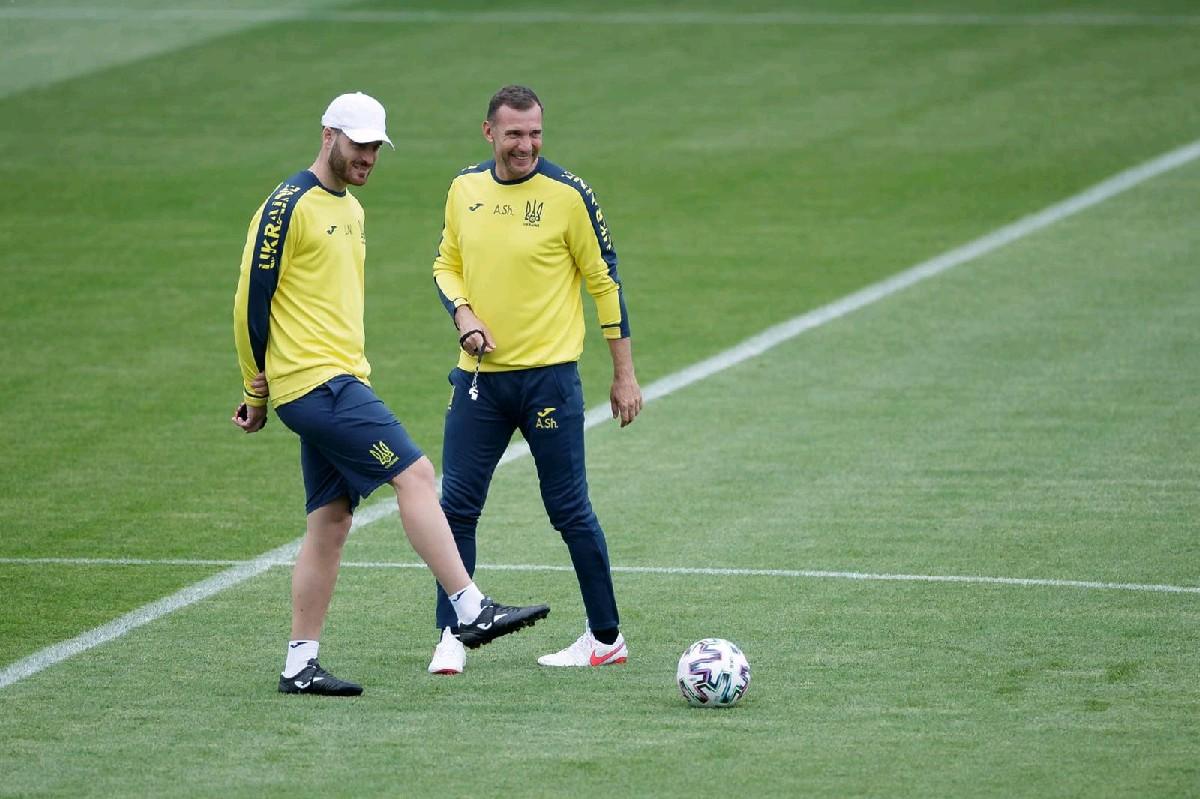
Dnipro’s sporting director had played alongside Andriy Shevchenko, and the connection led directly to Nocentini’s appointment with Ukraine’s national team, then coached by the former Ballon D’Or winner. “He’s a person with real charisma, a real presence and someone who gives you trust”, says Nocentini.
Ukraine achieved a historic result by reaching the quarter-final of Euro 2020, held in the summer of 2021, before losing to England – who went on to lose the final to Italy. Nocentini calls it one of the defining experiences of his career. “Hearing the anthem before a game, representing a nation – that’s something special. It’s an experience I’d happily live a hundred more times”.
The Different Discipline of International Football
Both Shevchenko and Nocentini returned to club football after the tournament. The decision is framed by Nocentini as a matter of craft rather than preference. International coaching, he argues, is closer to rapid-response scouting than long-term project-building. “You might have 25 players arriving with completely different philosophies, and ten days with three matches to prepare. It’s hard to stamp an identity on a squad with that little time”. The discipline it demands (preparing a match plan on a single training session) is one he says shaped how he works today.
Genoa: A Lesson in Resilience
Nocentini continued working with Shevchenko at Genoa, where they joined mid-season in November. The tenure was short: within months, the club dismissed its head coach, ending Nocentini’s role as well. “We didn’t have the time to bring out ideas to life”. However, he does not treat the experience as a wasted chapter. “I think it’s especially the bad experiences you learn the most from. Setting minimal, step-by-step objectives, and not forcing your ideas onto a group with almost no time to build trust are ideas that I kept for my following chapters”.
Ukraine Again, Then Empoli
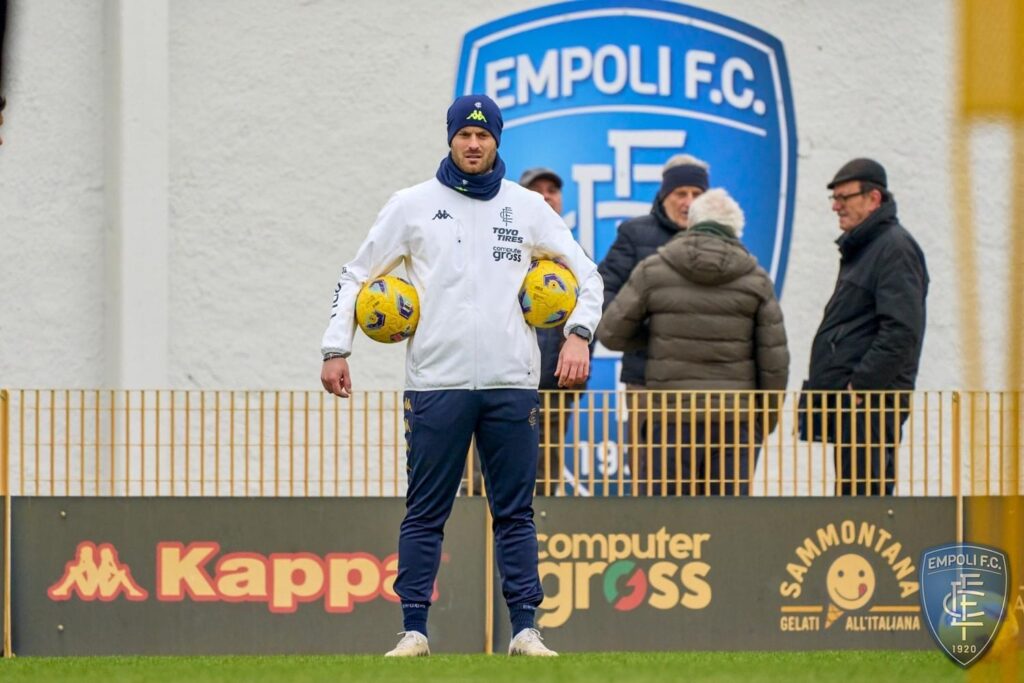
Roughly a year later, Ukraine’s federation recalled him. The spell lasted only a few months, but Nocentini found the earlier work had held. “I saw in the players what we’d left behind. I managed to pass my ideas back on quickly”.
He then returned to Empoli in a role new to him: club assistant manager, a position that reports to the club’s management rather than to any single head coach, therefore supporting whichever staff comes through the door. Three different coaching regimes passed through during his tenure, including Aurelio Andreazzoli whom Nocentini describes simply as a “fantastic coach”. The position, he says, taught him a skill distinct from anything before it: how to integrate into, rather than direct, an incoming staff.
Basel: Silverware and a Wartime Decision
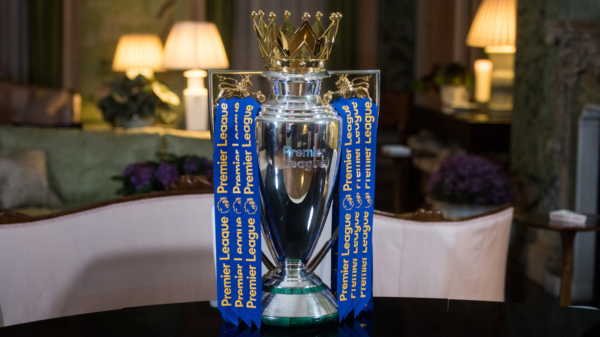
Nocentini joined his current club FC Basel roughly two and a half years ago, recruited by head coach Fabio Celestini. In their first season together, the club won the Swiss Super League and Cup double, its first league title in a decade. When Celestini left for Russian side CSKA Moscow, Nocentini chose not to follow – a decision, he says, informed by the personal ties he still holds with Ukraine. He stayed on under Celestini’s successor, and last season Basel reached the Champions League playoff round, before a Europa League campaign he describes as competitive despite a budget which is “clearly much lower” than most of the clubs Basel faced in Europe.
An Identity Before a Formation
Nocentini resists formation-first thinking. “Systems are all interpretable depending on the players you have”, he says. “I prefer a back four, but if I have three strong central defenders, I’ll play with three”. He cites Sarri and Guardiola as coaches whose identity survives any shape on the pitch – a rebuttal, he says, to the assumption that Sarri’s football only functions in a 4-3-3. What he wants from his own teams is active pressure without the ball, aiming to win it back as high as possible, and possession used, not admired. “Possession has to be functional. You play football to score goals. You win matches by playing football”.
No Deadline for the Top Job
Nocentini does not rule out becoming a head coach, but resists framing it as an inevitability. “It’s not an obsession. I want to live my career day by day”. He says he could remain an assistant indefinitely, given the right partnership of “a head coach whose ideas are close to mine, someone I can really collaborate with”.
Advice to Aspiring Coaches
His advice to aspiring coaches draws directly on a career built almost entirely in supporting roles – fourth assistant, technical collaborator, club assistant, now first assistant. “That’s a huge advantage. Building or evaluating a staff, I have a really open view of everything – of the people who’d end up working with me”. His broader point is blunter still. “When we start out, we know nothing. There’s a lot to learn in every situation, maybe especially the negative ones. Have the courage to accept mistakes. You only move forward by getting things wrong”.
About the author