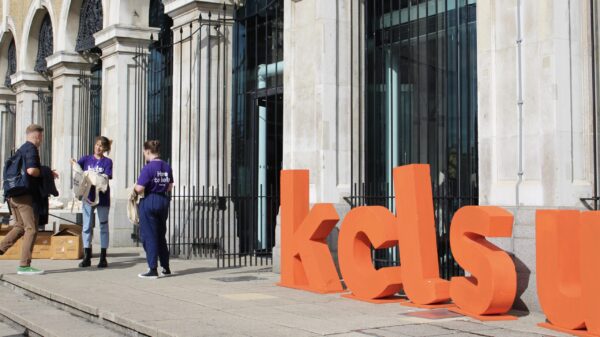
Staff Writer Guy de Basto breaks down KCLSU’s recent partnership with Canterbury for sports kits and examines its potential impact.
A new sports kit supplier might not seem like the kind of decision that changes the average student’s life. Yet, KCLSU’s decision to partner with Canterbury as its centralised kit provider signals something more substantial than just a change in branding. The move aims to standardise, professionalise and unify a sporting environment that is currently somewhat fragmented.
The partnership follows a six-month tender and consultation process involving surveys, showcase events and student panel interviews. KCLSU states that 143 students contributed feedback, representing a significant 74% proportion of sports clubs, with preferences leaning towards improved quality, affordability, customer support and more reliable delivery.
KCLSU should be applauded for making the deal happen. Partnering with a brand as internationally renowned as Canterbury is nothing to be scoffed at.
Chosen from an initial selection of 10 possible brands, later narrowed down to 6, the partnership looks very exciting. Now that the deal is sealed, an interesting question emerges: whether such consultation meaningfully translates into tangible change.
What’s in it for Students?
In practical terms, the partnership centralises sports kit provision under Canterbury of New Zealand, with Tacklebag Teamwear, based in Twickenham, acting as a regional supplier. KCLSU frames this as a move towards greater consistency, affordability and sustainability across all KCL and GKT sports clubs. For students, these claims matter in ways that are often underestimated.
Anyone involved in club sport or student societies in any capacity will emphasise how much time and effort can be lost to logistical issues such as delayed kit deliveries, inconsistent sizing, unclear ordering systems or just variations in quality between teams. These problems rarely make headlines, despite the fact that they inevitably have a profoundly large impact on the everyday experience of training, competing and representing the university.
A centralised supplier could theoretically reduce these frictions. A more structured system may simplify ordering processes and improve customer support, particularly for student committees who are already busy juggling responsibilities alongside sport and academic work. The introduction of standardised designs could also massively reduce turnaround times for many clubs, although teams opting for fully customised kits may experience longer ordering timelines.
This is particularly likely with a brand such as Canterbury, which is internationally recognised for the quality of their sporting apparel. However, whether the brand will materially reduce costs or simply standardise pricing at a similar level remains to be seen. Affordability is repeatedly emphasised in the announcement, but hasn’t been reflected in the costs yet.
That said, there are also direct financial incentives built into the partnership. KCLSU sports clubs will receive upfront investment towards Canterbury products for club use, with allocations reportedly linked to participation and membership figures from the previous year. Alongside this, the agreement also includes a cashback structure and access to discounts across affiliated Pentland brands such as Mitre, Berghaus and Speedo. Together, these generous measures suggest an attempt to reduce some of the financial burdens linked to running student sport.
Value vs Experience Trade-Off
KCLSU’s framing of the partnership is anchored in the language of “value for students”, and this reflects an attempt to define value in broadly student-centred terms. Lower prices, higher quality, and faster delivery are clear, measurable improvements, but student experience in sport is also shaped by less tangible factors such as club identity, sense of belonging, and connection to the wider university structure.
The consultation helped clarify these priorities, including improved garment quality, affordability, clearer customer support, and reliable delivery times. This is an indication of the strong focus on the practical aspects of student sport that most directly affect day-to-day participation. The response reinforces this by emphasising a “unified identity” across King’s Sport, thereby complementing these gains with a more cohesive overall sporting mindset.
Taken together, the partnership can be seen as moving beyond a purely logistical upgrade towards a broader effort to improve both the operational and cultural dimensions of student sport at King’s.
Building a Unified Sporting Identity
A recurring theme in the statement from both KCLSU and King’s Sport & Wellness is the ambition to strengthen a more unified sporting identity across the university. On one level, this reflects a practical and largely positive effort to bring coherence to a system that spans multiple campuses, medical schools, and a wide range of independently run clubs. In that sense, standardised kit can be understood less as an attempt to overwrite existing loyalties and more as an infrastructural layer that helps different parts of King’s sport present themselves more consistently, both internally and externally.
Importantly, this does not necessarily displace the strong identities that already exist within individual clubs. Most student athletes continue to orient their sense of belonging around their specific teams, whether rugby, squash or American football, and there is little evidence to suggest that a shared supplier alone would alter that hierarchy. Instead, the more plausible effect is additive: a wider King’s identity that sits alongside, rather than replaces, club-level affiliation.
From this perspective, the move towards visual and operational consistency can also be read as a form of capacity-building. A clearer and more unified sporting “brand” may improve visibility for smaller clubs, strengthen external recognition in inter-university competition and provide a more coherent framework for recruitment and engagement. In that sense, identity formation is not simply symbolic, but also functional—supporting how student sport is organised, perceived and sustained across the institution.
There is certainly a debate to be had about how far identity can be influenced through standardisation. For many teams, the strength of club culture is still heavily dependent on shared experience: training environments, leadership, performance and sports nights. A very plausible interpretation is that the partnership aims to complement these existing dynamics with a more coherent institutional layer rather than replace them altogether.
Importantly, while the SU is encouraging clubs to explore Canterbury for future kit orders, clubs experiencing issues with the agreement are still able to discuss alternative arrangement with KCLSU. This creates a system that is more centralized than before, but still retains a degree of flexibility for clubs with specific requirements.

The Ongoing Professionalisation of Student Sport
The involvement of Canterbury, a globally recognised sportswear brand, also signals a wider shift in how university sport is positioned. Statements from all parties consistently emphasise performance and heritage. Canterbury itself describes the partnership as an opportunity to support “world class kit designed for the demands of modern sport”, while KCLSU highlights improved quality and consistency.
Taken together, this language reflects a steady professionalisation of British student sport.
Club sport at major universities increasingly resembles semi-pro environments with structured training schedules, performance analytics, branded social media presence and formalised kit systems. This Canterbury partnership sits firmly within that trajectory.
It is worth considering trade-offs here as well. Does a more professional sporting infrastructure increase participation and recreational enjoyment or, in actuality, increase barriers between competitive and recreational students? Indeed, if sport becomes more standardised and brand-driven, does it still feel accessible to those who are not part of high-performance teams?
What Students Should Actually Expect
For most students, the most immediate impact will likely be practical rather than symbolic. If the partnership delivers on its stated aims, students will experience fewer delays in kit delivery, clearer ordering systems and more consistent product quality across clubs. Committee members, in particular, may see administrative processes simplified, reducing one of the less visible burdens of running student sport.
However, expectations should remain measured. Changes of this scale do not necessarily transform student experience overnight with supply chains and pricing structures tending to lead to a more gradual shift. Fundamentally, the associated success of the partnership will depend less on its announcement and wholly on its implementation over the coming seasons.
Conclusion
KCLSU’s partnership with Canterbury is, on the surface, a kit deal. But beneath the language of suppliers, tenders and sustainability commitments lies a broader ambition: a change in trajectory over how King’s sport presents itself and operates.
Ultimately, the partnership marks a very positive step forward in how student sport is organised and supported at the university. It reflects a genuine effort to improve infrastructure, reduce administrative bureaucracy and provide a more coherent and united experience for clubs across the university. If implemented effectively, it has the potential to quietly but meaningfully enhance the way students engage with sport here not through dramatic change, but, rather, through sustained, noticeable improvement.
Find the KCLSU statement concerning the collaboration here.
About the author