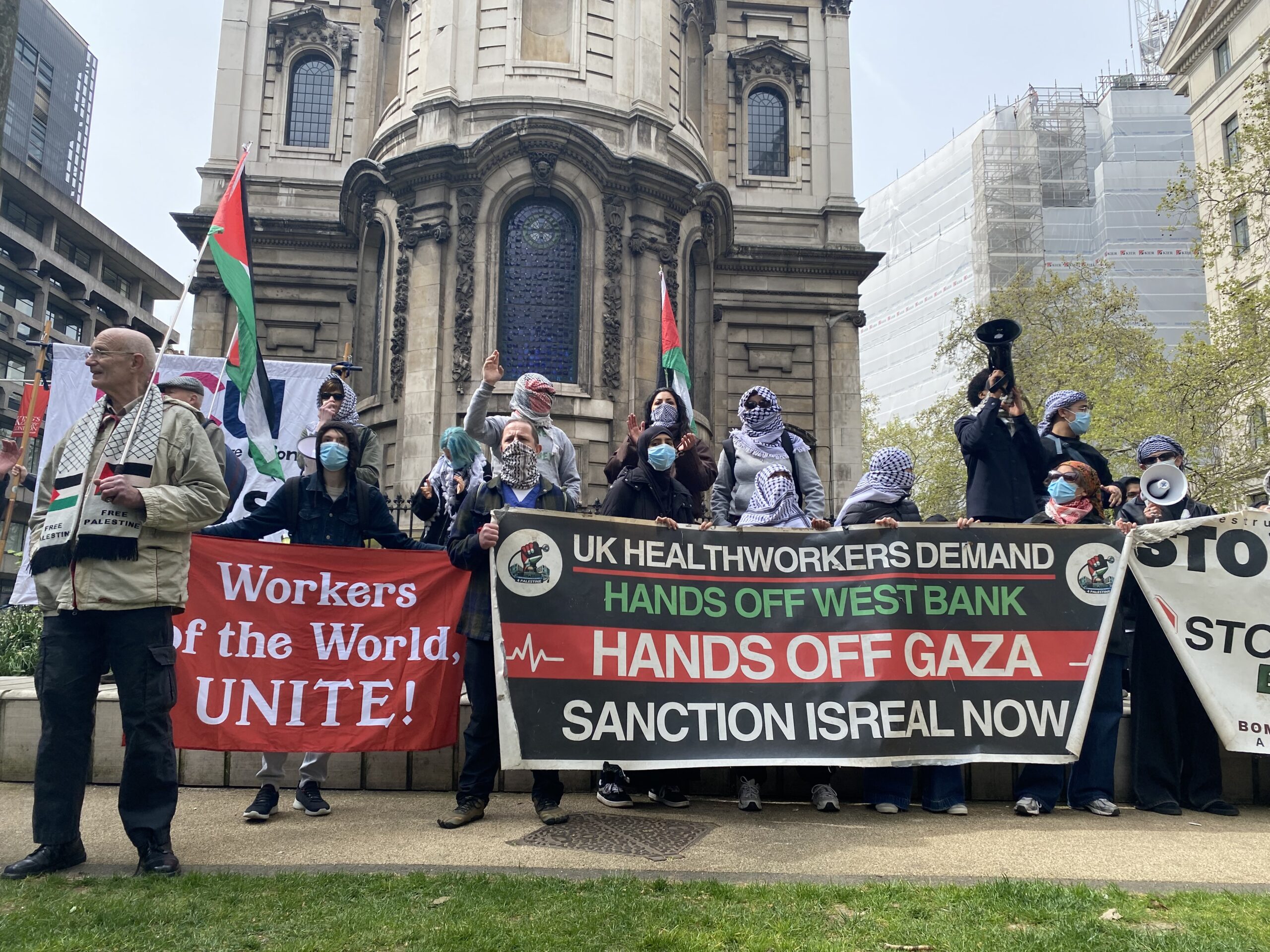
King’s College London opened the most disciplinary investigations into pro-Palestine students of any British university surveyed, an Al Jazeera/Liberty Investigates report has revealed.
According to the report, at least 26 students were subject to disciplinary investigations after engaging in pro-Palestine activism between October 2023 and November 2025. The figure is the highest among the British universities that replied to the investigation’s requests.
One student was suspended from campus and told to write a 5,000 word apology essay for posting information about a lecturer’s Israeli military history in a student group’s WhatsApp group chat that led to “heated” protest suggestions – though King’s says that these cases formed part of a “targeted harassment campaign.”
Disciplinary Investigations
Of the 26 affected students acknowledged by King’s, 13 were investigated for their behaviour in the May 2025 tent encampment in the Strand Quad that sought action from the university against Israel’s war in Gaza. Seven investigated students are on visas.
“We do not discipline students for lawful affiliations, including pro-Palestine views, lawful protests or freedom of expression, and any implication otherwise is inaccurate”, a King’s spokesperson said.
Six students were also sanctioned for protests disrupting three events in 2024 and 2025. These included members of a KCL S4J-led encampment trying to force entry into an alumni dinner, protesters disrupting a talk by an Iranian activist and protests at 2025’s London Defence Conference, which was held in Bush House.
Among those disciplined was Usama Ghanem, an Egyptian student who was indefinitely suspended from King’s in May 2025 following pressure from the charity Campaign Against Antisemitism (CAA).
Ghanem’s suspension and subsequent revocation of his student visa means that he risks deportation to Egypt, where he says he has faced torture and imprisonment. Others were disciplined for social media posts, “holding inappropriate banners”, refusing to show ID when asked and unspecified “offensive and abusive behaviour.”

The report comes months after Liberty Investigates also revealed that King’s paid £12,500 a year to private intelligence firm Horus to gather information on protests and investigate alleged student misconduct.
“It is incorrect to suggest that King’s uses a company [Horus Security] to carry out surveillance on our students… we only use publicly available information to understand when an event, such as a protest, will take place on or near our campuses”, a King’s spokesperson said.
“It Felt Like a Humiliation Ritual”
The report details allegations made by Khadija – whose name has been altered to protect her identity – an eighteen-year-old first-year disciplined by King’s seven weeks into her degree.
Khadija says that, after looking at her lecturer’s public LinkedIn profile, she discovered by chance that her lecturer had served four years in the Israeli Defence Forces. The lecturer had also shared social media content related to the Israel–Palestine conflict.
Khadija shared this information to the general WhatsApp channel of student society KCL Students For Justice For Palestine (KCL SJP) where students responded with a “heated” series of “protest suggestions”, including suggesting showing photos of slaughtered infants on the lecture hall projector – a suggestion which Khadija later said she disagreed with in her misconduct hearing.
She expressed in the chat her intention to carry a Palestinian flag and wear a keffiyeh – a traditional headdress associated with the Palestinian national identity – in her lecture as an act of protest, but King’s misconduct panel concluded this “intended to contribute to an intimidating environment” towards the lecturer.
None of the protest suggestions mentioned in the group chat came to fruition, with Khadija receiving a notice of disciplinary action 10 days later after the messages were shared with King’s Student Conduct & Appeals team.
A disciplinary outcome letter seen by Roar states that Khadija responded to the group chat messages by calling for “literally anything to make this happen”, which she says was referencing her intention to wear the keffiyeh, rather than provoking violence.
King’s says that “disciplinary measures are only taken in response to behaviour which threatens the safety or freedom of expression of others, or constitutes abuse of any kind.”
It also said that, in the cases mentioned, “there was clear evidence provided to the University that behaviour met this threshold for disciplinary investigation – including a targeted harassment campaign based on religious or national identity, compromising the safety of our central London campus, students and staff, and suppressing others’ rights to freedom of expression.”
Khadija was subsequently banned attending the Strand and Waterloo campuses during the hours of her lecturer’s classes after the panel deemed her remarks to be “inappropriate and offensive”. She was additionally ordered to write a 5,000-word essay to reflect on her actions in the WhatsApp group – later reduced to 2,000 words on appeal.
Khadija said that the investigation “felt like a humiliation ritual”, having also been made to attend a meeting with King’s discussing a possible referral to Prevent, a government counter-terrorism initiative to prevent extremist radicalisation.
Speaking to Roar, she confirmed that her selective campus ban has since been lifted, adding that she is “fully enrolled as usual”. She declined to comment on whether any other students faced a similar situation for their remarks in KCL SJP’s WhatsApp group.
“Utterly Disturbing”
King’s measures have drawn criticism for heavy-handedness and infringements on freedom of speech. The United Nations’ special rapporteur for freedom of peaceful assembly and association, Gina Romero, described the university’s actions as “utterly disturbing” and further described King’s as a “flashpoint” among universities repressing student activism.
A spokesperson for KCL Stands For Justice (KCL S4J), a pro-Palestine activist group, said that the exclusive’s findings are “representative of a wider pattern… affecting students who stand up for Palestine” and that they “will not be intimidated and will continue fighting for what is right.”
In a statement provided to Roar, a spokesperson for King’s College London said:
“We do not discipline students for lawful affiliations, including pro-Palestine views, lawful protests or freedom of expression, and any implication otherwise is inaccurate. Disciplinary measures are only taken in response to behaviour which threatens the safety or freedom of expression of others, or constitutes abuse of any kind including bullying, harassment, physical harm, Islamophobia, Antisemitism, and racism. In each of the examples reported by Al Jazeera, there was clear evidence provided to the University that behaviour met this threshold for disciplinary investigation – including a targeted harassment campaign based on religious or national identity, compromising the safety of our central London campus, students and staff, and suppressing others’ rights to freedom of expression. We have a duty to investigate all complaints, and we do this thoroughly and fairly.
“It is incorrect to suggest that King’s uses a company to carry out surveillance on our students. We have not, and would not, pay any person or service to monitor private social media accounts to target any group, political view, religious belief, or ethnicity, and only use publicly available information to make sure we have the right resources in place for protests, on any subject, near our campus.
“We are proud to welcome a diversity of political views, religious beliefs, and backgrounds and of our long history of protest, which we will continue to uphold at King’s.”
This article was updated at 3.15pm on 10 July 2026.
About the authors