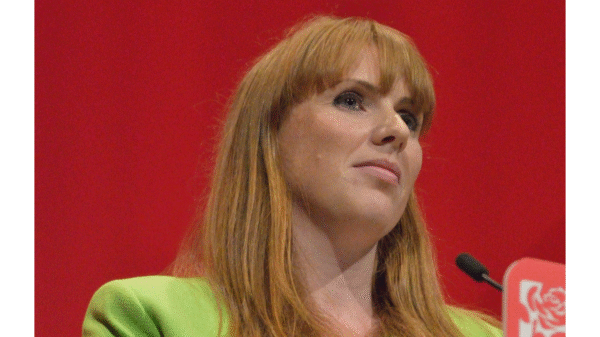
Deputy Editor-in-Chief Lara Bevan-Shiraz reports on the Strand Group’s panel discussion on 8 July, featuring Angela Rayner, which critiqued patchy devolution thus far, pressing for bold policy as the country expects promised momentum under Burnham.
King’s Strand Group has consolidated a reputation for robust debate on regional policy, since its “panel to end all panels” (as dubbed by Politico) in 2023. This paper launch panel on devolution was chaired by Ed Balls, Professor of Political Economy at KCL and former Labour politician, and featured former Deputy Prime Minister Angela Rayner, Mayor of North East England Kim McGuinness, former Conservative cabinet minister Michael Gove and Nick Macpherson, former Labour Chancellor, life peer and visiting professor at KCL.
The Harvard-King’s paper kicking off this discussion – “Regional Growth Two Years In: Is the government on track to boost UK growth by closing regional divides?” by Dan Turner, Nyasha Weinberg, Anna Stansbury, Esme Elsden and Ed Balls – formed the third instalment of a five-year project exploring the past, present, and future of devolution in the UK.
Stansbury summed up the state of devolution under the Starmer government: “This government hasn’t torn up the past but there’s a big risk of another missed opportunity.”
Progress was presented as “mixed” with capital spending up but an uneven spread across policy areas and “no clear path to a complete map of mayors” dragging progress down, thus fuelling criticism of the Council of Nations and Regions for being “a glorified talking shop”.
Turner chalked this inaction up to a lack of political leadership to incentivise political mobilisation. He said, “There’s never been a consistent push for devolution.”
Yet, looking forward, he emphasised the “fortunate timing” of the paper’s publication a day before Labour’s leadership nominations, styling it as an “exciting moment where we can ask,’what would an ambitious agenda look like?’”
The panel sought to imagine exactly that, but before jumping in to design this brave new world, they took everyone back to assess previous governments’ errors and wins.
‘A culture that needs to be changed’
Gove analysed the generalised Westminster modus operandi that frustrated his Levelling Up policy and which continues to hamper the more progress-minded in government: “three incentives govern how Tory cabinet ministers operate: Will the Prime Minister sack him? Will the Chancellor give me more money? Will I, as a result of doing this, rise more in…popularity? The third is the main one.” Political ambitions do not always align with ambitious politics it seems, and not just at the ministerial level. Gove also blamed lagging devolution on councillors, on whom “almost all parties depend” who see “any form of constitutional or local government change, even if it’s in their broad political interests, as threatening”.
Also calling out this “culture that needs to be changed”, Rayner told how government ministers “get a little bit techy” when asked to devolve power—with such realities of office thwarting rapid momentum: “At one point I said, ‘I feel like I’m the trade union rep of the government’. And that’s great because I’ve been a union rep for a very long time, but I did feel like I was doing a convening role where I was trying to negotiate”.
Like the rest of the panel, Kim McGuinness identified Rayner as a unique engine of momentum for devolution, noting that this momentum “stalled” when she left government. She too showed exasperation with the otherwise sluggish reticence of Westminster: “we’ve gotten really good in the last two years at devolving process rather than devolving power”. “We’re stuck in this loop of doing the same thing over and over and over again and expecting different results”, she says—much like the definition of insanity often attributed to Albert Einstein.
Towards ‘devolution by default’
To escape this doom loop, McGuinness advocates “devolution by default—actually saying not ‘how many different ways can we stop this?’, but ‘how can we make it happen?’”
Gove “[had] the answers to all those questions”, he quipped, tongue in cheek. To work around Macpherson’s apt point that “governments are better at publishing strategies than ever implementing them”, Gove urged the Burnham government follow three “B”s. “Bribe”, he advised, “to get people over the line”. “Bully” to force action—on housing targets, “I actually think you should nationalise land”, he says. And lastly, “Barberise”—after the former civil servant and head of the PM’s Delivery Unit under Blair, Michael Barber. Or maybe not lastly, Gove’s honorary fourth “B” was “bring in the people who have direct experience”. That is to say, “make Angela Chancellor!”
Whilst Rayner wouldn’t be drawn on what role she might take in the new government, she shared her advice for Burnham: “You’ve got even less time now, so you’re going to have to share the responsibility, share the vote and share the endeavour—empowering people more will deliver your outcomes”. “Be responsive”, she said—“give them a tram!” if they want a tram in Leeds—central government might see it as an expense, but local governments see the socioeconomic ecosystem it would support. Rayner added: “I hate the pecking order of how government works, [it] doesn’t build a consensus”. Specifically, she believes “the Treasury shouldn’t be as powerful as it is… it kind of makes it a bit of a Hunger Games.”
She advises Burnham to “pick a couple of things that you think is absolutely crucial that speaks to the public, that speaks to your values, speaks to growth, and speaks to the cost of living.” Because this regional inequality “goes to the heart of our democracy. People feel like nothing can ever change and nothing ever gets done”. Political disaffection is “a siren call… if we don’t get this sorted, we are out.”
Gove notes Reform’s electoral gains have “made people previously favorable [to devolution] less keen overall”. For McGuinness, fears of ‘populism’ are far too often “used as an excuse” by those opposed to devolution. To those who say “Well, what if you get a reform mayor?”, her response is: “What if you do? People voted for that. And do you know what? If they want to stand on a platform of ending immigration from a region, they’re going to fail and they’ll lose. That is democracy. And so we have to trust the model.”
Rayner cited London’s devolution as “incredibly successful”. Yet, here too, she sees room for improvement: “Sadiq had to come and ask me whether we could pedestrianise Oxford Street. Why are you asking the Secretary of State whether you should pedestrianise Oxford Street?”
As mayor, “you genuinely always get to put your place before your party”, McGuinness enthused. Gove too noted that mayors like Burnham and Andrew Street enjoyed popularity far above that of their respective parties. In a politically splintered society, regionalisation seems to build consensus and Burnham will be keen to drive that nationally.
KCL as a ‘convening space’
Director of the Policy Institute, Professor Bobby Duffy, closed off the evening with King’s maxim “knowledge with purpose”. In this case, the “convening space of the university”, bringing civil servants, practitioners and students together, opening future possibilities.
If Burnham’s government is serious about regional growth, it must break Westminster’s monopoly on state power. While Rayner’s “Give them a tram!” provided the evening’s most memorable line, the panel’s deeper message raised a challenge: distribute power and trust regional leaders to decide where these tracks should go.
This event was hosted by the Policy Institute’s MA Government Studies programme. To find out more about the course, click here.
For more coverage of King’s events, click here.
About the author