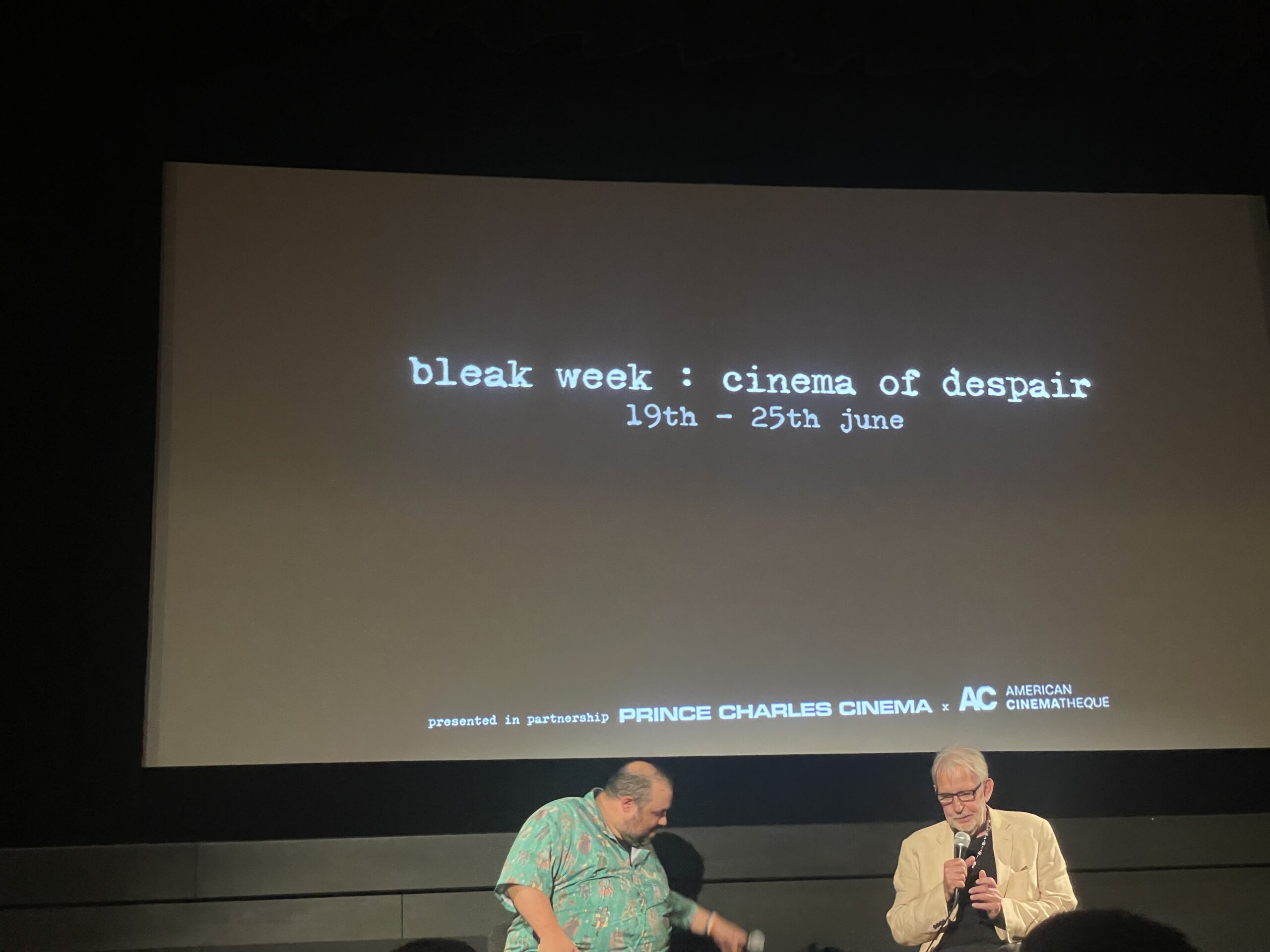
Culture Editor Thomas Deakin analyses the importance of the recent Bleak Week season at the Prince Charles Cinema as the epicentre of a worldwide collaboration among numerous prominent independent cinemas.
From 19–25 June, the air-conditioned enclave of the Prince Charles Cinema (PCC) served as a perfect oasis from London’s rising humidity during its yearly Bleak Week festival. Started by the American Cinematheque in Los Angeles in 2022, the festival has expanded globally and transformed into a yearly tradition. Co-partnered with London’s premier independent cinema, the event is held in over 100 theatres across the Americas and the U.K., including Oxford’s Ultimate Picture Palace and Leeds’s Hyde Park Picture House.
The Insight of Walter Murch
Whilst headlined by French actress Isabelle Huppert, the highlight of the PCC’s festival was undeniably two consecutive appearances by famed film editor Walter Murch on 21 June. Although Murch was initially only supposed to do a post-film Q&A following an original 70mm print of his only directorial effort, Return to Oz (1985), he also gave a brief but memorable introduction to a screening of Apocalypse Now (1979), Francis Ford Coppola’s Vietnam War critique that made him a renowned film editor.
For both his Q&A and introduction, Murch successfully engaged with the audience through his sincere approachability, balancing moments of humour with insightful reflections. While expressing the struggles he endured during these two films, he introduced the locations of these events and their various interpretations within cinematic history. These included his mixed memories of filming at Hertfordshire’s Elstree Studios instead of the planned location shooting in Europe. This was due to Disney’s failure to provide a sufficient budget, which he argued was exacerbated by his initial firing, but was then rehired for the harrowing acuity of his vision.
On a more humorous note, he commented on the irony of a sequel to a film associated with an idyllic image of Americana having its only location shooting done on Wiltshire’s Salisbury Plain, a post-apocalyptic recreation of Kansas that symbolically mirrors the chaotic productions and narratives of Return to Oz and Apocalypse Now. The intrigue of Murch’s Q&A was also matched by the audience’s excitement at the rarity of seeing the original 70mm print that he had not seen since the film’s New York premiere in 1985. By showing an original print, the programmers at the PCC insinuated that the central purpose of Bleak Week was to preserve the previously analog-dominated nature of cinema.
Though considerably briefer, Murch continued his satirical sincerity in his introduction to Apocalypse Now, providing an ideal counterpoint to the suffocatingly hellish gloom of Coppola’s magnum opus. Comparing that film to Return to Oz, he noted that both had fraught production schedules because Murch only joined the production in 1977, two years before its release, but a whole year after its filming had started. Murch recalled how he had to create an entirely new audiovisual atmosphere in the form of Dolby 5.1 Surround Sound to capture Coppola’s colossal vision accurately. He also half-jokingly summarised that both films are about a traumatised figure travelling back to their homeland, aided by a series of eccentric characters. The resolved bleakness of his directorial effort was the antithesis of the irresolvable nihilism of Coppola’s Heart of Darkness, he remarked.
Utilising Murch’s illuminating interviews as a microcosm, it becomes clear for numerous reasons why Bleak Week is an essential part of the cinematic calendar for the PCC. As mentioned, Bleak Week is one of many opportunities where the cinema has the chance to screen original 35 and 70mm prints. Synthesised with an array of 4K restorations and Q&As like Murch’s, the PCC draws from its surrounding independent cinemas in London in its commitment to preserving film history on a universal level. Whilst this catch-all attitude is perhaps not as attuned to niche cinephiles’ tastes, the insight gained through diversifying potential experiences distinguishes the PCC from the increasingly popular yet uncreative sphere of streaming services. Instead of prioritising information over experience, the PCC realises how the two can work in tandem. Amidst the PCC’s threat of closure due to leasing issues, it asserts its worth by proving it can co-host a successful event on a global stage. This demonstrates the positivity of the co-dependent relationship between the PCC and its standout yearly festival of Bleak Week.
The Global Unity of Bleak Week
However, the principal success and returns of Bleak Week should not just be attributed to PCC. Bleak Week is not just a chance for well-known independent cinemas to combat threats to cinematic originality, including AI and streaming, but also for these communities to unite, which benefits their commercial revenue and draws in audiences from a plethora of backgrounds. Considering the role this festival played in proving the danger of AI, emphasising works by Isabelle Huppert in Los Angeles and Walter Murch in London, respectively, highlights the programming in fields that are increasingly at risk due to AI’s reduction of human ingenuity, acting, and editing. These ironically pessimistic films can thus be used to document these modes of cultural production, separated from AI, to influence young aspiring filmmakers and cinephiles, an increasingly appealing audience to British independent cinema, to reproduce them. This was corroborated in the American Cinematheque’s decision to have Huppert interviewed by Sophy Romvari, whose newly released film “Blue Heron” is highly concerned with modern methods attempting to culturally reproduce the past.
It is also important to note that the programming of Bleak Week, like all art and especially in its role as a global event, does not exist outside of a vacuum and is intrinsically linked to the political spheres orbiting it. For example, the American Cinematheque’s decision to expand the festival to 73 cities this year and to have Aboriginal Australian director Warwick Thornton give an in-person Q&A on his film Samson and Delilah (2009) seems like a targeted attack on the Trump administration. These decisions reject Trump’s attempts to take total control of the American film industry and restrict its legitimate growth to producing films abroad by incorporating multicultural values through the role of Special Ambassador to Hollywood. The organisation’s embrace of multicultural ideals asserts that Trump’s political power cannot stifle the political and ideological complexity of Hollywood that allowed it to remain at the centre of the cinematic world. In addition, the PCC’s inclusion of LGBT cinema, such as Rainer Werner Fassbinder’s In a Year with 13 Moons (1978) (programmed by the repertory cinema’s LGBT programming Funeral Parade Presents), serves as a protest against the rollback of transgender rights in the UK. Through a reminder of the centrality of queer creativity, Fassbinder reiterates how the history of cinema is a constantly developing art form.
Ultimately, the global film festival of Bleak Week is a bold and optimistic representation of international cinematic collaboration when the converging forces of AI, streaming, and right-wing political monoculturalism threaten to limit the communitarian benefits of the cinematic experience. Having already grown exponentially since 2022, the demand for Bleak Week will hopefully spread even further globally next year, giving audiences worldwide the chance to find the beauty in seemingly disturbing films.
About the author