Staff Writer Saskia Catton analyses how the recent UK local elections delivered significant Reform UK gains across the East of England.
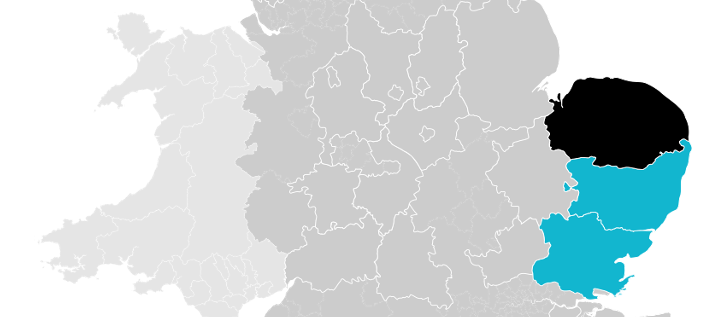
The East of England received a new coat of political colour last week as voters in Norfolk, Suffolk, and Essex went to the polls to elect their new county councillors. These contests formed part of a wider set of local and devolved elections across the country, with 136 English local authorities, the Scottish Parliament, and the Senedd Cymru up for grabs.
Despite the East’s reputation as a bedrock of Conservatism, Reform UK won over 200 seats and in doing so altered the balance of power across the region. The insurgent right-wing party won large majorities in Essex and Suffolk, and secured significant influence in Norfolk.

A realignment in support was concentrated in Norfolk’s rural south, where residents returned 40 Reform UK councillors – just three short of a majority. South Norfolk delivered some of Reform’s strongest results, historically one of the Conservatives’ safest areas. Labour, meanwhile, secured just one seat.
Even so, Reform narrowly missed out on a council majority.
The success of Great Yarmouth First, the local arm of Rupert Lowe’s Restore Britain, had split the vote along the east coast by appealing to Great Yarmouth voters concerned with local matters and frustrations. Lowe was suspended from Reform last year and has since launched Restore Britain as an umbrella political party. The affiliate party won all nine seats it contested, accounting for 5% of all votes across the Norfolk elections. This stood out compared to Labour winning just over 10% of Norfolk’s vote share, despite the party standing in 84 seats across the county.
The turquoise and dark blue wave failed to break through in North Norfolk, however, where the Liberal Democrats held firm with 39% of the vote. However, Reform’s 32% placed them as a close second and demonstrated how tight the contest was between the liberal centrists and the populist right.
The separate Norwich City Council results were almost anomalous, with the Green Party taking control from Labour. This was hardly surprising given the national political tide that Norwich Labour leader Mike Stonard admitted had been running against his party, combined with the city’s deep rooted history of electing Green councillors. Though this doesn’t erase Norfolk’s wider realignment; Reform still secured two seats in a council that has traditionally leaned left within a largely Conservative rural county.
Whether Norfolk remains a Conservative rurality or whether accumulated frustrations over local services and infrastructure have pushed voters beyond status-quo politics will only become clearer with time.
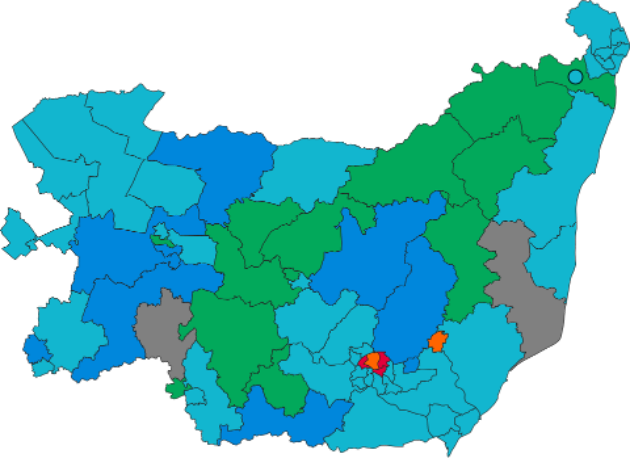
Further along England’s eastern stretch, Suffolk’s electoral map fractured into various shades of blue and green. However, these green clusters are more optical than structural, with the Green Party only returning 13 out of 70 county councillors. Reform UK, meanwhile, secured a majority with 41 seats and ended over two decades of Conservative control.
Suffolk’s election has been described by some observers as evidence of a two-horse race between Reform and the Greens. Although Zack Polanski has declared Britain’s traditional two-party system as “dead and buried” following his party’s strong performance in London, the Greens secured only a handful of seats in Suffolk relative to Reform and were even less competitive in Norfolk and Essex. Whilst the Conservatives and Labour won fewer seats than the Greens in Suffolk combined, Reform still finished with more than triple the seats achieved by the two main parties put together.
Although Polanski was quick to interpret the local results as new political competition between Reform and the Greens, the applicability of this claim to Suffolk is tentative at best. With local sentiment suggesting growing disillusionment and frustration with the former Conservative leadership, voter experimentation with an alternative political choice may be a more plausible reading than any suggestion of a broader realignment.
Ipswich’s Borough Council election results echoed the wider county trend, with Reform outperforming Labour, the Greens, and the Liberal Democrats combined. Although Labour held onto the council due to only one-third of seats being contested, these results were nonetheless indicative of a growing openness towards Reform seen across Suffolk.
Even so, the Saxmundham and District result suggested that voters were still weighing their options. Independent candidate Julia Ewart topped the poll with 1,108 votes, ahead of Reform and the Greens on 906 and 903 respectively. A former Liberal Democrat who resigned over planning issues, Ewart argued that the two parties had become brands that lacked local specificity or personal connection. This indicates a continued appetite for personalised local representation over national party labels or branding.

If Zack Polanski’s claim of a new political rivalry was only tentative in Suffolk, it crumbles entirely in Essex. The numbers speak for themselves: Reform UK won 53 seats in Essex, whereas the Greens scraped one.
The legacy of the Essex Man, once shorthand for Thatcherite loyalty, has swapped his true-blue colours for new promises of council tax freezes and a harder line on migration. Many of the voters once associated with this archetype have grown disillusioned after 14 years of Conservative government and 25 years of a Conservative council. Much of this disillusionment had arguably coalesced around Nigel Farage, whose decision to represent Clacton has offered former Conservatives a nearby alternative.
Although immigration is a national policy area, the use of RAF Wethersfield and The Bell Hotel as asylum accommodation in Essex has made it a recurring point of local debate. This made Reform’s anti-immigration stance a strong feature of their local campaign, contributing to their local gains in Essex.
However, this raises the question of why national issues are influencing local elections when Essex County Council have no authority over immigration policy.
The remaining seats were mostly divided between the Conservatives and Liberal Democrats. The Conservatives had lost 37 seats from the previous election in 2021, including that of former Council leader Kevin Bentley. Though the party managed to retain the district of Stansted, part of the North West Essex constituency represented by Kemi Badenoch.
The Liberal Democrats secured 5 seats in central Chelmsford and Colchester, reflecting their continued strength in more urban areas. Though they narrowly missed out elsewhere, losing to Reform by 117 votes in Brentwood North and by just 34 in Great Baddow and Galleywood. One vacancy remains in Springfield following the death of the incumbent Liberal Democrat councillor, Mike Mackrory.
Reform’s landslide in Essex was quickly overshadowed by the conduct of its newly elected Rayleigh West councillor, who has since resigned following concerns of racist and Islamophobic posts on social media. The newly elected Reform council has also faced recent scrutiny after removing a Ukrainian flag outside County Hall, describing this move as a “proud moment” in line with the party’s national flag policy.
Implications
With voter disillusionment effectively creating space for Reform UK to convert national grievances into local gains, the East of England illustrates how quickly decades-old political allegiances can fracture. The shrinking support for both the Conservatives and Labour across the region raises the question whether the traditional party system is under threat, but the evidence for a new two-party realignment between Reform and the Greens is far too slight to support any firm conclusions.
These elections had already been postponed from last year due to ongoing local government reforms, with all three county councils now set to be replaced by new unitary authorities within the next two years. As these councils are scheduled to be abolished, the political significance of these results may prove to be fleeting, however dramatic they appear today.
About the author