Staff Writer Albert Horne analyses international responses to the crisis in the Middle East.
Editor’s note: All students are invited to write for Roar. The views expressed by commentators are not those of the newspaper.
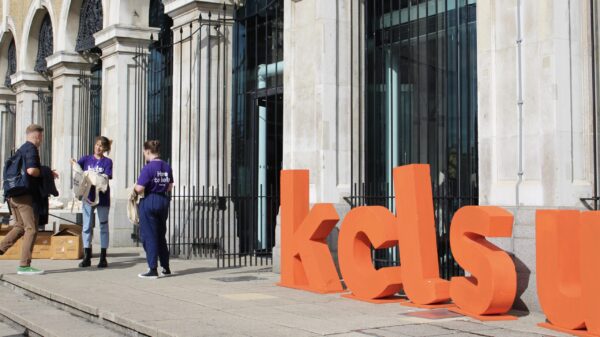
Over the past few months the humanitarian situation in Gaza and the West Bank has worsened. The Britain Palestine Project, an organisation set up to discuss Britain’s role in a potential solution, hosted their annual conference at King’s College London on 8th May. There were four rounds of discussions on international law, humanitarian aid and diplomacy in which guest speakers were invited to discuss the ongoing situation unfolding in the Middle East. One such discussion focused on the “rule of law” and whether international court rulings by the International Criminal Court (ICC) and International Court of Justice (ICJ) could have an impact on the unlawful occupation and war crimes Israel is accused of committing. Essentially, how the international community can help to stop the atrocities committed against Palestinians in Gaza and the West Bank.
In recent months, Israeli forces have begun offensives on Northern and Southern Gaza by land. This is unsurprising, however, after Israel’s defence secretary, Israel Katz, promised “the gates of hell will open and [Hamas] will face the full might of the IDF in the air, at sea and on land” should Israeli hostages not be released. It appears that the Israeli officials have kept their promise. Bombing and land offensives on Gaza have killed at least 583 people since 27th May, bringing the death toll to over 56,000 according to Gaza’s Ministry of Health.
The news then is bleak and an end to the brutality seems a long way off, with Benjamin Netanyahu warning these attacks are “only the beginning“. Blockades on food and aid into Gaza have raised accusations amongst the international community that Israel is weaponising starvation. The Integrated Food Security Phase Classification (IPC), who assessed living conditions in Gaza concluded that the Palestinians are already at critical risk of famine. A spokesperson from Unicef stated in May that they alone had already treated 11,000 children for illnesses related to starvation since January. Israeli officials claim the blockades are implemented to pressure Hamas to release hostages, yet starvation as a military tactic affects the 2 million Palestinians far more than it would Hamas. The IPC estimate of 244,000 people in critical risk of famine. Since their conception by the UN in 2004, they have only declared famine four times. The situation in Gaza is “catastrophic”.
International Law
If improvements are not going to come from Israel itself, then it is crucial that the international community seek solutions. Since Britain held a conference establishing “a national home for Jewish people” in the Balfour Declarations of 1917, Israel has violated numerous laws and been condemned by the UN’s international courts. At the BPP conference Baroness Brenda Hale (former President of the UK Supreme Court) and Micheal Sfard (Israeli Human Rights Lawyer) gave detailed descriptions of these rulings and how they may be used to internationally condemn Israel.
We were reminded that not a single Arab representative was invited to the 1917 conference that established a State inside their own land. In 1947, the UK handed over mandatory rule of the area over to the UN General Assembly. At this point every single state in the Middle East had been afforded independence, with the exception of Palestine. In 1947, the UN recommended the creation of both an Arab, Palestinian state and a Jewish, Israeli one. Israel proclaimed its independence on 14th May 1948 and the First Arab-Israeli War and the Nakba began. In one year Israel expanded from 6% of the historical Palestinian land to 78% of it, expelling 750,000 Palestinians. In 1967 Israel increased this to 85%, expelling a further 500,000 people. This triggered the UN Security Council to pass resolutions ordering Israel to end the occupation. In 1974 the General Assembly reaffirmed the Palestinians’ right to self-determination and sovereignty, which established the illegality of Israeli occupation. In 1988 the Palestine Liberation Organisation (PLO) declared the establishment of the State of Palestine.
The illegality of Israel’s occupation is clear then and has subsequently been found so under international law. In 2004 the ICJ found Israel’s barrier in the West Bank, used in displacing Palestinians, as illegal. The barrier’s construction was not stopped. In 2024, the ICJ found the settlements in the West Bank illegal, ordering Israel to remove settlers and pay reparations. The General Assembly ordered that all occupation of Palestinian Territories should be ended by 2025. Most famously, South Africa brought a case of genocide against Israel, which was accepted by the ICJ, and for which investigations are ongoing. The ICC have also released arrest warrants for Netanyahu and Gallant on charges of war crimes and crimes against humanity.
So, if the international courts have such overwhelming cases against Israel’s occupation and brutality in Palestine, then why is the wider international community not acknowledging them? So far, Britain, who holds responsibility for the context from which the 1947 conflict arose, has issued no major sanctions on Israel for its crimes. The only financial action that has been taken was to reprimand a handful of individuals and two outposts in the West Bank. The government was taken to court in May by a Palestinian NGO which alleges that a carve out for the indirect sale of F-35 jet components has broken international law. The model has been used by the IDF to carry out airstrikes across Gaza. In 2024, the UK suspended direct shipments. Yet, according to the non-profit Campaign Against Arms Trade, Starmer’s government has used a loophole to continue the supply of up to 15% of the F-35 parts used by Israel. Whilst this has been deemed lawful by the UK High Court, ethical questions remain: the British government continues, through its actions, to be in alliance with Israel, despite rulings by international courts.
Palestinian Voices
Change then, will have to come from the people. This, however, is not as simple as it sounds. It is no secret that the voices of the Palestinian people are being suppressed. Fatima Hassouna, a Palestinian photo journalist, documented her experience in Gaza. A documentary following Hassouna was accepted into the Cannes Acid, a programmed section running parallel to the Cannes Film Festival. Just 24 hours after the acceptance, she was killed in an Israeli air-strike along with 10 family members, including her pregnant sister. Sepideh Farsi, the film’s director, said she feared that Hassouna was directly targeted by the IDF for her photojournalism. Considering more than 170 journalists have been killed in Gaza, the concern is comprehensible. Palestinian voices then can get no louder. Hassouna and many others have died in their attempts to raise awareness.
Western Voices
Outcry in the West has had a muted effect. Marches were held across the world to commemorate the 77th anniversary of the Nakba, including in London, where organisers estimated around 500,000 people attended. This would be the biggest march in Britain since October 2023, yet coverage by the majority of major news outlets did not reflect this. When covering protests, The Independent also gave undue weight to the counter protest which contained less than 150 people. Thus, the problem continues to be treated as a political one and subject to the rules of political discourse. Yet the reality is, the human toll in Gaza is now far beyond politics. This is a humanitarian issue and should be treated as such.
There is Hope
In the past few weeks, however, there have been some changes that inspire some hope. The BBC broadcasted Louis Theroux’s documentary on Israeli settlers in the West Bank, highlighting the illegality of their actions and painting an accurate (change word) picture of the Palestinian’s experience in the West Bank. This indicates a shift towards granting more space for awareness for the Palestinian plight.
This trend is reflected in the political scene too. Following public pressure, as indicated by a vote by members of the Co-op, which recommended a complete boycott of all Israeli goods, political will is firming up, with the government denouncing Israel’s actions in Gaza as “intolerable”.
In addition, a joint statement released by leaders of the UK, France and Canada marks a significant change in the international stance, stating the countries’ opposition to “any attempt to expand settlements in the West Bank” and calling upon Israel to “halt settlements which are illegal and undermine the viability of a Palestinian state and the security of both Israelis and Palestinians.” The three leaders further reinforced this message by warning that they “will not hesitate to take further action, including targeted sanctions” should Israel not comply. They also expressed concern over the blockade of aid to Gaza, stating that the minimal aid now allowed in by the Netanyahu administration is “wholly inadequate”. Finally, they called the new military offensive in Gaza “morally unacceptable”.
Despite such threats of “concrete action” against Israel, the UK’s sanctions thus far have been largely symbolic. Suspending trade talks with Israel as well as minor suspensions on trade with two illegal outposts in the West Bank is simply not enough. The only sanction the state has received is a suspension of arms licences that are directly used against Gaza, which has proved largely ineffective. Whilst Israeli leaders such as Smotrich and Ben-Gvir have been banned from the UK and have had all British assets frozen, this kind of sanction must move from the individual to the state.
Nevertheless, it does finally feel like a significant shift has been made. The voices of those with a platform, as well as the hundreds of thousands that gather outside Downing Street, are at last being recognised. A UN-sponsored Conference was meant to be held last month, where major countries across the world could formerly recognise a Palestinian State. Unfortunately, these talks were postponed following Israel’s bombing of Iran on the 13th June. This happened just the day before a verdict was meant to be reached. It is crucial then that the war between Iran and Israel does not become a distraction from what continues to unfold in Gaza and the West Bank. Continued support amongst voters in the UK is more important than ever. The changes thus far are not enough, but offer hope that serious ones could be coming soon.
For more in-depth analysis on the Israel Gaza War, click here.
About the author