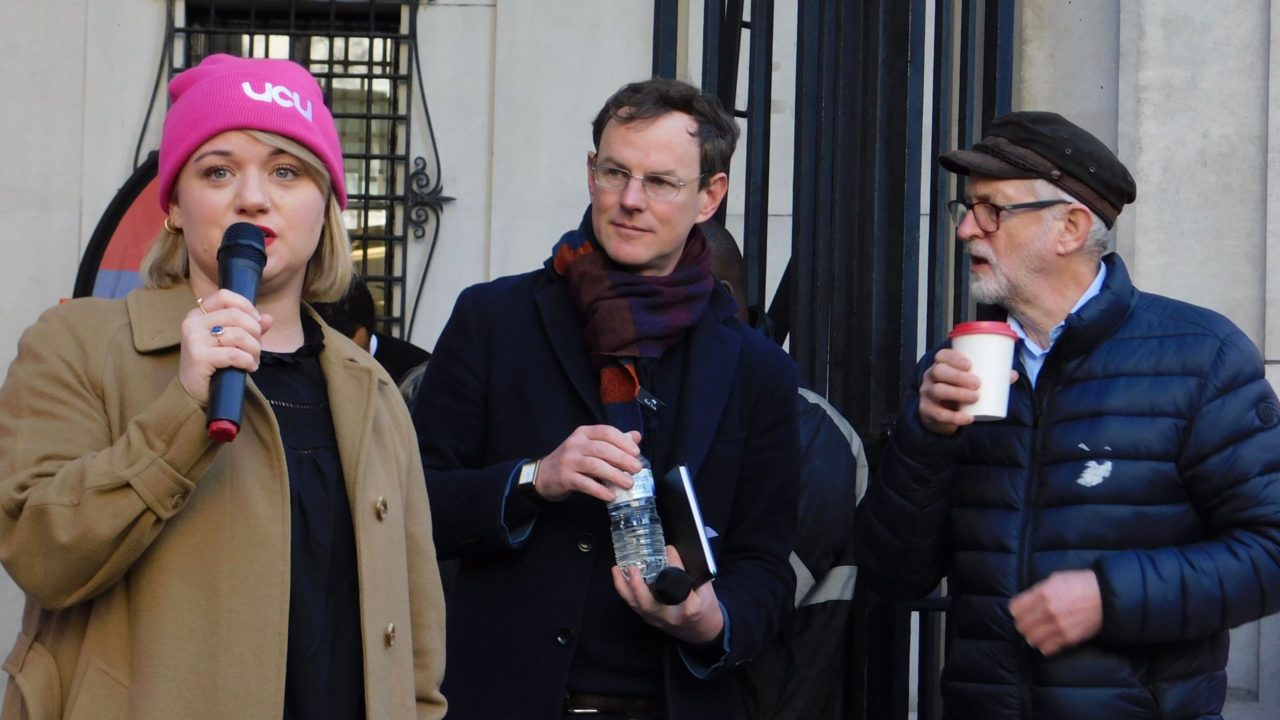
Roar spoke to KCL UCU branch president Ewan McGaughey ahead of the February strikes. Items discussed included previous strike action, hopes for the future and how students can get involved.Â
Roar: Firstly, after the strike action in December, have you heard anything from KCL management? How did it go in terms of progress with your demands being met?
Ewan McGaughey: Yeah, good question. So, yes, there’s ongoing dialogue, but the question is whether we’ve got dialogue about substantive issues. So, just to recap, the main issues in the strike action are 20% pay cuts in real terms since 2010, so, tuition fees are soaring while investment in teaching is going down, people’s pay is being cut whilst international student fees have doubled; home student fees have tripled. We need national action to stop the pay cuts.
Second thing is the gender and race pay gaps, it’s 16% or 17% nationally, and it’s much worse at KCL faculties. That’s a problem that we can really solve right now in KCL; we can take measures to ensure that everybody has equal pay, parental leave and that it’s higher so that the problems with the gender pay gap aren’t being perpetuated by differences in childcare responsibilities, and we can change our hire and promotion pay practices. We put forward proposals, but we haven’t seen any real engagement on that from KCL management.
The third thing is really, job insecurity. So, you’ve got a system in higher education where lots and lots of, particularly young, staff are hired on external contracts year to year – they have to apply for their jobs every year – and then, even for older staff, job insecurity is really big. We have people being dismissed for, you know, even things that violate the equality act, so we’ve got big problems with discrimination, sex discrimination, race discrimination, disability discrimination. We see these cases all the time, everybody thinks it’s wrong, but you know, we need concrete action to stop it. And we haven’t really seen enough engagement from KCL. And, you know, underlying all of this is that the right to vote for students and staff was abolished mostly in 2009 for the KCL Council. There’s been three academic members of staff restored who were elected to the KCL Council, one student who has voting rights, but we haven’t really seen any concrete movement. 16 out of 20 members of the Council are unelected and unaccountable. And, you know, that drives all of the problems that we see in pay, in inequality, discrimination, job insecurity.
Oh, and by the way, there’s the pension. So, university managers want to cut the pension by 35%. None of this makes sense, and privately a lot of managers in KCL recognise how wrong it is to launch an attack on the pension at the moment. There’s a £7 billion surplus in the pension fund. We’ve taken legal action against the directors of the pension fund, also we’re saying they should divest from fossil fuels. But KCL management hasn’t vocally backed the steps that we’re taking, so I hope we would see a change and that we don’t have another management shut down.
R: With regards to support, is there anything different this time? I know KCLSU have put forward a motion again to decide if the Union should back GTAs and members of the UCU. Do you feel more hopeful about gaining support from students this time around?
E: Well, I think in general support from the students is absolutely overwhelming. There’s no question about that. Different students’ societies have taken different points of view. It’s completely clear to all of us, and very humbling to see how much students are backing the teachers because, fundamentally, they can see that it’s wrong for their tuition fees to be going up and up, to be hiked by managers, and for less money to be going into their teaching, you know? Where is the money going if student fees are going up and teacher pay is being cut? You know, once people understand the issues it’s very difficult to think that the issues behind the strike action are not completely justified. So, I think it’s really important that all students’ societies debate what’s happening and go forward on an informed basis.
R: Recently, UNISON members have also balloted in favour of strike action. * What are your thoughts on this and will the UCU be uniting with them and supporting them?
E: Absolutely. So, UNISON represents mostly professional services staff. So, there’s our colleagues in administration. The other union is UNITE, which is representing technical staff, so, for instance, in catering or security, and all three of the workplace unions work very closely together and we’re all aligned on issues like the need to end systemic discrimination; the need for pay not to be cut. Everyone is behind UCU in fighting the pension cuts.
We also all want to see a rise in the London weighting, back to where it was before. So, if you go back to 1992, since then the London weighting has been cut by about 32%. And for those who haven’t heard of the London weighting, it’s, you know, because London costs a lot of money to live in and many people can’t afford to live in London, so they commute, there’s an extra amount of money paid for people who are London workers. So, like all other pay, London weighting has been going down, and that has got to change.
And everyone wants to see the restoration of staff voice on the KCL Council. So, yes, the unions work very closely together and just like we have very close relationships with students’ unions, like the National Union of Students. The National Union of Students is absolutely being fantastic, Larissa Kennedy, the President, was coming to our rallies and I hope will again.
R: In the statement from UCU, there was talk of a potential boycotting of marking in summer. Do you know if that’s going to go ahead yet?
E: I hope there is no strike forced by management or the university shutting down at all because what I hope, is that the university managers stop paying themselves fancy six-figure salaries and squandering all the money they take from students; and pay proper wages; don’t cut the pension; stop sex discrimination; stop race discrimination; end the job insecurity. All teachers want to teach and do research, and, well, I’m not sure exam marking is my favourite thing in the world but, we want to ensure everything is running absolutely smoothly. So, I hope it doesn’t get anywhere near that.
R: Regarding this cycle of strike action, how hopeful are you feeling about making progress? The first week of strikes are centred around the pensions dispute because of various talks at universities regarding the acceptance of the USS’ proposal; is King’s a part of this?
E: Yes, so there’s two things we’ve got to keep in mind. There’s national bargaining over pay and pensions, and then there’s local issues. Which include the things that there’s a national dispute about, like discrimination and job insecurity. So, we can solve everything at King’s – if we want to. If King’s College Management publicly distances itself from the pay cuts at national level and publicly campaigns against them, and if they publicly distance themselves from the reckless pension cuts that are trying to be driven through, and campaigns against them, and then they take concrete steps to resolve all of the issues that we’ve got at local level, on discrimination, on job insecurity on loss of worker voice, then there doesn’t need to be this shutdown. You know, everybody wants a resolution, and there’s no reason that can’t happen.
Now I think that what’s going on at the moment is a lot of people in King’s College London management are very, very uncomfortable with how things are working at national level, because it’s so indefensible that they can cut the pension by 35%, no deficit, massive surplus, but I think that they’re afraid of speaking out, and afraid of telling everybody the truth.
One of the reasons I want to talk to you and think it’s great that Roar are doing such great coverage, is that university managements don’t put out information about what the dispute is actually about. You don’t see this in college communications, you know? The fact that we’ve got 20% pay cuts; the fact that 35% is being threatened to be cut from the pension fund; the fact of huge gender and race pay gaps. So it’s very important that we make sure everybody knows what’s happening. And then, we just need managers to do the right thing
R: So, I suppose the first step is vocal support for staff members, followed by action to back it up?
E: That’s right, and so, you know, I’m involved in the Union at King’s College London and if there were a group of workers that were going on a wildcat strike, then the Union is not liable for the harm that might be caused by an unauthorised strike, if it publicly distances itself from it. And we’ve got a wildcat national university employer group, that is driving higher education into the ground, costing the sector billions of pounds, shutting down education for students. And so, university principals and vice chancellors need to have the guts, and the courage, to stand up and say, “no, this isn’t right. We want to protect education and we don’t want to go down the route that we’ve been going down.†Especially after the pandemic and everything that everybody’s been through, you know? Why on earth do they want to cut people’s pay and pensions? They still put everyone’s fees up though, don’t they?
R: What would you say to students regarding the strikes?
E: Come and join us! So, on the picket lines from next week – if there’s not a resolution – there will be lots of people to join arms with and sing together with and demonstrate that it’s not okay to hike tuition fees and cut everybody’s pay. So, join your teachers and support your teachers.
Write to management and say you don’t want them to continue cutting everybody’s pay while hiking tuition fees. Say that we want an end to systemic discrimination; say that we want an end to systemic job insecurity. Because you’ve got to know as well that the vast majority of university staff – university lecturers, professors – we want to see free higher education as a public service. We don’t agree with universities being commodified and marketised. Because your education shouldn’t be a monetary transaction – it should be about the joy of learning, the joy of knowledge. So, you know, university staff and students have exactly the same interests at heart and what needs to change is management. It should be them walking out, not us.
R: Are more staff members striking this time around? Do you know the number of people who will be striking?
E: Well, we represent, I think it’s safe to say, the majority of academic staff at the university. Now that said, a number of staff, and particularly the people this strike action is focused on, academic staff who are younger, and perhaps in a more vulnerable position, perhaps in a more precarious position, are often very worried about, you know; if they go on strike, will something bad happen to them? Will they lose their job? So, you know, I think that is one of the deterrents that management is very happy with over strike action. We aim for everybody to come out and join a movement for fair pay. Because, of course, all the things we’re pushing for are things that improve the working conditions of everyone, whether they’re in the union or not.
R: Legally, can management threaten staff with dismissal or repercussions for strike action?
E: No. No, for at least 12 weeks, any dismissal is unfair. If people take part in lawful strike action, which this is, any detriment to staff for strike action is unlawful. Now, that doesn’t mean we don’t see instances of it that we fight against. But quite apart from the law, if management take retaliation action against staff that are engaging in a movement for fair wages and fair working conditions, that would be very, very, very damaging, and it’s not something that I would expect to see happen because there would be very serious repercussions. Fundamentally, that shouldn’t be part of the discussion, because staff are pushing for fair pay, equality, fair conditions, and I think management needs to respect that, and perhaps the main thing they can do is go further and make sure that it happens at national level and at King’s.
R: Are there any further comments you’d like to make?
E: Fundamentally, this is about whether we have a more equal, a more democratic, and a more fair and even more efficient and innovative higher education system. We’re all here because we want to learn, we want to be educated, we take joy in education. By the way, academics are people who love education so much they want to do it for their whole lives. And, you know, we can have a fairer university system – if we solve the issues in the strike.
About the author