Culture Editor Alex Blank on “Skank,” a comedy-drama about the anxieties of life, death, and recycling.
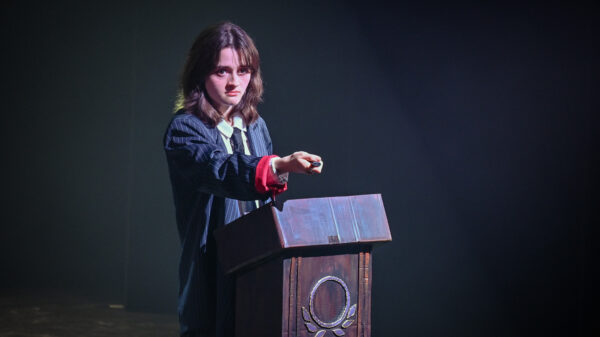
“Skank,†created and performed by Clementine Bogg-Hargroves, is a show about a woman with tinnitus, anxiety, and an empty can of beans on her side. With its Fleabag-esque breaking of the fourth wall and a lockdown-reminiscent one-person setting, it gives us an insight into a rather commonplace universe: one where dreams are crushed, feelings are held inside, and Semi-Colon is a mockingly appealing name for a cafe. Apparently, it really exists, too.
In between trying and failing to write, flirt, recycle, talk to her coworkers, and to stop thinking about the inescapability of death, Kate, the main character of the show, uses sex as an often funnily disappointing distraction. But as sex is often referred to as a little death, what might really be at play here is the character’s ambivalent relationship to life itself. Although she uses sex to seemingly escape thinking about death, its symbolically death-like qualities might bring up semi-masochistic connotations, where one goes back to the roots of their trauma in order to “get it rightâ€. As Kate herself admits: “I don’t want to die…but if I was dead, I wouldn’t need to worry about dyingâ€. There is a sense of relief in the prospect of death, as well as a kind of shame in admitting it. That said, instead of talking about it, Kate prefers to plunge into that loss of consciousness, that better death, where being on the verge of life and death seems too alive to be shameful. Her fixation with finding the right bin to recycle her can of beans can only intensifies this, as it presents an ongoing anxiety about the existential threat looming above all of us, as well as our helplessness faced with it.
The empty can of Heinz beans carries its own significance. At the beginning of the show, it only seems like a prop: she tells her coworker she wants to recycle it, but can’t find the right bin for it. After a while, as she takes the can with her everywhere (and even drinks a vodka shot from it), it becomes clear there is something else going on. I tried to figure it out while watching the play – is it an externalisation of yet another sign of our collective anxiety? Is it a fruitless fixation on trying to carry the weight of the climate crisis on one’s shoulders? Is it just something to make the character stand out? – until the end, where she gives the can to a doctor after opening up about her mental health issues. As she gives the can and leaves the room, it becomes a symbol of her own issues, ones she does not know how to “recycle†properly, but she remains convinced she can do it all by herself; until she cannot. The play ends on a note of relief, as she finally trusts someone enough to help her process her issues. At the same time, however, it reminds us of the layered and long-winded nature of seeking and receiving professional help, both mental and physical, and we can’t help but wonder if she’ll actually get the support she needs.
There is something else I could not ignore while watching, which is that there is no one else on the stage besides her. Every other character is nothing but a voice, while Kate speaks into a perpetual void. It might not carry any intentional meaning, but for the large portion of the play, I was partly convinced that everything that was happening took place solely in Kate’s head. As far as maladaptive daydreaming goes, we’re all probably experts in it at this point – who cannot relate to this sense of fruitless attempts at connection with someone, anyone, on the other side? In lockdown, we all had our own ways of doing it, until we realised barely any of it made sense, so instead of actually creating tangible things, we distracted ourselves by telling stories, imagining what could have been, or masochistically recollecting how things actually are. So, what if all of this is only Kate’s inability to write? What if she’s just sitting at her table for an hour, trying to think of the right word, the right sentence, the right story, but eventually realises: “Is this it? If this is it, then all of my hopes and dreams are utterly crushedâ€.
As someone who regularly makes themselves face the pain of a blank page, and who is always confused by the intricacies of recycling, I tend to avoid this question myself. But at the very least, we can try to admit that we’re confused by the rules, to create something of value, to get the help we need. And to articulate that we are afraid of death, while also feeling attracted to it in slightly terrifying ways. This is it. The ambiguity, the isolation, the silence of not-writing. But, as Kate reminds us at one point, at least we can have company amidst the chaos.
The show is playing at the Chiswick Playhouse until 2 October, and you can buy a ticket here. You can also see it at the Watford Fringe Festival on 3 October, and at The Pleasance from 14 to 16 October.
About the author