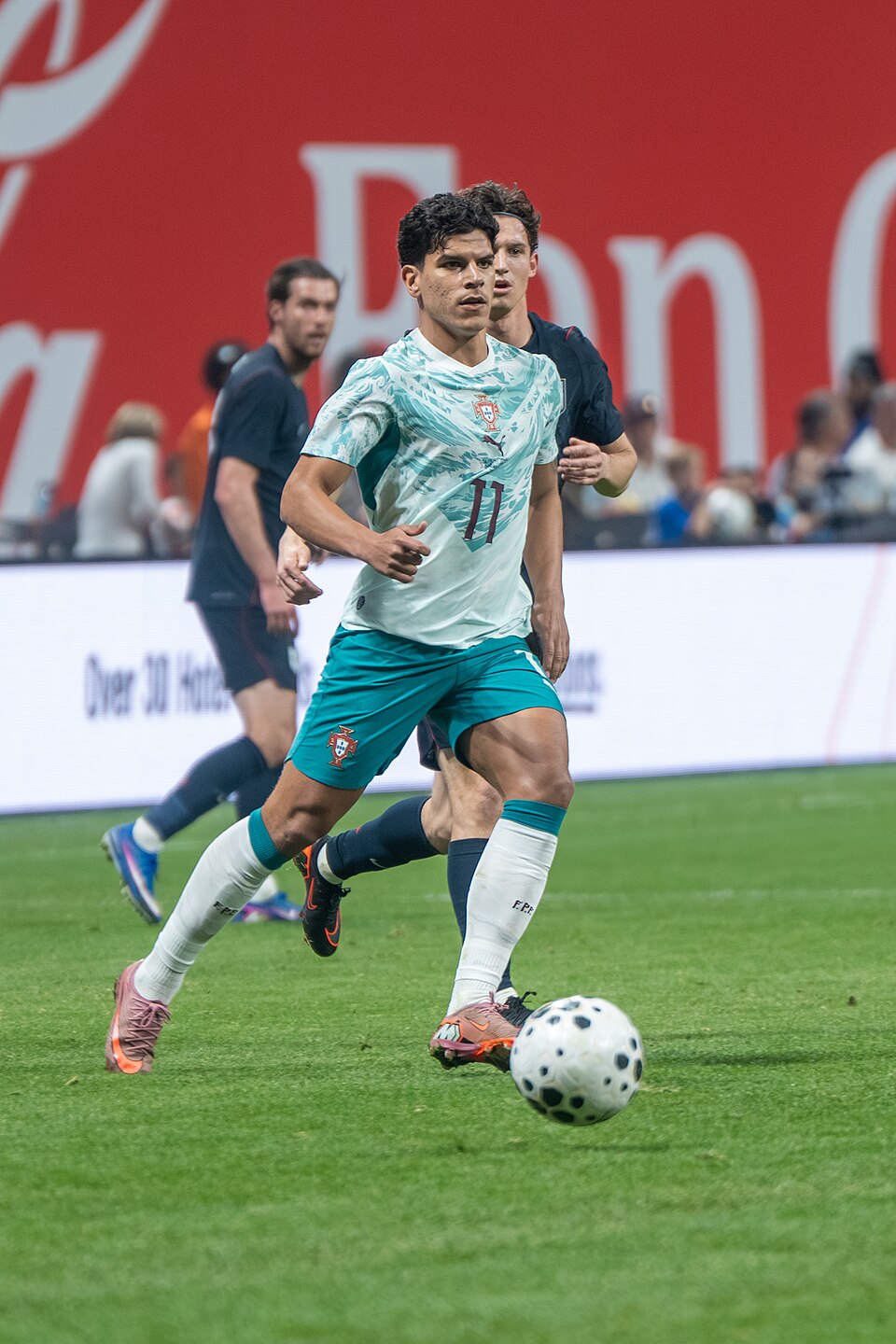
Joel Lim and Guy de Basto go over, what they believe, to be the standout eight transfers from this year’s transfer window.
The transfer window dust has settled. In ten years’ time, when we revisit this window, Roar believes that these eight moves will be remembered as the true game-changers.
Johan Manzambi: The next footballing wizard
Swiss international sensation Johan Manzambi completed one of the summer’s marquee transfers by joining Premier League side Aston Villa from SC Freiburg in a deal worth up to £59.5 million (€70 million with add-ons). This guaranteed initial package of around £59.5 million set a new high mark at Villa Park. In dramatic fashion, Aston Villa outmaneuvered several rival European clubs (with Newcastle having already travelled to Germany for advanced talks with SC Freiburg) to secure Manzambi’s signature immediately following his summer campaign.
The 20-year-old attacking midfielder’s rapid rise reached new heights in July 2026 following stellar performances on both the domestic and international stages. Signed by Unai Emery, Manzambi brings versatility, technical composure, and elite spatial awareness to Villa’s attacking core ahead of their domestic and European fixtures. He possesses showstopping dribbling ability and immense composure on the ball.
Born in Geneva in October 2005, Manzambi progressed rapidly through SC Freiburg’s academy system into the first-team lineup, attracting attention across Europe for his creative passing and goal threat from central midfield. His profile escalated dramatically during the 2026 FIFA World Cup in North America. Playing a key role in Switzerland’s midfield, Manzambi scored three goals, including a brace off the bench, and added two assists to cap off a fantastic World Cup debut. With his move to the Premier League finalized, Manzambi enters the season as one of Europe’s premier young talents to watch.
Antonio Silva: The next Huijsen / Zabarnyi?
AFC Bournemouth completed one of the summer’s most astute defensive transfers, signing Portuguese international centre-back António Silva from Benfica in a deal worth £25 million. The 22-year-old committed his long-term future to the Cherries, stepping straight into Marco Rose’s backline following Marcos Senesi’s departure to Tottenham Hotspur.
Despite his young age, Silva arrives in England with extensive top-level experience. Developed in Benfica’s famed academy, Silva has lifted a Primeira Liga title, two Super Cups and earned the Primeira Liga Defender of the Year award during the 2022–23 campaign. His young age has also not precluded him from international exposure, where he has been a part of Portugal’s 2022 World Cup and Euro 2024 squads. Silva boasts 20 senior international caps and was part of Portugal’s 2025 UEFA Nations League-winning side.
Standing at 1.87m, Silva combines strong aerial duel capability with calm distribution under pressure, making him an ideal partner alongside Illia Zabarnyi. In a transfer market where proven international centre-backs regularly command fees exceeding £50m, landing a defender of Silva’s European pedigree for this price is a massive coup. Given Bournemouth’s stellar track record of refining elite young defensive talent, Silva provides immediate composure and long-term asset value in the Premier League.
Carlos Espi: An absolute bargain for a young and upcoming star striker
Real Madrid’s decision to trigger Carlos Espí’s €25 million release clause from Levante UD wasn’t just a market bargain. Rather, it was a strategic masterstroke that solves a structural void in Los Blancos’ squad.
While Real Madrid boasts immense dynamic flair with attackers like Kylian Mbappé, Vinícius Júnior, and Jude Bellingham, they have lacked a towering focal point since Joselu’s departure. Standing at 1.94m (6’4″), Espí gives Madrid a physical presence up front, with two particularly prominent strengths:
Ariel Dominance: He won 56.1% of his ariel duels at Levante last season, providing a lethal target on crosses against low-block defenses.
Hold-Up Play: Beyond his ariel prowess, his 33.8 km/h top speed allows him to run the channels and press effectively from the front.
In one of the most inflated windows of all time (Savio for £85 million; Elliot Anderson for £116 million; Morgan Rogers for £117 million), at €25 million, Espí arrived as one of the summer’s most value-driven signings. He proved his readiness on day one by coming off the bench to score the match-winner on his competitive debut in a 2–1 victory against Espanyol. Finishing last season as Levante’s top scorer with 11 league goals, his ability to impact games instantly makes this deal look like a stroke-of-genius business for the next decade.
Matheus Fernandes: An all-round midfield maestro in the making
Tottenham Hotspur’s decision to sign Matheus Fernandes from West Ham United wasn’t just a clever intra-league move. Rather, it was a strategic masterstroke that solves a persistent structural void in Spurs’ midfield.
Spurs have long lacked a press-resistant, combative anchor to stabilise transitions, produce line-breaking passes or make penetrative runs through defences. Fernandes provides elite central control with two prominent strengths:
Press Resistance: Completing 89% of his passes under heavy pressure, he effortlessly escapes tight traps and triggers forward attacks from deep.
Defensive Coverage: Averaging 3.6 tackels and interceptions per 90 minutes, his lateral work rate effectively neutralizes opposition from counter-attacks.
In an inflated market, poaching a battle-tested Premier League midfielder represents exceptional value. Throughout pre-season and the first two Premier League matches, Fernandes has already proven himself as Spurs’ best midfielder, with technical abilities and footballing IQ that are heads and shoulders above any other player.
Elliot Anderson: The Metronome
For a very brief spell, the fee of £116 million made Anderson the most expensive British player in history. However, this proved a record short-lived, as it was only a few weeks before Morgan Rogers’ move to Chelsea (see below), which also took place simultaneously in July. Still, it would be hard to argue that he was overpaid for, and in my opinion, he was the best acquisition in the whole window.
Now, Elliot Anderson only won his first England cap in August 2025 with a fantastic showing against Andorra, but he has proved pivotal since then. The move to the Citizens was struck up earlier than most fans realised, with talks happening in the midst of the Three Lions campaign getting underway.
Looking at the stats, it becomes even clearer why City were so willing to cough up the money that they did. The Forest man racked up more touches of the ball than anyone else in the Premier League last season, with an astounding 3,300 in total, and became the first player since Declan Rice in 2019-20 to record more than 300 successful possession-wins in a single Premier League campaign. As if that wasn’t enough already, no central midfielder in the league completed more passes than his 2,038.
To risk sounding cliché, the best ability is availability, which might be his best trait. Anderson barely misses a week, with 37 starts in the Prem last year. There’s a reason why pundits and rival fans alike have come round to him not because of one big moment but because he’s just there, every match, doing the same things well, consistently performing at an 8/10 level. Teammates and managers frequently describe him as someone who leads by doing rather than talking, which tracks with everything else about how he plays. This only makes me admire him more, and he could be a fantastic England captain for many a tournament to come.
These numbers are even more impressive when you consider what was actually happening at Forest last year. With four manager changes and plenty of shenanigans from owner Marinakis, it didn’t matter. Anderson kept performing week in, week out. Expect big things from the lad from Whitley Bay, and you shall not be disappointed.
Morgan Rogers: The Positionless Magician
If you’ve paid attention to this Villa side for the last few years, you’d know that nobody in the Premier League turns on a sixpence quite like Rogers. His ability to pick the ball up in impossibly tight spaces and glide past defenders effortlessly is uncanny and unnatural.
A move to a big 6 club was always inevitable for the boy from Halesowen and Chelsea were the side fortunate to get him and set a British transfer record in the process. With that being said, Rogers being 24 and signing a contract until 2033 makes me almost call it a great piece of business for the Blues.
Another interesting thing about Rogers is that trying to pin him to one position just doesn’t really work. At Villa, anyone with eyes would say his best form came from a narrow left, cutting inside onto his stronger right foot. At this World Cup though, England used him on the right wing instead, and he adapted seamlessly. This only corroborated that wherever he lines up, the end product looks similar, and it’s absolutely fantastic.
The so-called eye test is backed up by stats as well. Rogers impressed me last time out by his ability to create chances out of nothing all season, and while 10 goals in the league (against an xG of 7.6) and 6 assists are solid on paper, they ultimately neglect how often he was the reason a move started in the first place.
Moreover, what doesn’t get talked about enough is the defensive side. He isn’t flashy by any means, but his work rate off the ball is one of the quieter reasons Villa trusted him in bigger games. It’s a good signing, and one Chelsea fans should be ecstatic at.
Ezri Konsa: Mr 96.2%
Ezri Konsa has left Aston Villa for Arsenal in a £51 million deal. On the surface, it’s a kind of strange signing. Arsenal’s defence was already one of the best in the league, and there wasn’t an obvious gap to fill. The catch, however, is fitness — several of that back line are unlikely to be available for the start of the season, namely Timber and Saliba, and Arsenal weren’t willing to gamble on that alone, despite keeping 2 clean sheets from a possible 2 games so far.
Interestingly, there’s another trend a lot of people haven’t noticed regarding Arsenal’s transfer logic this summer. Paired with the Bruno Guimarães deal, a pattern is emerging, whereby Arsenal aren’t chasing potential this summer. Instead, there’s been a shift toward buying players with a track record, rather than betting on academy graduates to become that player two or three years down the line.
Konsa’s underlying numbers back up the cost. He posted the best passing accuracy in the Premier League last season at a mental 96.2%, and also led the league in retention rate — 94.8%, an advanced metric of how often a player keeps the ball under pressure. Crucially, his ground duel success, 73.1% among players who contested at least 20, also topped the division, which is an area that Arsenal felt needed improving.
It’s going to be a long season. Fans of the Gunners are expecting deep runs in domestic competitions and now, the Champions League. The option here of a high-quality centreback who’s calm on the ball and outright ferocious off it is where Konsa’s value really shows. If William Saliba, who’s been in the PFA Team of the Year four years consecutively, is fit and preferred once he’s back from injury, the ex-Villa man becomes arguably the best backup defender in the league.
Goncalo Ramos: Need for Speed
Portugal’s Goncalo Ramos has joined AC Milan from PSG for £63 million, which makes him the most expensive signing in the club’s history.
The move to his previous team, PSG, dates back to August 2023, when the French giants signed Ramos on a season-long loan with an obligation to buy, for €65m plus €15m in add-ons, totalling €80m. Ramos was born on 20 June 2001 in Olhão, Portugal, and came through Benfica’s academy, where he finished as top scorer in the 2019 UEFA Youth League.
His breakout campaign came in 2022/23, when he scored 19 league goals, two behind Taremi for the golden boot. That form carried into the World Cup, where he scored a hat-trick on his debut as Portugal beat Switzerland 6-1 — the first player to do that on a World Cup debut since Miroslav Klose in 2002.
Part of what makes him so dangerous is pure speed in transition. Last season’s Champions League data clocked him at 32.1 kmph, fast enough to get in behind a back line that thinks it has him covered.
Whether you’ve watched him play domestically or in Europe, his first touch is a massive selling point. His ability to cushion the ball instinctively is otherworldly, and it allows him to receive under pressure and keep it close in areas where most strikers would need an extra touch. Add his ambidexterity, as he’s shown comfort shooting off either foot from almost any angle, and defenders simply can’t tell which way he’s actually going before he’s zipped past them.
Where he really separates himself from other top-level strikers is his off-the-ball movement. He is constantly scanning the gaps between centre-backs, not dropping deep to get the ball and turn, but preferring to sit on the last line and time intelligent runs into tricky areas. It stretches defences and means he can shape much of the play, even in games where he doesn’t get much service.
The trade-off is hold-up play. Unlike former AC Milan talisman Olivier Giroud, Ramos is someone you can’t just hoof it up to. He isn’t going to knock it down and hold off a defender. His main game, as I mentioned, is built on his ability to get in behind, not on fighting centre-backs whilst facing his own net.
Whilst some might not have realised this transfer took place, it marks a significant change in European football and will certainly affect the dynamics in both the Champions League and the Europa League this year. Watch this space.
About the authors