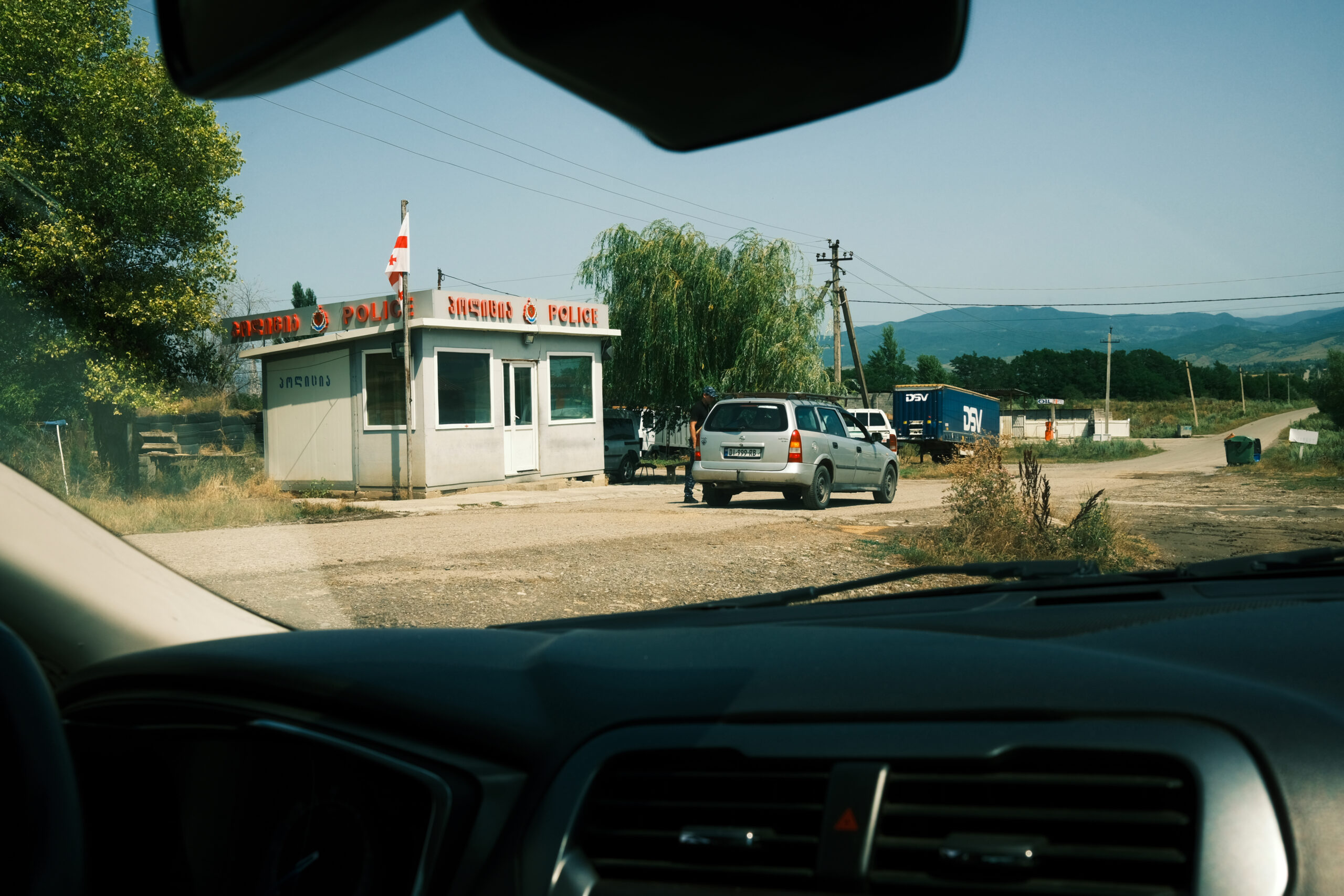
Staff writer Thomas Noonan reports on the impact of borderization on local Georgian citizens along the border with South Ossetia.
300 metres from Georgia’s main highway lies a breakaway separatist entity, the Republic of South Ossetia. Created in the wake of the Soviet Union’s collapse and under military occupation by Russia since the 2008 Russia-Georgia War, what appears from the road to be ordinary farmland is now one of the most volatile borders in the world.
Border guards of the Russian Federation patrol it day and night, erecting new fences, laying barbed wire, and detaining any trespassers to assert the independence of South Ossetia. In doing so, they push the border further and further into Georgia, encroaching on farmland or simply cutting through villages themselves.
In 2015, Russian troops pushed the border back by 500 metres to capture farmland belonging to Georgian villagers from Khurvaleti and Tsitelubani. This area is now completely fenced, dotted with watchtowers and border signs, and patrolled by Russian border guards who regularly detain locals attempting to tend to their fields, pursuing them into Georgian territory. Many have since fallen into poverty.


However, this creeping occupation did not stem from a desire for farmland. Passing underneath this area is the BP-operated Baku-Supsa pipeline. It is one of three oil pipelines in the South Caucasus linking Europe to the Caspian oil fields, a direct competitor to Russian oil and gas. This is part of a wider Russian military and economic strategy of backing separatist republics in the South Caucasus and Eastern Europe to project influence across the former USSR. Most affected by this is Georgia herself. Abkhazia and South Ossetia proclaimed and established de facto independence with Russia’s support in the early 1990s, in brutal wars that led to the withdrawal of Georgian forces and the ethnic cleansing of Georgians from those regions.
South Ossetia enjoys particularly strong support from Russia, raising the idea of annexation into the Russian Federation to unite with the Republic of North Ossetia-Alania. Since the Russia-Georgia War of 2008, Russia has recognised its independence and signed a Treaty of Friendship. This ensures the continuous presence of a Russian military base and offloads border security to the Russian Federation’s FSB border guards. They have since started demarcating the border with fences, barbed wire, cameras, and watchtowers, preventing locals from accessing their land, and sometimes even cutting through their backyards.
It is unclear where the border lies. Russia uses this uncertainty to push further and further into Georgian territory, reportedly using Soviet-era maps of the region. The area we visited was seized in 2015, after Russia annexed Crimea and the outbreak of war in the Donbas.

Due to the ongoing war in Ukraine and the tense political climate within Georgia, access to the Administrative Boundary Line is more difficult than ever. The government seeks closer ties with Russia, partly in hopes of progressing towards a political settlement of the separatist conflicts, and partly because of oligarch Bidzina Ivanishvili, founder of Georgia’s ruling party, and his pro-Russian agenda.
As a result, Georgia is very wary of incidents at the border, with it now taking at least a week for foreign journalists to get an entry permit. So, despite having requested a permit five days in advance and confirmed on the phone the day prior to my trip into the villages, the State Security Service agents on the ground never received any information. After some back and forth between the Tbilisi HQ, us, and the local station lasting for a few hours, we were still not allowed in.
However, one officer offered to escort us on the main highway to a viewpoint where we could see the ABL just 300 metres away. He believed that since the new government’s pro-Russian geopolitical turn, the situation on the border has stabilised greatly. The Georgian forces are under very strict orders not to engage in provocations, and Russian troops are appearing to be less provocative than before. This is reflected in the small reduction in border incidents, from 25 in 2021 to 5 in 2025 so far, including the arrest of a Georgian citizen in the village of Khurvaleti. Despite this, the situation remains extremely volatile, with a noticeable spike in 2023 when 27 Georgian citizens were arrested by occupation forces and one was shot dead.
About the author