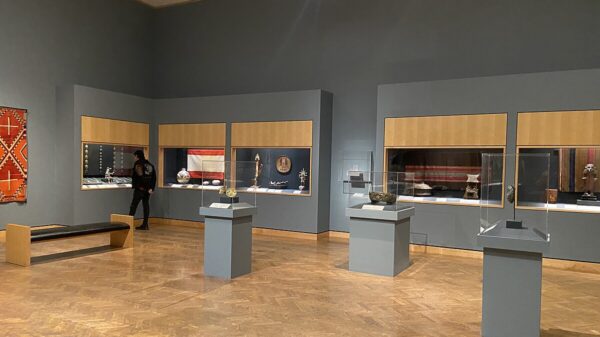
Buddhist monk and self-taught artist Dachan held an exclusive exhibition at the British Museum on the 25th of November. The event featured drinks, gifts, Lords and Ladies, and Dachan himself.
On the November Sunday, I headed for the British Museum while all the other visitors were leaving. People in suits were strategically placed around the entrance area, constantly pointing you in the right direction should you look confused. Finally, after being greeted by at least three different persons as though I was royalty, I found my way downstairs to the registration desk. I presented my name and received an invitation in a wax-sealed envelope along with the programme for the evening.


Shortly after receiving a glass of champagne, a lady asked me if I would like her to give me an introduction to the artwork. Imagine that, a private guide! She began by briefly introducing the artist (who was standing just a couple of meters away from us), saying that Dachan was a child prodigy who “fell in love with poetry, calligraphy and painting at an early ageâ€. The exhibition featured all three elements, where a recurring theme is using art to communicate a deeper truth.
Dachan’s paintings are grounded in traditional Chinese techniques but still has a very distinct, soft touch to them. He uses ink to create his watercolour-like paintings, where each brushstroke is of significance. Unlike oil paintings, you cannot repaint anything with this technique, so everything has to be precisely calculated before he brings the brush to canvas. Despite this almost mathematical precision his paintings still appear spontaneous, full of vitality, and with an exquisite coherence. The result is paintings with a water-like quality, with soft contrasts and beautiful colour palette.
A central motif in his work is the lotus flower, an important symbol within Buddhism. The flower grows in muddy water, yet rises above it and achieves enlightenment. Different colours carry different meanings, all of which are present in Dachan’s works. His poetry juxtaposes goals of the material world with those of the spiritual world. His calligraphy “Dragonâ€, a character normally associated with strength and vigour, is painted both firmly and so gentle that it is barely visible. This shows that even something powerful can be as gentle as silk at times.
His calligraphy and poetry draw heavily on impulses from the outside world, something that was shown during the musical part of the programme. We were instructed to enter an auditorium, where a string quintet from the Philharmonia Orchestra awaited. They expertly performed several known pieces from both the Eastern and Western world. While they were remarkably well-coordinated and played beautifully, it remained a programme solely based on popular demand. Additionally, the physical copy of the programme must have been written by someone who clearly does not know how to cite classical music, as neither Opus nor composer was written. And I would have preferred to hear something less well-known than excerpts from Vivaldi’s “Four Seasons†and Bach’s “Air on a G stringâ€, but then again I might not have been part of the target group.


The real highlight was when Dachan did live calligraphy accompanied by the quintet. It illustrated the musical impulses he received, creating a very organic piece of art. During the fast, energetic measures Dachan conducted his brush light-handed and speedy, and during the calmer ones he painted more slowly and elegant. This showed how different artistic expressions can influence each other, here uniting three at once; music, poetry and calligraphy.
This naturally led to a standing ovation and marked the end of the formal programme, although we did get an encore from the string quintet. We were then brought out again, where the main focus had clearly shifted from appreciating Dachan’s art to wanting to take a picture with him. Finally, upon leaving, we were all given a gift bag consisting of various prints, a booklet and even a cashmere scarf. This left me with a sense that the resources spent on this could probably have been spent elsewhere, and on something that would benefit more people. Nevertheless, I left very happy to have seen such beautiful paintings and additionally getting a glimpse into the British and Chinese culture elite.


About the author