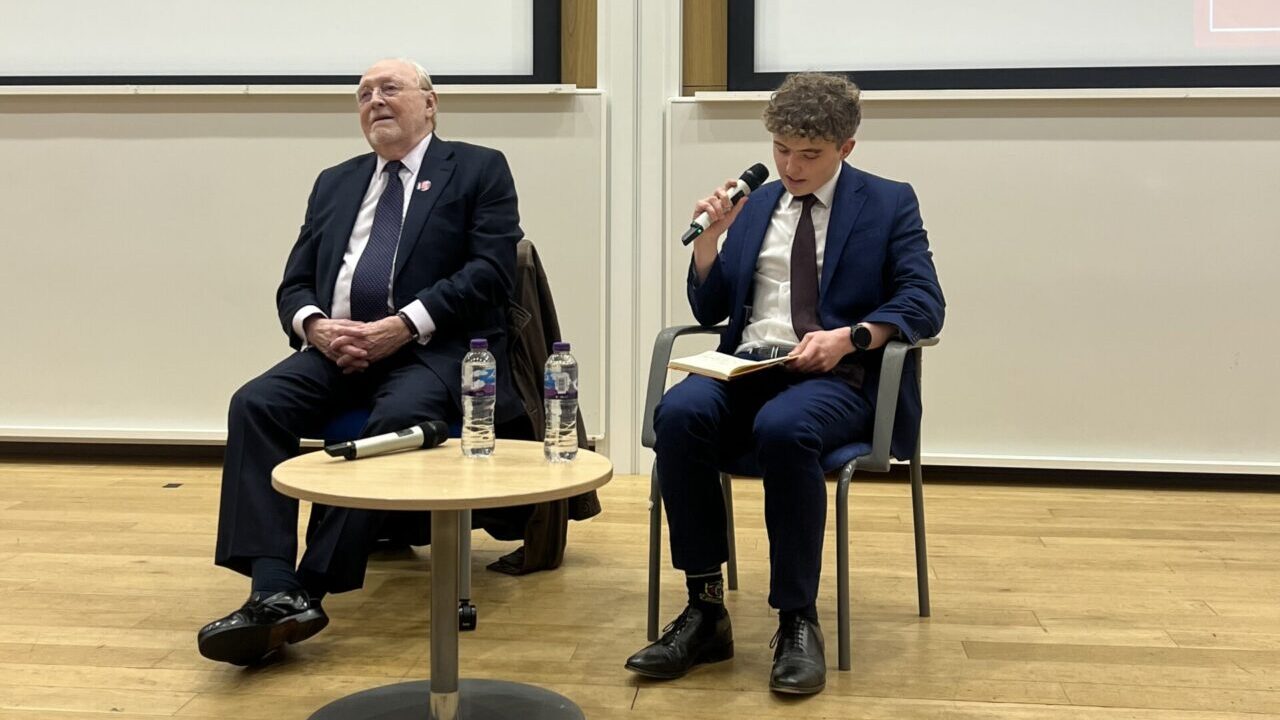
Staff Writers Penelope Spencer-Simpson and Saskia Catton reflect and analyse the visit of former Labour Leader, Lord Neil Kinnock, to King’s College London.
From the killer behind Labour’s ‘longest suicide note in history’ to an appointed life peer under Tony Blair’s premiership, KCL Labour’s evening with Neil Kinnock offered a reflective assessment of British politics, international relations, and his own early years in the Labour Party.
The Britain That Formed Him
True to form, Kinnock situated the present moment by looking back to post-war Britain. He recalled the “terrific advantages” of a secure double-income home, the opportunities opened up by free secondary education, and the NHS in its purest Bevanite phase, all of which he saw as “made possible by collective contribution and provision for individual freedom and fulfilment”.
Bringing the discussion into the present, Kinnock apologised for the “pretty lousy condition” in which his generation had left the world, warning that such post-war provisions were now “under attack and fading”. Describing Vladimir Putin as a “murderous despot” and Donald Trump as a “crazy narcissist”, he fears that today’s volatile international arena leaves us “in more danger than we have collectively been in at any time since 1945”. For today’s generation, the task was nothing less than to “save the world – it’s that serious”.
Arguably, we saw this attempt to “save the world” in the 2024 UK General Election. Though widespread tactical voting to remove the Conservatives from government, Kinnock describes the victory as “rare”. Even so, the precarity of the Labour government – and the questions to Starmer’s premiership – were inevitable. As he put it, “we paid the price in giving the impression that we wouldn’t make serious policy changes such as not raising taxes, that was unrealistic”.
In discrediting the idealistic 2024 manifesto, this prompted audience members to reflect on the similar backlash Kinnock himself faced over Labour’s 1983 manifesto. The programme had called for a radical left upsurge to the party such as nuclear disarmament, withdrawal from the European Economic Community (EEC) without a referendum, and abolish the House of Lords – the chamber Lord Kinnock himself now sits in.
Labour’s Identity Crisis?
Kinnock’s reflections on Labour’s current trajectory were equally incisive. In recalling Keir Starmer’s earlier warning that things are going to get worse before they get better, Kinnock contrasted this very sentiment with the confidence of figures like Churchill or Attlee who, he suggested, would never have voiced such pessimism. He then turned to Labour’s recent record in government, pointing to U-turns on winter fuel payments, the two-child benefit cap, and the restoration of local elections as “very un-Labour and un-Comradely” behaviour. He was similarly critical of the party’s limited communication strategy, joking that he had been unaware Labour even had a director of communications until news of his resignation had surfaced.
Yet his assessment of Keir Starmer himself was more generous. Kinnock expressed genuine respect for the Prime Minister both personally and professionally, describing him as “by God what our party and country needs”. Though he mourned the extent to which Starmer is, in his view, constrained by “myopic advisors” – some of whom have since departed his senior team.
Kinnock’s concerns extended beyond Labour to the wider fragmentation of the electorate, particularly the rise of Reform UK in formerly industrial and working-class constituencies like his own. He warned that the sense of abandonment in communities emptied of “jobs, hope, and cultural nourishment” had left voters vulnerable to what he describes as Reform’s simplistic responses – not answers – to very complex questions. Kinnock described the party as an intrinsic and instrumental threat, drawing on historical moments when democracies allowed authoritarian forces to enter their orbit: “it’s a mistake that democrats should never make again…we need to beat these people”.
His analysis of the wider electoral landscape also encompassed Plaid Cymru and the Scottish Nationalist Party. Though he made no secret of his distaste for the direction they represent, Kinnock nonetheless anticipated relative gains for both parties in the foreseeable future. In his view, this reflected a gradual seepage of voters from Labour towards other parties that continue to defend the welfare state, strong local administration, community values, and otherwise social-democratic commitments that once formed the core of Labour’s identity.
“We used to be that standard, without comparison, for eighty years.”
Neil Kinnock
Kinnock took the recent by-election in Caerphilly as a telling example of this drift. He interpreted it as an easily foreseen contest, one in which voters channelled their frustrations with the Labour government in Westminster through Plaid Cymru whilst simultaneously rejecting Reform UK. As a Welshman himself, he was confident that Caerphilly would not hand Reform a majority, yet he admitted that the result was “less certain than it should be” for such a reliable (alas now broken) Labour stronghold. Any relief he felt, however, carried an unease that spoke volumes.
“When I can take comfort in a nationalist victory, you know something is wrong.”
Neil Kinnock
A similar pattern, he insisted, can be seen in London with the Green Party: “this is refuge, not gains”. In seeking a progressive and enlightened alternative to Labour, he suggested that many voters are gravitating towards the Greens as a place to park their support. He argued that the danger lies in the Greens’ ability to deploy populist tactics that effectively position them as the more principled and radical alternative to Labour, who he deemed as “the real democratic socialists”. For Kinnock, the deeper danger is that such tactical appeal is misinterpreted as genuine political realignment, when it is better understood as a symptom of Labour’s failure to offer a convincing progressive home.
The Cost of a Broken System
From this discussion, Roar questioned an update on Kinnock’s stance on proportional representation. A fan of the system since 1983, when Thatcher won 42.4% of the vote, he argues that the “massive disproportion” between herself and voters was what granted the success to the Conservatives in the election. Kinnock, with apparent disgust, could not comprehend how under 43% of the vote granted the previous Prime Minister this much electoral power.
This statistical disproportion has been exaggerated in recent years. In the 2024 general election, the Labour Party occupied 63% of the House of Commons, despite only a vote share of 33.7%. Clearly, this disproportionality has inflated over time, making Kinnock’s insight useful as someone who has seen this shift exacerbate. More so, he argues he could not properly express his discontent at the time, especially in the political witch hunt the party was under after their loss in the 1983 election. He imagined that headlines would have had a field day running “Kinnock recognises that Labour can’t win” as a response to the system. In order to understand democracy he recognises that this systematic change is essential to “modernise” and clarify the intricacies of the electoral system to voters.
Simultaneously, Kinnock expresses concerns over the democratic privileges the government has debated. One discussed was the government proscription of Palestine Action. His assignment condemns the organisation’s pursuit with “terriorism” and argues we get into “dangerous territory” with associating offence against persons and blocking highways to terrorism. Yet, he does not deny that the behaviour from Palestine Action was eligible for prosecution. He did not support not voting for the proscription of Palestine Action but admitted he often found the organisation “irritating” at times. Despite this, he does linger with the regret of not voting against the proscription.
“I thought that proscribing Palestine Action as terrorism produces immediate injustices.”
Neil Kinnock
Kinnock’s visit served as both diagnosis and a warning: a reminder of what has been lost, and of what remains at stake. His reflections traced the fault lines of a fragmented electorate, but also the urgency of addressing them with far greater seriousness than we have yet seen.
About the authors