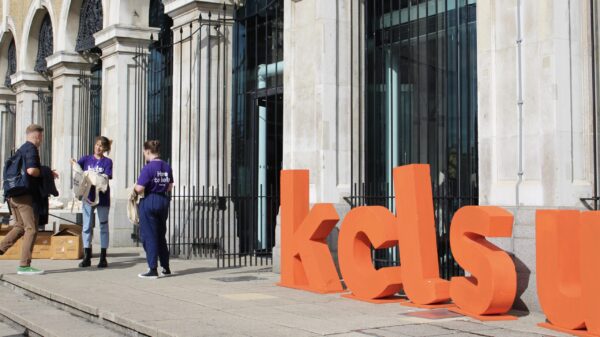
King’s College London Student Union (KCLSU) has seen a 6.6% increase in student societies, and 5.2% increase in paid memberships over the previous academic year. Some 20 new societies were created and 600 memberships bought by the end of term one this academic year.
This article was originally published in Roar’s Spring 2026 print edition.
According to a student survey conducted by Roar, 37.2% of students mainly attend academic events (including Activity Group based talks, Guest Speaker events and trips), followed closely by 30.2% sports-related events (including playing and/or watching KCLSU associated sports), and 27.9% prefer social functions (including balls, quiz nights and alcoholic-based events).
The survey identified that 62.8% were paying members of two or more societies ranging from Academic Associations, Sports Clubs and Activity Groups.
Moreover, survey findings suggest that 58.1% of students declare that they attend society events for which they do not pay a membership as they only attend a few events. This could suggest that events have broadened in choice for students. Therefore, students do not limit themselves to societies they are paying memberships for.
Unsurprisingly, the Activity Group category confronted the biggest increase; with a 7.2% rise in societies and a 5.9% increase in paid memberships.
Ahead of the KCLSU elections for the academic year 2026/27, Roar spoke to some society committees whose societies were recently ratified or are seeking ratification from the KCLSU for the upcoming year.
At the King’s Union Society, founder and president, Mustafa Dassu, said the society seeks to establish a free debating society promoting a “forum in line with the university” in order to encourage free speech. Thus far, the society has hosted many debates covering controversial topics including the US intervention in Venezuela, regime change in Iran and socialism versus capitalism.
Another society, Freedom of Religious Belief Society (FoRB), was ratified earlier this academic year, hosting a number of events for their members from Guest Speaker panels to trips to Parliament to attend hearings of the All-Party Parliamentary Group (APPG) for International Freedom of Religion or Belief.
Co-Founder and Co-President, Mollie Lane-Winter told Roar they founded the society as they saw a gap in student engagement on the issue, suggesting that the society created a necessary space for students to engage in discussions around religion.
Societies have also diversified the events they host. 48.8% of the students sampled said this diversity has improved their overall student experience. This figure maps closely to the National Student Survey (NSS) 2025, in which KCLSU scored 49.2%, a 1.2% increase from the previous year.
As societies continue to diversify their events with the aim of improving student experience, many are subject to debate and controversy.
Will Andrews, President of KCL Politics Society, explained that the society has experienced a large demand for big speaker events. Notable speakers so far this year include Richard Tice (MP for Boston and Skegness and Deputy Leader of Reform UK), Zack Polanski (Leader of the Green Party of England and Wales) and Bernd Lucke (Co-Founder of the AfD).
Andrews, who chaired several such events, argued the society “has had some controversy at times, but, on the whole [they’ve] had a successful year.”
This controversy refers to the presence of student protests and opposition attending the speaker events. During the Richard Tice event, hecklers branded the Deputy Reform Leader as a “Nazi”, as security had to intervene and remove students.
Despite controversies on speaker events, the society has hosted many social events, international trips and a charity fundraiser to engage with students across the political spectrum. KCL Politics Society asserts it is the largest student political society in London.
Adrija Zaman, Head of Events for KCL Diplomacy Society, had similarly found difficulties in holding events with politically sensitive figures such as the Palestinian Ambassador.
Although there are events offered by societies that cater towards both pro-Palestine and Zionist students, the representative said they have had to introduce a code of conduct to be “sensitive towards such a complicated issue” so as to avoid hostility between members, other students and the university.
About the author