Staff Writer Daniel Saldaña explores the geopolitical agency of universities—in particular, KCL.
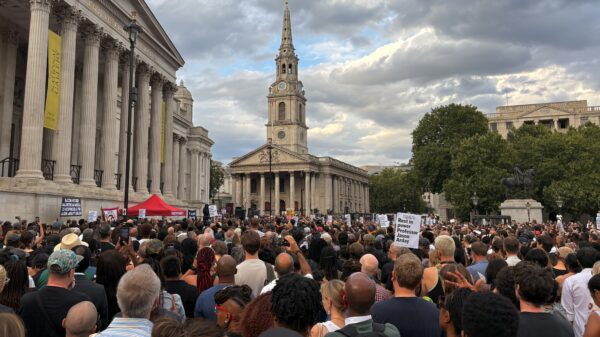
Universities present themselves as a space for calm debate, removed from the noise of real-world politics and with a clear objective: to teach critical, original thinking. However, university campuses are simultaneously the main stages for protests and occupations, which can lead to sharply uncomfortable confrontations, as demonstrated by the encampments and sit-ins for Gaza at King’s College London (KCL) and other British academic institutions. These protest actions indicate these institutions have ceased to be perceived by students and society as neutral actors.
No one protests against an irrelevant institution, but rather against one that holds an inherent political position. The university is not on the sidelines of the world’s major geopolitical conflicts: it has agency within them.
Furthermore, neutrality can be perceived as a form of tacit consent. The protests at Strand and other campuses around the city are symptomatic of this growing awareness within the student body, with the May 2024 Strand encampment and boycott and divestment campaigns linked to the ongoing conflict in Gaza.
Academic institutions in the UK have long been linked to tensions in the international order. Amidst the decolonisation processes of the 1950s and beyond, disciplines were reformulated, from international relations to economics. London classrooms hosted debates about territories that were ceasing to be colonies, whilst students from these colonies entered these institutions, analysing the world from the British imperial centre. KCL archives from the 1960s show student activism strongly focused on decolonisation and nuclear disarmament.
The institution was not merely an outside observer, but rather thought about, taught and legitimised this knowledge, which would later circulate in colonial administrations and newly independent states. As such, KCL not only had a responsibility to shape the knowledge paradigm and analysis, but also to put this knowledge into practice.
However, as an institutional voice, the university never presented itself as a clear geopolitical actor, yet still flexed soft power in choosing objectivity and academic neutrality. This narrative claim remains relevant today in KCL’s current policy is of “values-based impartiality”, where it will “not express a view, save where it directly impacts the security and safety of our staff and students” and in a context when many university administrations insist on “institutional neutrality” as a shield. But this is a dangerous illusion.
Academic institutions not only study geopolitics, they also practice it. If ‘everything is politics,’ then universities wield significant power with every institutional action. Who they collaborate with, what they research, and which conflicts they choose to analyse in greater depth (and which they do not) transfers into the international system. Pretending these institutions are neutral agents is not merely naive; it is a convenient way to avoid political responsibility.
Under the guise of objectivity, students linked to certain causes are sanctioned. Usama Ghanem was officially suspended by KCL in relation to his conduct during protests (the details of which have not been disclosed by the university). KCL also launched disciplinary action against 28 students for alleged actions relating to their pro-Palestine activism.
Furthermore, King’s has faced criticism for its engagement with the defence sector: from hosting the London Defence Conference on campus to maintaining research and policy collaborations with the security and defence field, whilst simultaneously publicising measures to end direct investments in arms suppliers to Israel. This coexistence of divestment announcements with highly visible defence-focused collaborations raises questions regarding how the university can symbolically legitimise specific geopolitical agendas whilst claiming neutrality.
Recognising KCL as a geopolitical actor does not imply the university should be politicised, much less sacrifice its academic freedom. Rather, it means accepting that conducting research, teaching and collaboration in a profoundly unequal and globalised world can never be an isolated act. Campuses act as geopolitically discursive and active spaces where boundaries are negotiated around contested conceptions of global justice.
Recent protests make visible a continuing dynamic that must be acknowledged: students have a voice and need more ownership of our educational space and to be centred in debates about freedom of expression and international conflict. KCL is not just a place where the world is passively studied: it produces this world and shapes the minds that may one day make decisions to change or improve it. Accepting this does not make the institution less academic, it makes it more responsible. It pushes for a rethink of KCL’s role as an institution situated at the heart of analysis of – and a possible shift in – contemporary global geopolitical disputes.
For more opinion writing, click here.
About the author