Staff Writer Jack Ford examines the Belt and Road Initiative’s stated aims against its record, asking whether the programme lives up to its own theory, and whether it could be called an imperial project.
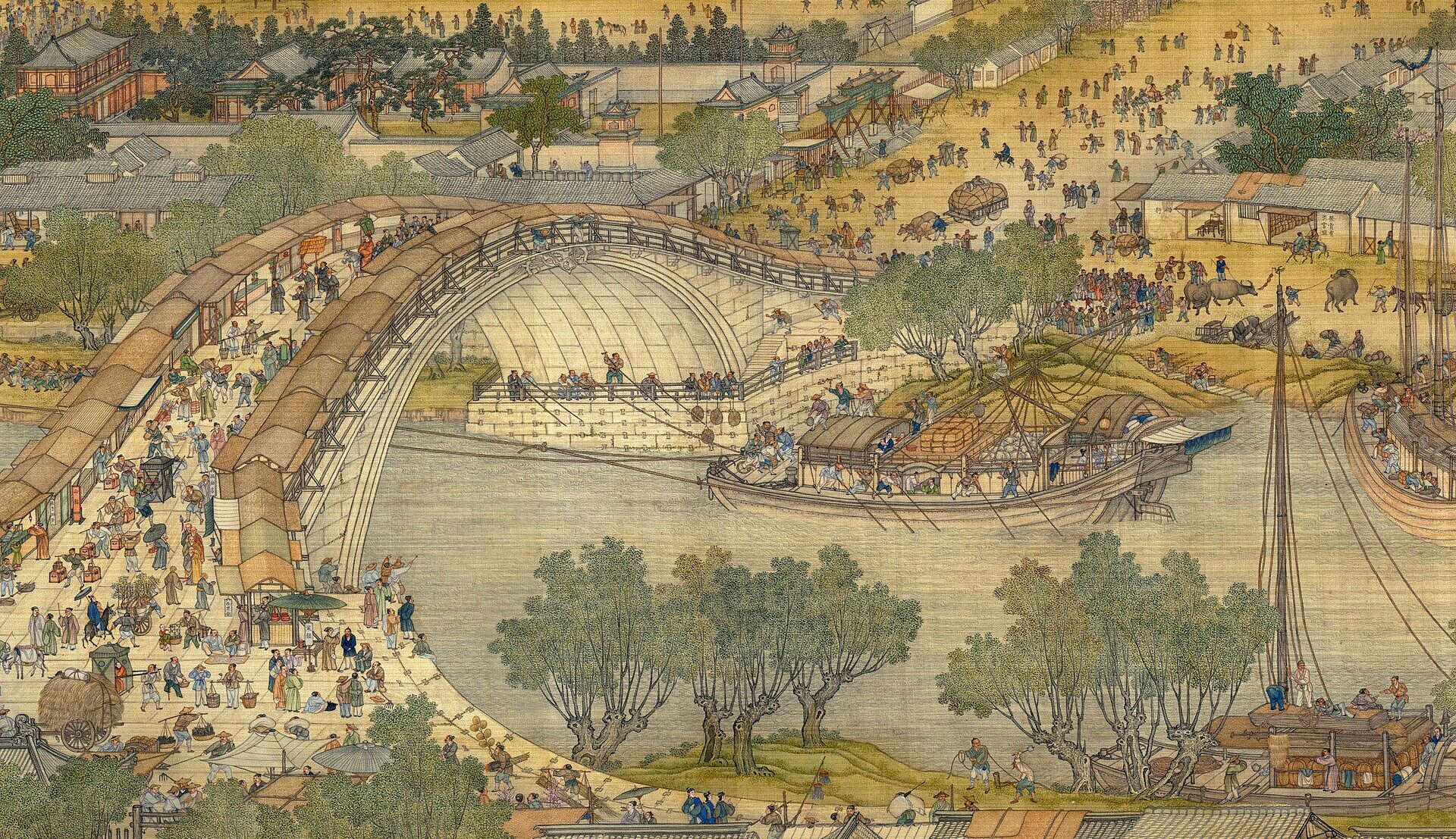
A caravan of a hundred men proceeds along the Hexi corridor. Flanked by barren and undulating terrain, the corridor stretches fertile over a thousand kilometres. The men are laden with cavalry bows, and among them is Zhang Qian – a palace officer. They hope to forge an alliance to end a bitter conflict. This mission yielded death for most, and prolonged capture for the few who survived, and set into motion Zhang Qian’s painful transformation into a national hero. The fated palace officer, turned military commander, turned chief imperial envoy, was instrumental in the creation of the Silk Road – a six thousand kilometre network of trade routes that endured for over 1500 years. From Chang’an to the Mediterranean, the deep ringing of camel bells was a rhythmic fixture, and the fragrance of spice hung thick in the air.
It was this imagery that Chinese President and Communist Party General Secretary Xi Jinping evoked at the founding of the Belt and Road Initiative in 2013. In two founding speeches, the first in Astana and the second in Jakarta, the project’s initial ambitions were revealed. Emerging from the shadow of the ‘Century of Humiliation’, wherein China was subject to colonial extraction and imperial invasion, the BRI is the latest major instrument in ‘Opening Up’ China to the wider world. Its scope was regional, but it signalled a qualitative geopolitical transition from ‘passive participation’ to ‘global cooperation’. Even in this embryonic state, the Belt and Road Initiative was posited as the beginnings of a return to the splendour of the Silk Road.
A decade later, the third Belt and Road Forum was hosted in Beijing. The scope of the initiative had rapidly enlarged, becoming China’s grand arrival onto the world stage. The BRI had touched 155 countries, and had seen an overall investment of over $1 trillion. This scope stretched across nations encompassing 75% of the global population, and over half of global GDP – a ‘rebirth’ beyond the range of the ancient Silk Road. Immense infrastructural mega-projects, from Pakistan to Kenya to Indonesia, framed this period of growth.
This notion of ‘rebirth’ is narratively compelling – an ascendent China recapturing the grandeur of the ancient Silk Road. However, how does this image fare in contact with reality? The BRI’s direction has seemingly altered in recent years to ‘small and beautiful’ projects – concerned with manufacturing and green energy, meanwhile Western commentators raise fears of Chinese ‘debt traps’, and an economic imperialism. This raises some important questions: Are these critiques valid? How does China’s rise to global prominence impact the rest of the developing world? And is the BRI an imperialistic programme?
To evaluate the truth of the Chinese vision, we will first analyse how the BRI justifies and advocates itself, using government documents, a Party-School journal, and a National Social Science Fund project. We will also draw on Roland Boer’s ‘Socialism with Chinese Characteristics’, as it explores some more official Chinese-language sources surrounding the BRI. Using these documents, we can better understand the professed nature of the initiative. Then, we will turn to empirical reality – its real-world impact, the question of ‘debt traps’, and using data to parallel the theory. Through this process, we will begin to understand whether the Belt and Road Initiative is imperialistic, and whether its theoretical vision holds up to reality.
The BRI in Theory
The Belt and Road Initiative is theorised along two parallel tracks. Party-School academics and NSSF funded scholarship state that its foundational pillar is Marxist economic principles. Hence, they view the BRI as continuing the research, left unfinished by earlier Marxist thinkers, through practice. Meanwhile, official policy documents speak on the importance of international connectivity and mutual benefit in a market liberal tone, devoid of any Marxist framing. This begs the question – is such a framing a retrospective addition, or the engine actually driving the programme’s development?
Both Communist Party sources and Party-School academics describe the Belt and Road Initiative as China’s attempt to develop a ‘higher-level open economy’. This is achieved through a proactive self-integration into the world system, centred on ‘equality, mutual benefit, and win-win (‘gongying’) results’, outcomes wherein both parties derive value. It positions itself in fundamental opposition to capitalistic plunder through ‘colonialism’, and the systemic process of Unequal Exchange (explored more deeply in my article ‘Trade, Treats, & Fascism‘). This ‘higher level open economy’ emphasises a top level design ‘grounded in regional history and economy’.
The CPC framing of the BRI is that the project hopes to create a ‘new model of the international division of labour’, based on a ‘mutual complementarity’. This entails the leverage of respective national advantages, and (explored to a greater extent in the Party-School scholarship) opposes the resource extraction of ‘capitalist globalisation’. This opposition to resource extraction is seen as a more equitable terrain for international relations.
This terrain is said to emphasise the Five Connections (wǔ tōng): policy coordination, infrastructure connectivity, unimpeded trade, financial integration, and people-to-people bonds. The contradiction driving this Initiative is considered to be between a ‘goal of global connectivity’ (achieving the ‘Five Connections’), and the lack of solid material foundation for this connectivity (a lack which the BRI is trying to resolve).
Beginning truly in the ‘new normal’ (xīn cháng tài) phase – a period marking the transition from ultra-fast growth to a more sustainable model – the Belt and Road is understood as a ‘new form of globalisation’, aiming to act in the ‘common interests of humanity’, and ‘build a community with a shared future for mankind’. Both Party-School and Official registers converge on the concept of sovereignty – a central emphasis on the mutual respect for the self-determination of all nations.
The programme is also intended to develop domestic and international productive forces. It is said to act twofold on a domestic level, helping China cope with the strains of its socialist market economy, while aiding in coordinated development of China’s historically underdeveloped zones: primarily the North East and Central Regions.
The Party-School scholarship states that the socialist market economy has yielded an ‘enormous productive capacity’, but suffers limited domestic demand. This is an excess which can be resolved through the ‘expansion of overseas market capacity’ (increasing global trade and investment). This expansion is said to help channel productive capacities toward countries in need of industrialisation and infrastructure, while acting toward ‘stabilising the global economic situation’, and ‘rebalancing it’, while respecting ‘socialist and international value theory’.
The BRI in practice
‘Debt Trap Diplomacy’
In the real world, the Belt and Road initiative overwhelmingly takes the form of lending from the Chinese government to developing nations: hence, the nature of these loans needs to be explored.
The common conception of the Belt-and-Road Initiative as a form of ‘Debt-Trap Diplomacy’ has its roots in a 2017 article published by Indian professor Brahma Chellaney. This idea became incredibly popular in Western media and government circles, painting China as a predatory creditor, looking to leverage unsustainable debt over developing nations.
This claim that China engaged in deliberate debt-trap diplomacy is largely recognised as a ‘meme’, forwarded through negativity bias, lacking any empirical basis. In a 2020 study conducted by Prof. Deborah Brautigam, drawing on a large database of African loans and wider global cases, no deliberate entrapment can be evidenced. The case-study of Sri Lanka’s Hambantota Port is oft cited as an irrefutable proof of ‘Debt Trap Diplomacy’, yet its 99-year lease of the port to Chinese firms was to pay off Western debt, not lower-interest Chinese loans.
Brautigam also covers the cases of Angola and Venezuela which are also raised as ‘evidence’, despite the former being a success story, and the latter cited as a ‘lending trap’ for China. Chinese lenders often engage in debt restructuring, deferral, and interest write-offs, while the seizure of assets is practically non-existent in reality. Perception polls from Africa also reflect a majority of respondents, particularly in Nigeria, held favourable views of China as a partner for development (as of 2020). China’s role in Africa is a significant topic of discussion, and will be the subject of a more comprehensive article.
Even though the mainstream inception of BRI skepticism was founded upon a misconception, the question of the nature of the initiative remains a subject of heated debate, particularly in the realm of whether it should be classified as an ‘imperial project’.
An Imperial Project?
A common argument in academic circles is embodied in Ho-fung Hung’s “Clash of Empires“, which parallels the contemporary US-China dynamic with the inter-imperialist rivalry between the UK and Germany in the early-twentieth century. This dynamic of rivalry is rooted in ‘changing relationships between corporations’: a Chinese state-backed corporate squeeze forcing the US out of domestic and global markets, through mechanisms like the BRI.
This squeeze takes the form of market share shifting toward Chinese firms (at the expense of Western firms), and ‘Intellectual Property Theft’. The source states that the US-China dynamic is a ‘structural conflict between two capitalist empires’. Interestingly, just as the Party-School journal, Hung cites ‘industrial overcapacity’, and a crisis of ‘over-accumulation’ as a driving force behind the BRI, and other Chinese geopolitical programmes.
Professors Li & Kotz take a different approach: the crucial counterpoint to Hung’s narrative is the nature of China’s economic system – a subject I covered on a deeper theoretical basis in the first article of this series. China’s economy is governed by a socialist state utilising the market as a tool for development – a ‘mixed economy’. They argue the absence of a ruling capitalist class within Chinese society means that incentives are governed in a wholly different structure. To develop this argument further, private capital is not absent from the Chinese system, it is ultimately subservient to the Party structure with state discipline of the private sector a well-known phenomenon (namely in the ‘Ant Group’ IPO suspension). The activity of capital is strictly regulated and under the purview of the government.
Therefore BRI projects and lending, which are almost completely funded by state-run policy-banks, are bound to governmentally aligned goals – not the seeking of maximal profits which drives the imperial processes of capital. Said goals of the state can be meaningfully accomplished through ‘mutual benefit’, not via a ‘costly process’ of imperial control.
In my reading, this ‘mixed economy’ is naturally an imperfect, and ultimately transitory, system, however capital controls, state ownership of finance/banking, as well as core economic assets – energy, transport, land (which is either collectively or state-owned, and leased out), and an institutionalised ‘superiority of public ownership’ prevent capital from taking political primacy, even if an instrumental tool in development.
Since China operates under a non-capitalistic development logic, economic phenomena like the ‘export of overcapacity’ can be conducted under strict regulatory measures, and lending can be conducted abiding by state objectives, as opposed to seeking maximal return. China and the US have qualitatively different investments in the developing world: the former – infrastructure & productive investment, the latter – often a proponent of hazardous financialisation & speculation.
Unequal Exchange?
Measured through a ‘multi-regional input-output’ (MRIO) framework, China is classified as part of the Global South, and historically embodies one of the largest net drains of labour to the Global North – approximately one sixth of the North’s total net appropriation. As China has developed, its net loss to the Global North has lessened owing to improved wages and technology. Despite this, it is still in a net ‘exploited’ position.
As China develops, many have described its status as semi-periphery – essentially a middle ground between North and South. The notion of China being a semi-peripheral nation needs deeper theoretical exploration that this article hasn’t the space to explore.
Theory Against Reality
I would argue the BRI cannot be classified as an imperialistic programme – lacking evidence of debt trapping of BRI partners. More indirect forms of imperial exploitation cannot be evidenced through the BRI’s loaning or contract-design practices. China’s material interests lie in stable supply relationships, and market access, not in cruder forms of imperial expansion. Wider Chinese foreign policy, and China’s role as a potentially exploitative semi-peripheral power (particularly with respect to Africa) will be covered soon in a following article. Nonetheless, the initiative does fail to live up to many of its theoretical claims.
Though the size of unreported loans to developing countries is much smaller than initially thought, ‘Hidden Debt’, as well as an ‘unusual loan confidentiality’ post-2014, do raise the question of the standard of Chinese loans. This question is made evermore poignant by loans carrying commercial interest rates (at a 3.2% average) – higher than the terms of other large national lenders. This could be considered a design to manage credit risk, discourage ‘aid dependency’, or reduce the burden on the Chinese domestic taxpayer, however when it is also combined with issues surrounding confidentiality, it does bring into question the transparency and accountability of Chinese loans.
BRI loans often also contain a ‘creative design‘ – clauses that demand repayment following significant policy changes, and restricting borrowers from use of collective loan restructuring, via the Paris Club. These restrictions on the actions of debtor nations are justified by China as a tool for risk-mitigation and protection of state assets. However, they do also beg the question of whether they restrict the financial sovereignty of debtors.
Facing Reality
China’s Belt and Road Initiative is neither imperialistic, nor a form of idealised ‘win-win’ altruism. It is a state-directed, pragmatic development framework, which attempts to tackle the monumental challenge of balancing domestic industrial strategy with commercial risk management in a volatile global market.
This gap between theory and reality, with problems surrounding debt distress and risk exposure, has directly shaped the BRI into its contemporary “small and beautiful” form. Even as investment in the BRI grows, this change is a pivot to smaller, greener, more risk-averse projects – a break from the initial trend of riskier, mega-scale sovereign loans.
The Belt and Road is not a static ‘imperial’ master-plan but a form of adaptive foreign policy. The harsh world of global finance often casts ideological rhetoric asunder: a vision of a ‘harmonious Silk Road reborn‘ forced to reckon with reality.
For more Comments and Feature pieces click here.
About the author