Staff writer Sarah Marlowe sat down with bookstore owner Soichi to talk about how he balances his unique double life: working in corporate accounting on weekdays and co-running a bookstore in Tokyo on weekends.
A Weekend Bookstore in Old Tokyo
Jimbocho, Tokyo, a neighbourhood just 10 minutes by subway from Tokyo Station, was named the “World’s Coolest Neighbourhood” by Time Out magazine in 2025, thanks to its roughly 130 second-hand bookstores, among the highest concentrations of such stores in the world. Unlike Shinjuku or Shibuya, districts known for Tokyo’s neon-lit shopping and entertainment, Jimbocho’s identity is built on books, drawing readers and browsers from around the world.
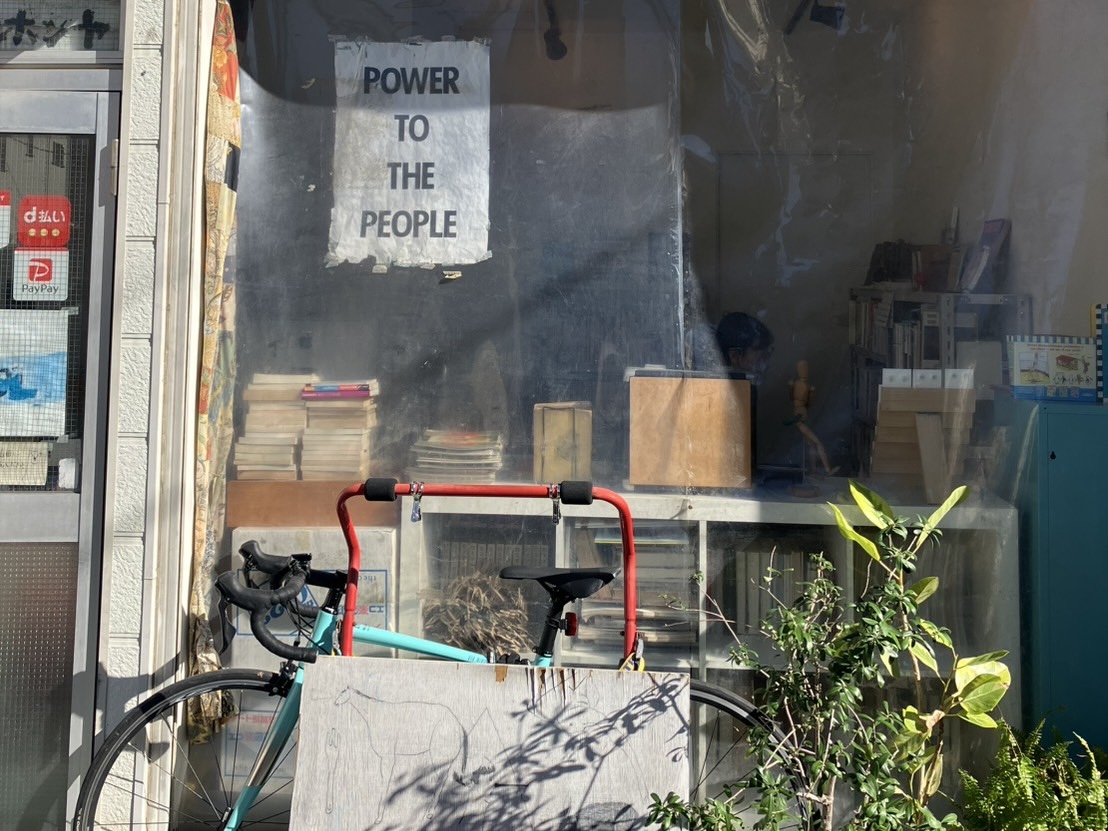
But Jimbocho isn’t the only town where Tokyo’s book culture thrives. 15 minutes northeast lies Nezu, a quieter part of the city where old eateries and the historic Nezu Shrine still shape the streetscape. Tucked into one of its backstreets is ‘Tanaka Hon’ya‘—Japanese for ‘Tanaka’s Bookstore’—a small shop that opens only on weekends. The space is snug, with sunlight pouring in through a large window and washing the white walls in soft light.
Tanaka Hon’ya is both a second-hand bookstore and a gallery space. Since opening in 2012, it has hosted events alongside its book business, from wall art displays to film screenings. Most recently, in July 2026, it held an exhibition by six art university students. Speaking to Soichi, a 2024 graduate of King’s College London (KCL), who has been co-running the shop with founder Koji Tanaka since February 2026, we discussed how he operates the bookstore and his motivations for doing so.
“I Didn’t Want to Give Up on the Things I Love”
On weekdays, you’ll find Soichi, a humble office worker behind a desk in Tokyo’s financial district, working in corporate accounting. On weekends, he takes on the responsibilities of a shop owner in his hometown of Nezu—handling management, book curation, and staffing.
At King’s, Soichi studied Philosophy, Politics, and Economics (PPE). Although economics may have helped him navigate Japan’s rigid graduate hiring system, it was cultural interests that mattered to him most. He’d always loved reading and film—the kind of activities that invite deep reflection. He took that further during his studies, wrestling with philosophical questions, which became one of the most rewarding parts of his university years. That same intellectual curiosity shows up on the shelves he curates at Tanaka Hon’ya, filled with ethics classics like Kant’s Groundwork of the Metaphysics of Morals, Nietzsche’s On the Genealogy of Morals, and Kitaro Nishida’s An Inquiry into the Good.
Even after starting his corporate career, Soichi wanted to carve out time for cultural pursuits amid his hectic schedule. Tanaka’s invitation to become a co-owner was the perfect vehicle for that ambition, since he’d already held a solo painting exhibition there in 2024. “My vision came to life sooner than expected. I got to stay in the corporate world and never gave up on my intellectual curiosity,” says Soichi.
His driving motivation at Tanaka Hon’ya is to create a space where he can feel alive. He selects books, arranges them on the shelves, chats with customers, and records his podcast. Through it all, he spends his weekends in unhurried reflection. Looking ahead, Soichi is excited to participate in the upcoming Gunsan Book Fair 2026 in Korea, from August 29 to 30—a milestone marking the shop’s first venture beyond Japan.
In this dual life, these weekend hours offer slow moments with visitors, something absent from a corporate world dictated by efficiency and profit.


Speaking on the bookstore owner, Tanaka, Soichi says: “He reminds me of the protagonist in the Academy Award-nominated film Perfect Days (2023).” Hirayama sticks to his plain routine seemingly by choice, thereby keeping a distance from a profit-driven, consumption-heavy society. Soichi sees something of that same quality in Tanaka.
Tanaka, for his part, has his own take on Soichi: “It’s rare to see someone who works at a big corporation pour this much time into something as unprofitable as a used bookstore”.
A Writer’s Afterthought
When I first heard the news of Soichi starting as co-owner, I felt something like hope. Having studied philosophy and ethics for the past six years, I am now approaching graduation and the start of my full-time career in Japan. This transition has left me wondering: will I still have the capacity to feed my hunger to know and think once I’m working?
For a while, I feared I was alone in this anxiety. But I was not. Literary critic and author of the 2024 hit book Why Can’t We Read After We Start Working?, Kaho Miyake, struck a nerve by starkly pointing out a harsh reality many of us face: once we step into the labour market, the pursuit of a cultured life becomes nearly impossible to sustain. Yet, Soichi’s story offers a different perspective, inspiring me to believe that finding that balance might be possible after all.
About the author