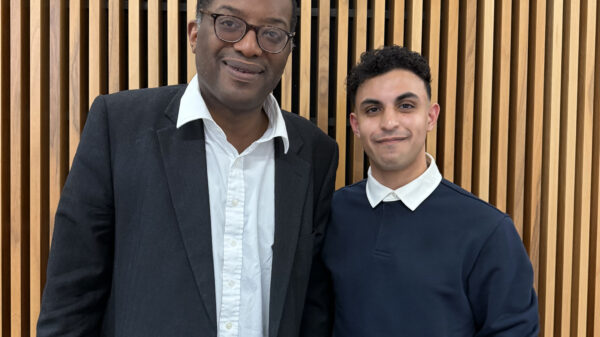
Staff Writer Viktoria Levkanicova talks to 2009 Nobel Prize laureate Dr Venki Ramakrishnan about all things structural biology.
This article was originally published in print on 28 November.
After the first half of what was turning out to be a hectic first day at New Scientist Live, the press lounge became the backdrop for an interview with one of the most influential people in structural biology: Dr Venki Ramakrishnan.
Dr Venki Ramakrishnan discovered the structure of the ribosome—a crucial piece of cellular machinery responsible for the expression of genes, and won the 2009 Nobel Prize for Chemistry, alongside Thomas Steitz and Ada E. Yonath. Dr Ramakrishnan also served as the President of the Royal Society between 2015 and 2020. He took a moment to chat with Roar News before his talk on the human fight against ageing.
The ribosome is a huge molecular factory, made up of more than 50 independent protein ‘cogs’. All these cogs work in synchrony, translating long strands of mRNA (transcribed genes) and synthesising them into ribosomes — the final products which make our bodies tick. Resolving the structure of such a complicated system is vital to our modern-day understanding of biology and genetics.
Dr Ramakrishnan’s journey of discovery started in the 1970s with Peter Moore and Joan Steitz, whom he initially met at Yale University. Eventually, a collaboration with Moore and Steitz’s husband, Thomas Steitz, culminated in Ramakrishnan’s Nobel Prize in Chemistry.
He described how they used a “modular approach”, similar to building a Lego set, to try and illuminate the final structure. “Steve White, a former colleague of mine, and I decided to solve the structure of individual ribosomal proteins, but it wasn’t very satisfying because it didn’t really tell you about how the ribosome worked. We had to understand it in context,” he said.
The breakthrough didn’t come until Dr. Ramakrishnan went on a well-deserved sabbatical at the MRC Laboratory of Molecular Biology (LMB), where he now functions as a principal investigator. He said: “I brought some data with me to solve a structure by a technique called Multiwavelength anomalous diffraction, which is a technique that you can use on Synchrotrons.”
Synchrotrons are giant, ultra-powerful microscopes. They accelerate electrons to nearly the speed of light, before using them to resolve structures to a molecular level. “The synchrotron from that structure was so good that I thought that the method could be used to solve something very large, like the ribosome, and that is in fact what turned out to be correct,” he told Roar.
The technology necessary for this discovery is analogous to the technological advances we see nowadays with predictive AI. For instance, take AlphaFold 3, the program that won the most recent Nobel prize in Chemistry.
Predictive models work akin to expert puzzle solvers. They deduce a 3D structure of a protein based on the molecular information we give them. This increased computational power could be invaluable in the discovery of novel drug targets and therapeutics, although the accuracy and use of this model are still hotly debated among scientists.
Dr Ramakrishnan is optimistic about the use of predictive AI in modern-day research. He said, “I think AlphaFold is a fantastic tool and it’s been used by structural biologists, cell biologists – by lots of people… The next challenge for AlphaFold is putting those structures in context and being able to visualise how the protein interacts with its targets. There have been some successes with AlphaFold3 when it comes to smaller structures, but the bulk of the work is still very much experimental.”
As the conversation drew to a close, Dr. Ramakrishnan looked back and evaluated the development of the field, and where an undergraduate student interested in the molecular mechanics of life might find their place. He predicted the end of structural biology as a field. “In the old days, you could spend 20 years trying to solve a structure. That era has disappeared. So, you could think of structural development as simply a stage in solving a problem,” he continued, “I would suggest that young scientists focus on real biological questions and learn the tools they need to attack that problem.”
For more of Roar’s coverage of New Scientist Live 2024, click here.
About the author