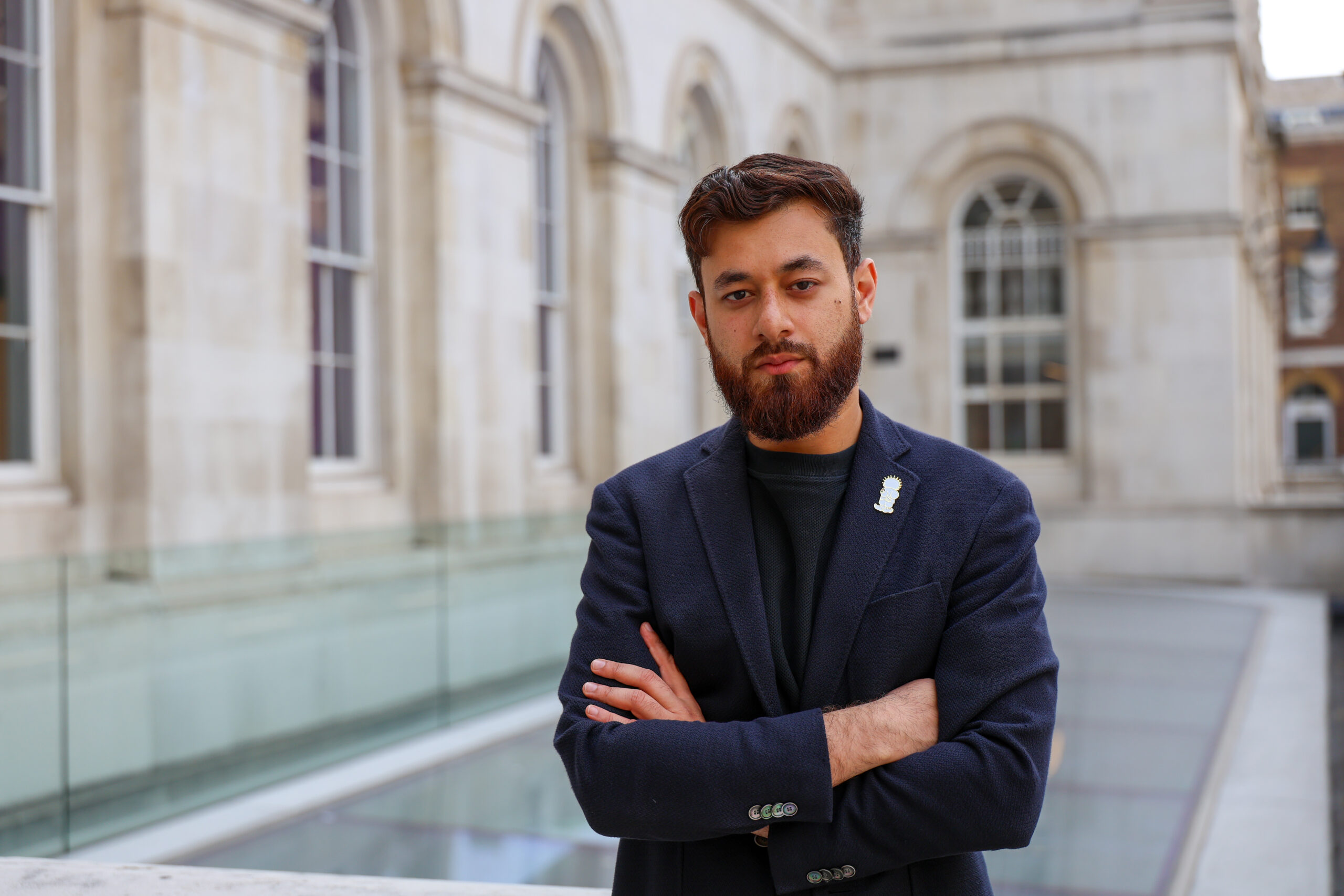
In his first sit-down interview as KCLSU president, Dr Luqmaan Waqar committed to an independent inquiry into 26 disciplinary cases involving pro-Palestine demonstrators, pledged to push for emergency funding to cut King’s counselling wait times, and vowed to embed student voice into major decisions – including a review of KCL’s Ethical Investment Policy.
Waqar committed to the “independent and impartial” inquiry after a joint-investigation by Al Jazeera and Liberty Investigates reported that at least 26 King’s students faced disciplinary action following pro-Palestine protest activity. This was the highest number of disciplinary cases among UK universities from which data was received.
At the time, Waqar commented that while some cases required attention for security or safety concerns, in many instances the university appeared to “weaponise arbitrary investigations to dissuade participation in protest”.
King’s disputed this characterisation, telling Roar that it does not discipline students over lawful affiliations, including pro-Palestine views or lawful protest, and that disciplinary measures are taken only in response to conduct that threatens the safety or freedom of expression of others.
Speaking to Roar, Waqar was more tentative, declining to draw a firm conclusion on the 26 cases beyond noting two possibilities: that King’s had been harsher than other universities, or that “a lot of question marks and grey area around freedom of expression at King’s” had led students unaware they had broken policy into “intimidating” investigations.
Only an independent inquiry, he said, could determine whether King’s had been consistent in its approach to the pro-Palestine demonstrators.
“I’m going to support, as the president of KCLSU, an independent investigation, but also institute a student and staff task force to determine a definition of freedom of expression at King’s”, he said.
He added that the aim is that “there is as little as possible grey area that is not then exploited to institute a chilling effect.”
Waqar will also co-chair a separate university working group on freedom of expression, alongside KCL’s newly appointed Vice-Principal for the issue, where he said the inquiry and a clear definition of free expression would be his priorities.
Freedom of expression at King’s is not only a concern for students. In November 2025, members of KCL’s Universities and Colleges Union branch (KCL UCU), the main trade union for academics, backed a ballot on academic freedom – which won 70.5% support but narrowly missed the turnout threshold for industrial action – partially prompted by the treatment of Gazan Palestinian academic Dr Rana Baker.
Baker’s case had already drawn national media attention before the ballot. In 2024, a student secretly recorded one of her seminars on post-colonial approaches to Middle East history – in which she paired an extract from a Hamas document with counter-texts from Israeli historical figures, such as Ze’ev Jabotinsky’s Iron Wall – and complained to King’s.
After the university dismissed the complaint, the student shared the recording with the Jewish Chronicle. After the paper published a story on it, King’s reopened its investigation into Baker. She was later cleared a second time.
The story prompted a wave of further coverage in national media, and a campus protest against Baker, with posters bearing her photo crossed out in red and reading “Ban. Rana. Baker.”
Waqar linked Baker’s case to that of Professor Jason Arday, a University of Cambridge professor who was found dead on 14 August, following weeks of intense media scrutiny.
The scrutiny began after a Substack post by Nathan Cofnas, a self-defined “race realist” previously sacked by Cambridge, prompted a Telegraph investigation alleging plagiarism in Arday’s thesis – a claim he denied. Critics, including Cambridge’s chancellor, argued that the coverage was driven by racism.
“What makes the Professor Arday case so powerful and moving, and what drove us to put together that statement, wasn’t just solidarity with that individual case, but to draw a line in the sand… a recognition that this isn’t the first time there’s been trial by media for academics, particularly vulnerable academics.”
Waqar said both were racialised – Baker over being Palestinian and from Gaza, Arday “specifically as a black man”.
“They were specifically racialised, and that was then used as a way to discredit them”, he added.
He concluded, “This is something we need to keep front and centre going forward: how do we create a space where students and staff can exercise their freedom of speech without putting people at risk in that manner?”
Divestment and Cranfield Merger
After a prolonged campaign by students and negotiation by KCLSU officers, King’s added a controversial weapons clause to its Ethical Investment Policy in late July 2024, formalised in November 2024.
However, according to a report by the KCL BDS Forum and an investigation by Roar, the university appeared to continue investing in companies in breach of its ethical investment policy.
Roar‘s investigation found King’s still held over £350,000 in companies on the UN’s blacklist of firms operating in the occupied Palestinian territories, as well as a small stake in a firm linked to white phosphorus procurement for the US government – in apparent breach of a clause of their own ethical investment policy.
King’s maintains that the investments were held indirectly and screened by a “specialist agency” on behalf of the university and that none of the companies identified in that investigation had been flagged by the agency’s screening process as breaching its exclusions.
According to the university, the agency proactively screens funds to avoid “controversial and unethical sectors” while also investing in funds that actively target positive social investments.
In March 2025, KCLSU members voted to go further: 89.37% of the 1,924 students who cast a ballot backed a ‘corporate conclusion’ calling on King’s to divest from any investment linked to arms or military technology development, or to companies implicated in human rights violations.
Having previously been involved in divestment negotiations as part of the KCL UCU, Waqar asserted plans to reopen discussions.
He attributed his approach to the structural leverage of the presidency – a fixed seat on KCL Council and the Finance Committee, rather than relying on protest to force a seat at the table.
He declined to detail specific tactics, but said that “the core issue previously was that whether through the movements or staff unions, we were entirely dependent on KCL [to engage with discussions].”
“But now there’s a firm position on the table to consistently keep this as a core agenda point,” he added.
Asked what had gone wrong in the negotiations that followed the May 2024 encampment, he refused to call the process a failure, arguing that the campaigning itself had value regardless of outcome.
Waqar also said that he considered KCL’s planned merger with Cranfield University – an institution with significant defence research and consultancy interests – “concerning”.
He tied that concern to a wider complaint running across divestment, the Cranfield merger and KCL’s new membership of the Defence Universities Alliance: a lack of student consultation.
“I think the core issue here has been a notable lack of student voice in these decision-making processes – whether that’s the recent Defence Universities Alliance, or KCL’s merger with Cranfield University, which prides itself on its defence education, research and consultancy,” he said.
He added, “If students had been consulted, a lot of the opinion I’ve shared previously – the student conclusions we’ve had at King’s – would have been reflected in that decision-making.”
Separately, Waqar pointed to King’s stalled framework for supporting the rebuilding of Gaza’s higher education sector, which he framed as part of a wider institutional response to what UN experts have termed ‘scholasticide’ – a term they defined as “the systemic obliteration of education through the arrest, detention or killing of teachers, students and staff and the destruction of educational infrastructure.”
The destruction, per UN reporting, continued as Israel’s military operation in Gaza persisted, including the demolition of Israa University, the strip’s last remaining university, in January 2024. Waqar described the pattern as embedded within a wider genocide.
KCL’s support, he said, had scaled back from an original plan for several annual scholarships to one, now folded into the wider Sanctuary Programme, through which five students from Palestine have been supported this year.
“By their own admission, some members of senior leadership at King’s have admitted that the ball was dropped in that process,” he said.
Postgraduate researchers: pay and wellbeing
Waqar spent over five years at King’s, beginning his PhD on the links between loneliness and the mental health of postgraduate research students (PGRs), during the second COVID lockdown, in February 2021.
Over roughly the same period he worked as a graduate teaching assistant (GTA) from September 2021, and served as an executive student member of King’s branch of the University and College Union (KCL UCU), the main trade union representing academics. Thought to be KCLSU’s first PGR president, that combination of roles now feeds directly into several of his manifesto pledges, a first-year agenda he has said he does not expect to complete in a single term.
His now-completed PhD research found that loneliness – compounded for students in certain demographic groups – was the central driver of poor mental health among PGR students, with roughly a third experiencing depression and a third experiencing generalised anxiety disorder.
“It emerged that it was loneliness, not social isolation. No matter how much you try to mitigate it by surrounding yourself with people, it’s that psychological and emotional element of loneliness – the subjective experience of your desired and actual relationships – that’s the core issue.”
Waqar’s recommendations centred on reducing PGR students’ dependency on a single supervisory relationship and creating dedicated PGR social spaces, findings he says now inform his approach as president.
That same experience underpins his pledge to bring PhD stipends up to the London Living Wage, with King’s covering the gap for underfunded researchers.
Waqar pointed to a roughly 5% increase in UKRI-funded stipends secured through Russell Group-wide lobbying, which he said narrows the pool of students King’s itself would need to top up – self-funded PhD students in particular.
Asked how realistic the pledge was given King’s finances, he said, “Last I checked, King’s made a £40 million operational surplus last year [2024-25]. I don’t think they’re… in financial crisis. King’s seemed to be doing quite well.”
Waqar’s manifesto pledge on GTA pay focuses less on the hourly rate than on how that time is allocated. King’s already pays above the London Living Wage – £17.90 an hour against a living wage of £14.80 – but Waqar said GTAs are typically given only around 45 minutes to read, assess and provide feedback on an undergraduate assignment, which he said was insufficient.
“I’ve known of GTAs who’ve then used ChatGPT to generate feedback,” he said. “So then you’ve got this weird loop where you might get ChatGPT assignments marked by ChatGPT.”
Waqar said he would work with KCL UCU and the King’s Doctoral Students’ Association (KDSA) to pursue this aim.
Mental health and counselling
Last year, Roar found that average wait times for King’s counselling service had reached 16.7 working days in 2024/25 – a 44% increase on the year prior.
When asked how he would hold King’s accountable for fixing the counselling service, Waqar attributed the delay directly to counsellor workload.
He said, “I will, as president, demand immediate emergency funding for further triage for counsellors at King’s.”
He later clarified his position, after discussions with KCLSU: “I will press King’s for urgent additional investment to address counselling capacity and waiting times, and I intend to raise this at Council so that the scale of the issue and the University’s response receive appropriate senior scrutiny.”
A second issue is the gap between struggle and disclosure: only 6% of students disclosed mental health difficulties to their university, House of Commons research shows, yet Student Minds found 57% privately struggle, and over a quarter hold a clinical diagnosis.
“It’s obviously a shocking statistic, and it does perfectly track with my PGR research, where most did not disclose their mental health difficulties,” Waqar said.
He pointed to formalised peer support, discussed earlier in relation to his PGR research, as part of the solution to the disclosure gap specifically, arguing that trained peers could ease students through what he described as the bureaucratic burden of formally seeking help.
“It’s just making sure that these things are constantly being discussed, and that there is someone who will advocate for this – advocating for further funding, whether for counsellors in that specific instance, or addressing these major problems, to make sure that there is a university-wide approach,” he said.
Alleged Surveillance
In April, Al Jazeera and Liberty Investigates published a joint investigation which found 12 universities – including King’s – paid Horus, a private security consultancy, to gather intelligence on student activism.
According to a Freedom of Information response, another company – B3Sixty – was contracted to conduct independent disciplinary investigations on students.
He noted, however, that King’s had told him Horus was used for horizon scanning – identifying planned protests around campus – rather than for directly surveilling individual students.
Waqar also called for greater transparency from King’s about exactly what the services of companies like Horus and B3Sixty were being used for.
“It’s a major concern for freedom of speech and how students might feel the real chilling effect – and stifling of their freedom of speech – if they’re constantly feeling spied on – even if it’s one instance.”
He added, “We have seen the precedent of that across the country.”
He concluded, “If it is that King’s [is surveilling students], then 100% categorically, I do not support that, and I will speak out against it.”
Asked whether one year in office was enough to deliver on this scale of ambition – an independent inquiry, a divestment push, PGR pay reform, a mental health support overhaul, and a stand against third-party surveillance, among it – Waqar said he expects to seek a second term.
“For now, yes, I will probably run for a second term.”
A spokesperson for King’s College London said:
“We commend Dr Waqar’s advocacy for our students, and look forward to working with him during his tenure as KCLSU President to advance our shared belief that every student should thrive during their time at King’s.
“We have already begun to have constructive conversations with Dr Waqar, including to clarify that King’s has not carried out disciplinary action against any students on the basis of pro-Palestine views or activism, or any lawful freedom of expression, and that we do not carry out third-party surveillance on students, but use a horizon-scanning tool to collate publicly available information on events near campus.
“We have invited Dr Waqar to co-chair our freedom of expression group alongside our new Vice-Principal for Freedom of Expression, as well as to contribute his insights through his place on the University Council. We are proud of our strong relationship with KCLSU and look forward to building on that partnership over the year ahead.”
About the author