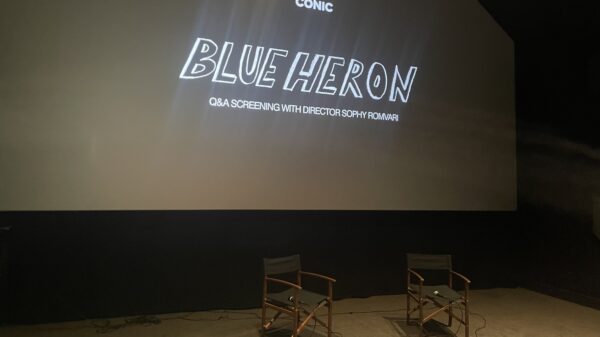
Staff Writer Thomas Deakin explores how the BFI London Film Festival 2024 simultaneously promises a bright future of cinema and warns about the consequences of clinging to its past, sharing his experience with ‘Blitz’, ‘Emilia Perez’ and ‘Anora’.
Upon accepting my offer to study at King’s this year, one of the first things that I did was getting a membership at the British Film Institute (BFI). This way, I could book tickets to some of the major premieres at the London Film Festival (LFF) as early as possible.
Fulfilling my high expectations as an avid cinephile, the three screenings that I attended were grandiose and monumental, which I thoroughly enjoyed. Going to a world premiere (Steve McQueen’s London-set World War II drama ‘Blitz’) and two UK premieres (Jacques Audiard’s modern cine-opera ‘Emilia Perez’ and Sean Baker’s Palme d’Or-winning tragicomedy ‘Anora’) as part of the festival, I was astonished by the scale of the screen at Royal Festival Hall. It was galvanising to be one of the first to see these films in the UK. This opportunity that enabled me to view them in a more objective light, devoid of too much external influence. Additionally, seeing prominent celebrities such as Saoirse Ronan, Sean Baker and Selena Gomez highlighted why going to a film festival feels so different – and perhaps more meaningful – than simply watching a movie in a cinema. Viewing a film in those circumstances grants a sense of personalisation and auteurism to the conversation by giving the creators the opportunity to speak about their work. This, in turn, reminds the audience that making a film in and of itself is an achievement worthy of praise, irregardless of its quality.
Unfortunately, when I remove the movies I saw from this festival bias, I have to acknowledge that only one of them truly moved me. While it was inspiring as an example of what cinema could become if it keeps improving, the other two seemed stuck in an inert state and tied to the conventions of the past.
Starting with the first and biggest of the three screenings, ‘Blitz’ ultimately left me with mixed feelings. Whilst the film itself was not without redeeming qualities, I was somewhat disappointed by how it overly adhered to surprisingly traditional and conventional narrative tropes associated with war and coming-of-age stories, especially for such a revolutionary director as Steve McQueen. On the other hand, I was impressed by the experimental use of special effects and repeated visual motifs to capture the entrapping atmosphere of the Blitz and how it destroyed the protagonist’s childhood innocence. Although I think that he could have delved deeper into the theme, I found McQueen’s exploration of a mixed-race child’s experience of wartime London interesting for how it emphasised the city’s simultaneous multi- and monoculturalism. I also admired the director’s sincere intentions to create a parallel with his own trauma and loss of innocence during his time as an official artist in the Iraq War in 2006. Still, these strengths were marred for me by the narrative’s frustratingly repetitive, stereotypical and tonally deaf documentation of the experience of a war-torn evacuee child. Although McQueen structured the plot intricately and tightly, the film felt like a step backwards for the auteur due to its inability to break away from the already overblown tropes associated with wartime stories. I was hoping for a subversive and thematically daring approach towards the traditional coming-of-age grand narrative; instead, what I got was a visually subversive but thematically simplistic work that felt bound by the pre-established conventions of the cinema.
Two days after ‘Blitz’, I watched the UK premieres of ‘Emilia Perez’ and ‘Anora’, back to back. Both of them have been touted by critics as exemplary for the future of cinema and allegedly modern, progressive and idiosyncratic elements. In my view, however, while ‘Anora’ is certainly emblematic of new positive cinematic possibilities, ‘Emilia Perez’ is a disappointingly liminal movie, yearning to be progressive but remaining tied to a patriarchal and transmisogynistic past.
One of the compensatory features of the frustrating letdown that ‘Emilia Perez’ was, is that it at least tried to be a respectful portrayal of a trans woman’s journey to living the life of the woman she’s always been. Although there are many moments that showed respect to the eponymous former drug kingpin through subverting transphobic stereotypes (such as the expectation that they are weak and compliant), the ending destroyed the film for me by acquiescing to the disrespectful trans-misery trope. This over-used and transmisogynistic narrative employed by cisgender directors wrongly advocates that a trans person’s life is destined to end in tragedy due to the crippling impact of dysphoria in a patriarchal world. Whilst there are some fleeting moments in this film that do concentrate on Emilia’s elation (especially her sapphic romance with Epifania) and the radiant trans actress Karla Sofia Gascon gives an Oscar nomination-worthy performance, Audiard’s decision to conclude the film with Emilia’s death at the hands of an “unavoidable” tragedy caused by male violence showed that there is still a long way to go before trans women get the recognition that they deserve from the mainstream film industry. By ending the movie this way, Audiard has turned the protagonist of his story into a narrative tool, unintentionally reflecting how trans women are still unfortunately viewed in mainstream cinema less as humans and more as objects for the industry’s profit.
Thankfully, the disappointment of ‘Emilia Perez’ did not last for long: Sean Baker’s futuristic, modern and wildly entertaining new magnum opus ‘Anora’ reassured me that there is hope. Without divulging too many spoilers (I know this film is more than likely to become one of the year’s biggest critical and commercial hits), Baker’s masterpiece foreshadows the future of cinema in its ability to tonally manage to be simultaneously extremely funny and tragically devastating. Whilst such a juxtaposition in one 139-minute movie would usually be jarring and impersonal, the beauty of ‘Anora’ is found in the director’s trademark humanism that remains constant in his exploration of the extremes of human behaviour. By using the story to destigmatise Brighton Beach sex workers, Baker sets the film in an objectively bleak reality that enables a brief subjectively idealistic experience. In particular, this phenomenological grounding of a modern fairy tale in reality is brought to life by the performance of Mikey Madison. Her subtle and graceful demonstration of the death of Ani/Anora’s idealism as an effect of the patriarchal pressures that swarm her, demonstrates a more natural and subversive loss of innocence than the overly conventional journey of George from McQueen’s ‘Blitz’. In fact, Madison’s dynamic presence lingers all throughout the film, even in moments when she is not on screen. Even more powerful and relatable than ‘Emilia Perez”s (still great) Gascon, this quality makes Madison the well-deserved frontrunner to win the Best Actress at the Oscars next year. Perhaps the film’s most moving scene occurs at the end between Mikey Madison and the phenomenal Russian actor Yura Borisov. According to Cannes Jury President Greta Gerwig, ‘Anor’a deserved to win because of how it “did something completely truthful and unexpected”. It’s true: in the wake of the two disappointing films screened by the BFI, seeing ‘Anora’ made me optimistic about the cinema’s future.
In conclusion, the experience of LFF as a film lover was certainly unforgettable and powerful. It gave me a greater insight into the ways in which films can personally unite cinephiles and wider audiences in the spectacle of demonstrating simply how much of an achievement a film can really be. Yet, I do realise it is necessary to separate this unique affair from the films themselves. Unfortunately, this leaves me questioning the future of cinema and its necessary modernisation: especially if we end up getting more ‘Blitzes’ and ‘Emilia Perezes’, while ‘Anoras’ remain diamonds in the rough.
About the author