Science Editor Jana Bazeed sat down with prominent theoretical physicist and author, Frank Close, to discuss particle physics, progress towards ‘theory of everything’ and science writing.
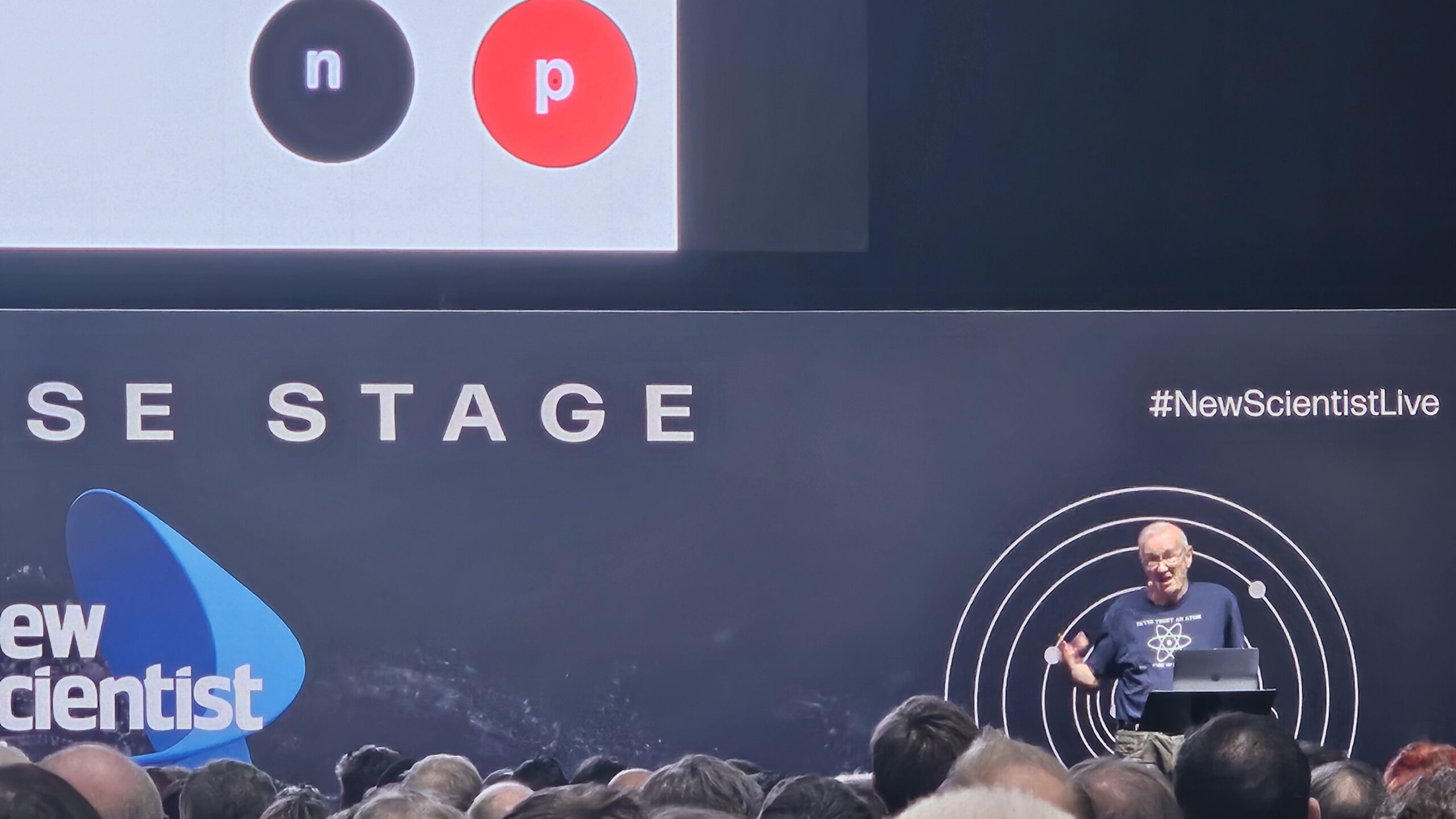
Close is an Emeritus Professor of Physics at the University of Oxford and multi-award-winning author. He gave his lecture ‘CHARGE – Why does gravity rule?‘, based off his latest book of the same name, at New Scientist Live 2024.
Close traces his interest in particle physics goes back to his school days. Speaking to Roar, he reflected:
“I’ve always been looking for the why underneath. That’s what brought me to particle physics.”
“Initially, I disliked [physics] because I couldn’t remember all of the facts. Then, one day in chemistry we were told that all atomic elements were made of atoms, and all atoms had electrons. It’s just the different number of electrons that determines one from the other and I thought ‘Wow! That’s simple’. That’s all I need to know in principle, and I can derive all of chemistry from it”. Decades later, that’s not turned out to be the case, but I’ve always been looking for the why underneath. That’s what brought me to particle physics.”
Close began his journey in particle theory in the late 60s — around the time quarks were first theorised.
“Quarks are the basic seeds that build up protons and neutrons, which then make up atoms and so on. To this day, we know of nothing smaller than that. I suppose my interest in quarks was just a natural continuation of my desire to get to the simplest level, then build up from there. I was very lucky to get involved in that particular field at the very beginning.”
The Search for a ‘Theory of Everything’
Over the years, Close became more interested in the history of the subject, and with it, the search for a unified physical theory.
“We had any number of crazy ideas — well, we didn’t know they were crazy back then. Then, the breakthrough happened. One of the great discoveries was that everything was much simpler than we thought it was. Now, 50 years later, we have a pretty good description of the three forces that control the atom. […] All of those follow the same mathematical ideas, suggesting there is something behind it all that’s unified.”
The breakthrough in question was when in 1964, Peter Higgs — 2013 Nobel Prize in Physics laureate, and King’s College London almunus— proposed the Higgs field. The Higgs Field is a kind of field that gives mass to all elementary particles. This “mathematical trick” marked a turning point in particle physics research.
“[Higgs] had an idea which, at the time nobody took much notice of. […] He showed that if you took everything away from the universe, rather than the vacuum being empty it would actually be unstable, strange as that may sound. But if there was some stuff [what we now call the Higgs field] In there as well, it could cause interesting things to happen. In particular, it could cause particles like the photon to become massive. […] Things increasingly fell into place.”
Science Writing as a Physicist
Alongside his research in particle physics, Close is a prominent science writer. He is the only physicist who holds three British Science Writers Prizes, and the winner of the Kelvin medal of the Institute of Physics for his “outstanding contributions to the public understanding of physics.”
Close credits his start in science writing to an opportunity brought about by what he deems pure coincidence.
“It all actually started quite accidentally. Many years ago I was part of the British Delegation that went to a conference in what was in those days the Soviet Union. It was at this conference that some very exciting news was announced, which was the beginning of this big revolution that we’re living through. Nature [Magazine] contacted me and asked if I would write a report about this for their news section. I think they asked me because my name alphabetically was just the first one on the list.”
Close found the challenge of communicating specialised knowledge interesting.
“It was an interesting challenge, because the news section was for scientists to read to be made aware of what’s going on in other fields. So you were writing for a serious [scientific] audience, but one that didn’t know all the details. I found that fascinating.”
Over the years, Close came to realise he enjoyed communicating science to the public. He views it as an effective means to develop his own scientific understanding.
“I’ll take the adventure of trying to learn it for myself, at a level that I can then explain it to people. And so my book [on Peter Higgs] is actually in part my journey into understanding this particular area of science.”
“Someone has to discover these things — it could be you.”
Close urges students to be curious and is optimistic about the future of science:
“In [my career], I’ve seen huge advances in understanding. Every question you answer, generates more questions you didn’t know were there before. You’re the generation that will be answering these questions. […] When I was a student, the textbooks were full of things that were discovered in the past. Then, I started research. Now, some of the discoveries I was involved in are in the textbooks your generation uses today. If you could imagine in the future, those textbooks have yet to be written, and there’ll be things that we don’t know yet. Someone has to discover these things — it could be you.”
For more of Roar’s coverage of New Scientist Live 2024, click here.
About the author