A Roar writer discusses the impact of the death of Iranian woman, Mahsa Amini, and the protests this has sparked regarding Womens’ rights in Iran.
Mahsa Amini, a 22-year-old Kurdish-Iranian woman visiting Tehran with her family, was arrested by Iran’s controversial and oppressive “Morality Police”, tasked with enforcing, often brutally, religious observance. Reports and eyewitnesses claim physical and verbal abuse at the hands of the authorities sent her into a coma for two days. On September 16, she was declared dead.
Many Iranians allege Mahsa, whose Kurdish name Jina means ‘life’, was senselessly killed by an autocratic regime, which invokes religion to rule Iran with an unruly holy fist. This regime is led by the “Velayat-e Faqih”, or “Guardian of the Islamic Jurist” system, a political ideology that is the brainchild of Iran’s late ruler and founder of the Islamic Republic, Ayatollah Khomeini. This states that a “worthy” Islamic jurist should govern society in the absence of the 12th and last Shia Imam, until his reappearance. This 40-year-old ideology, which has justified dictatorship through religion, has cast a dark shadow over nearly 2,500 years of Iranian history and culture.
The politics and cascade of events that lead to this moment in Iranian history is long and complex. This young republic has seen many demonstrations against it, but the death of Mahsa which likely occurred as a direct result of the violence inflicted by government forces in protecting Iran’s compulsory “veiling” law has triggered a feminist demonstration, on a scale which hasn’t been seen since the introduction of this law. Before, the Iranian regime could easily blame protests over “western-plots” to destabilise the country, its failing economy, high youth unemployment, high inflation and lack of opportunities on US-led sanctions. Its hand to downplay these events is now much weaker, as it rushes to blame her death on a poor heart condition, labelling protestors as “enemies of Islam”, organising counter-rallies and arresting prominent voices and the journalist, Niloufar Hamedi, who broke the story. Iran’s propaganda machine is running at high speeds.
With chants of “Zan, Zendegi, Azadi”, or “Woman, Life, Freedom”, outraged young Iranian woman, along with their fellow citizens, in their thousands bravely lead demonstrations with defiant acts of cutting their hair – an act of ancient mourning, burning their headscarves, dancing around bonfires and walking freely without a hijab. All of this has sparked a violent crackdown by a regime that isn’t afraid to fire live ammunition indiscriminately.
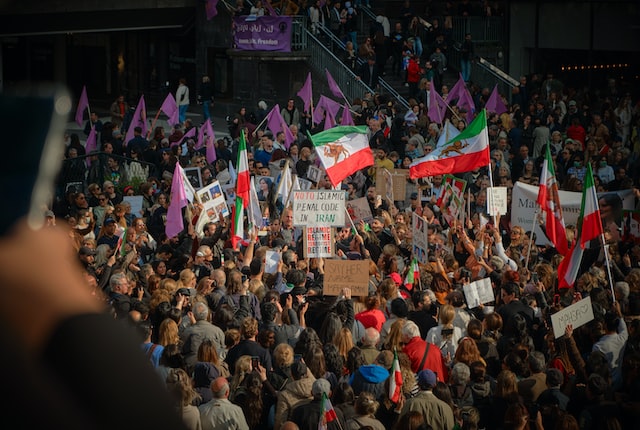
As nationwide protests in major cities and small towns continue for the 11th consecutive night, hundreds have been detained and, at the time of writing, Norway-based, ‘Iran Human Rights’ confirms the death toll at 83, though this could be much higher, as internet “black-outs” make it difficult to grasp the full situation. Iranians, however, remain defiant, spurred on by the international solidarity seen in demonstrations in London, Paris, New York and many other cities around the world.
Demonstrations should not be hijacked by small minorities with ulterior motives, including Islamophobic groups who wish to draw lines of division amongst society and drag Iran into sectarian violence. There has been an outpouring of social media support from security forces, and influential figures in the worlds of film, art and sport for the protests and observant Muslims along with Islamic scholars who question the legitimacy of such government. There are Iranians from all walks of life who are against authoritarian rule and desire a democratic, truly Republican and free Iran. Iranian culture was one of tolerance and freedom long before it reached the shores of Europe.
Persian version of the 19th century Italian protest folk song, Bella Ciao. #MahsaAmini #IranProtests pic.twitter.com/DZq4MHJbbU
— Habib Khan (@HabibKhanT) September 24, 2022
Mahsa’s death along with the outrage that followed was not an isolated incident. Iranian society, with decades of economic and social oppression, especially amongst its disenfranchised youth, has reached a boiling point. Protests will continue to erupt in Iran, though like many others that were brutally silenced and suppressed, the Islamic Republic will likely continue to ride out these turbulent storms and come out more authoritarian and oppressive than before. With virtually no organised opposition in Iran and influential voices silenced, the future of Iran remains unknown.
What should be known is that Womens’ rights are under attack all over the world; from “liberal democracies” to “authoritarian regimes”, the rights of women are being reeled back and trampled on. From rising anti-abortion laws to judiciaries and police forces that fail to protect women and transphobic bills and sentiments that can be seen in all parts of the world, our problem lies with a misogynistic, patriarchal society that sees women as second-class citizens.
The author of this article wished to remain anonymous.
About the author