Staff Writer Thomas Deakin examines rising musical artist Sean Trelford’s performance at The George Commercial Tavern in Stepney Green and his personal connection to Trelford’s music.
I first met Sean Trelford six years ago, when we were both attending the same secondary school in Cambridge. We were working on the same play project. Although it started out as just a small friendship, we eventually became close because of our shared interest in music as a counterpoint to our discontent with how student and staff treated us at our secondary school. Over the next couple of years, I watched as Trelford grew from a local celebrity in Cambridgeshire to a signed artist at Island Records at only 18 years old. Trelford is about to release his debut EP, ‘Ulcer.’ But it certainly hasn’t been an easy journey for Trelford to get to this point. His path to success was frequently fractured by petty rumours about his romantic life or artistic integrity. As Trelford mentioned in a recent profile for Rolling Stone, he felt like an outcast at secondary and sixth form due to this. However, Trelford combatted these negative rumours in secondary school, using his background to inspire a rebellious artistic vision that affirms his individuality and confronts musical and social conformity. It is this quality that I find to be particularly admirable, emotionally resonant, and unique in his oeuvre.
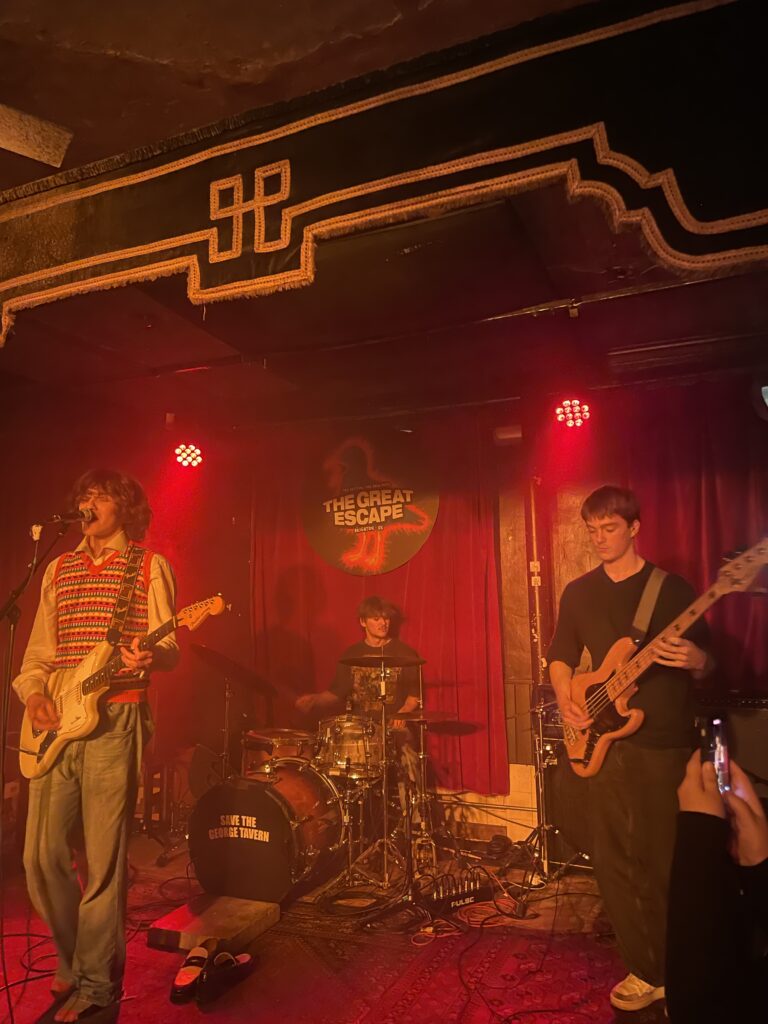
Despite having attended many of Trelford’s concerts and performances over the years, I hadn’t seen him perform in about a year and hadn’t seen him properly in about 10 months when I turned up early to his performance on the 13th of November at The George in Stepney Green, London as the headline act of one of their First Fifty Events. This performance marked one of several in the current international tour that Trelford has been undergoing, previously performing at Left of the Dial in Rotterdam and the Pitchfork Musical Festival in Paris, and performing in the future at The Portland Arms in Cambridge on the 26th of November and at The Lexington in Islington on the 15th of January 2026. Following a couple hours watching the relatively enjoyable bands ‘Clothelines from Hell’ and ‘Tanzania’ perform beforehand, and after a couple of conversations with Sean, his parents and friends about his art and life, Trelford began performing at 9:45pm. He was accompanied by Ollie Massey on bass and Roan Jaggs on drums, two Trinity Laban students whose friendship and close artistic bond with Trelford allowed them to perfectly accompany his unique sound.

Trelford and his equally talented backup band started out with ‘Bella’, a song that he wrote he was in 15 and released as a single in 2023. Trelford opened the concert by describing this song as being about the “image and apathetic problems” that defined his teenage years. Whilst this song has been unfairly interpreted by many casual Instagram commenters on his viral reels as another song about a teenager falling in love, it is actually an intrinsically personal reflection on the painful insecurity of body dysmorphia. It’s a pretty universal young person’s problem, and as such, this song struck a deeply emotional chord as a summation of the shared discontent and need to combat emptiness that brought Trelford and I together as friends during our teenage years.
Trelford then followed this ballad of self-reflection with the similarly sombre yet liberatory ‘Let You Go’; a track he had released as a single in 2024 that dramatises the difficult end of a fraught relationship in secondary school. Even amongst his highly emotional catalogue that often oscillates between nihilism and optimism to eventually find a midpoint between the two, this song comes across as particularly sorrowful and, as a result of its introspective sorrow, poetic. By managing to cover the origins of a relationship, its ending and the aftereffects of it within three minutes, Trelford explores both the pain of toxic relationships and the liberation of the epiphanies that emerge in their conclusion and spearhead personal growth.
Trelford followed this up with a trio of songs that expressed his internal struggle over the bullying and rumours that he faced at secondary school and sixth form. These songs particularly vocalised how this negatively impacted his mental health by forcing him to cover certain parts of his personality under a façade as a means of self-preservation until he could flourish into the sublime musical artist that he is today. ‘I Should’ve Known’, ‘Hide’, and particularly ‘I’m So Happy’ are deeply existential and self-reflective works constructed by the dialectic between Trelford’s desire for authentic musical success and the frequent rebuttals of a world which unfairly views his task as unattainable. I emotionally related to this song both as someone who has been debilitated by untrue, yet blindly believed rumours and as someone whose ambition of becoming a filmmaker has been derided and mocked as impossible. Therefore, I found this triad to be a self-aware affirmation of why we need sincere artists and personal songs in a modern music environment where music is so often commodified for personal reasons at the expense of personal expression. Trelford’s use of a lo-fi production style fractured with the beating heart of classical rock conveys this notion perfectly by epitomising the rarely stated aphorism that slightly imperfect yet personal art is so much more meaningful and transcendent than art defined by commerce.

Finally, Trelford concluded this set of songs with what might just be my favourite of his songs so far, ‘Naked’, a track that he released as a single late in 2025. He explained before the performance that this song is a metaphorical representation of the dynamics of apathy and manipulation he experienced during a past bad relationship. Although all his other songs were also authentically self-revealing, ‘Naked’ was definitely my favourite of Trelford’s songs because the rawness and vulnerability of its musical elements, lyrics and personal tone emphasised how Trelford’s ambition to get into music is rooted fully in a genuine passion for his craft and need to make outcasts feel less alone. It is a profoundly complex and nuanced song that does not shy away from the traumatic and terrible periods of self-hatred and depression that Trelford has had to go through. However, its ultimate prioritisation of his rediscovery of his artistic voice made it the standout tune of his successful attempt through music to grow and progress by evolving beyond nihilism and naivety.
Photo Taken by Thomas Deakin
These songs collectively shaped a musical atmosphere for his performance that was very angry and emotionally volatile, yet in a way that was touching and relatable instead of being aggressive. His music oscillated between much higher dynamic tones and more subtle beats that linked to his intimate, lo-fi genre origins. Although the resulting tone crafted by sound and atmosphere wasn’t always consistent, it was the personalism and authenticity of this variety that made his performance a constantly engaging manipulation of the often overly commercial soundscape of the concert to convey a musical, mental and emotional journey to self-actualisation to the audience.
In terms of his musical influences, Trelford’s work is liberated by its inability to be described in simple terms that limit it to a single genre. Whereas he described his music at the beginning of The George performance as “lo-fi, but not lo-fi beats to study and relax to”, he also suggested in the Rolling Stone profile that his music is acid classical for outsiders and somewhat on the indie, psychedelic, jazzy route. This range of stylistic influences is also not purely musical. Trelford also noted in the Rolling Stone piece that the literature of Oscar Wilde and Albert Camus; and the music of the Electric Light Orchestra and Paul McCartney among others helped to morph him into the decisively intellectual and beautifully personal artist that he has become today. Both these intellectual influences and the personal content of his art are so genuine and heartfelt in their expression because they highlight Trelford’s determination to overcome those who predicted that his music would fail when it has actually done quite the opposite. Talking to his parents before the performance began, I learnt from his mum, his biggest and most encouraging influence, that Trelford’s disillusionment with sixth form was amplified by his Music Tech A Level teacher telling him that he would never be successful. Although many people would be put off from entering such a notoriously tough industry by this bluntly rude statement, Trelford was galvanised by this insult to eventually reach a position in the music industry, where the only quality that exceeds his talent and success is his unashamedly personal authenticity.

Overall, Sean Trelford’s performance at The George on the 13th of November 2025 was a milestone in his career thus far. Whilst I have enjoyed all of his performances, it felt particularly special to be in the presence of his parents, close friends and management at a performance that perfectly demonstrated why he deserves the immense success that he has garnered so far and is destined for even greater success. Therefore, I think I can confidently say that this highly emotionally resonant performance was the best that Trelford has given yet. It was the first, but definitely will not be the last time, where he has performed a completely uncompromised and unashamedly personal reconfiguration of his past trauma into something progressive, beautiful and hopefully meaningful for a lot of people.
Sean Trelford continues to announce new music on his Instagram.

English with Film Studies Undergraduate at King's College London.