Culture writer Biraj Khadka explores how Bad Bunny’s Superbowl halftime show was not just a performance but a display of political resistance in today’s America
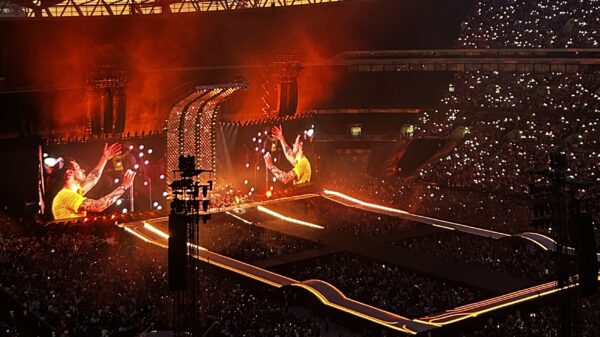
Already at a career high following his Album of The Year win at the Grammy’s last week, the ceiling opened to give way to a seemingly endless expanse for Bad Bunny this Sunday evening as he took the stage at the Super Bowl halftime show, delivering the first ever Spanish language performance in the show’s history. Levi’s Stadium, in Santa Clara, California, transformed for 13 minutes into a beacon of Hispanic-infused joy broadcast to more than 135 million viewers tuned in for Bad Bunny’s jaunty and jubilant celebration of the American continents.
At its core, the performance was an ode to the artist’s Puerto Rican heritage. During his performance of El Apagón, a song about the dual ills of socioeconomic stress and the gentrification-driven displacements faced by his fellow Puerto Ricans, Bad Bunny stands while brandishing a Puerto Rican flag.
Notably, the triangular section is colored light blue, which differs from the traditional dark blue hues seen in the official flag. The lighter shade is meant to portray the island – which has been a U.S. territory since 1898 – as independent from the United States.
Soon after, Bad Bunny, clad in a white jersey donning the number ‘64,’ is seen climbing onto an electricity pole, symbolizing the constant blackouts faced by residents of his island. Some fans have surmised that the number depicts the official death toll of Hurricane Maria, which devastated Puerto Rico in 2017. At the time, the Trump administration faced backlash for a slow response to the disaster, and the initial death toll of 64 was later revised to over 2,900 following an outcry.
While Bad Bunny remained the clear focal point of the night, his performance was packed with appearances by numerous leading musicians. Amongst them were Cardi B and Karol G, who were shown dancing on the porch of La Casita, Bad Bunny’s rendition of a traditional Puerto Rican village home. The same model home was a staple at his 31 show sold out residency in San Juan last summer. That residency preceded his ongoing Debí Tirar Más Fotos Tour, a 57-show monolith spanning five continents that is bypassing the United States entirely over fears the shows could become hotspots for ICE operations.
These fears are rooted in the Trump administration’s aggressive deportation campaign, which has led to ICE agents descending on several cities in order to conduct heavy-handed deportation operations. The unease has resulted in once bustling Hispanic neighbourhoods in cities such as Chicago hollowing out as residents hunker indoors to avoid federal agents.
Toward the middle of the performance, a real life couple say their wedding vows, and soon after, Lady Gaga, wrapped in a bright blue dress, is revealed as a special guest. In what is essentially a literal wedding reception, Gaga belts to her and Bruno Mars’ standout hit ‘Die With a Smile,’ albeit delivered in a salsa flair accompanied by Los Sobrinos, a Puerto Rican musical group also present for Bad Bunny’s San Juan residency. Although Gaga delivered what were the only English lyrics of the show, her upbeat appearance seemed perfectly in harmony with the celebratory spirit of the night.
For the next special appearance, Bad Bunny chose fellow Puerto Rican star Ricky Martin. Martin, styled in a simple cream coloured look, sang parts of Bunny’s ‘LO QUE LE PASÓ A HAWAii,’ a song about the colonisations of both Hawaii and Puerto Rico, reinforcing Bad Bunny’s unwillingness to shy away from sensitive themes.
Amidst a backdrop of lush, Puerto Rican influenced street scenes, Caribbean style partying, and a sheer abundance of joy, Bad Bunny delivered a show which was resolutely antithetical to an image of America that has dominated the past year: one filled with ICE raids and mass deportations, hostile rhetoric toward immigrants coming from the White House, and an overall rollback of democratic norms that have left many shaken and with a sense of despair.
Of course, outside of the enclave of celebration that was Levi’s Stadium, signs of the political divisions cleaving the United States weren’t hard to come by: Presented as a counterpoint to Bad Bunny’s Spanish halftime show, Turning Point USA hosted their own, ‘All American’ rendition, headlined by Kid Rock and flush with tributes to the organization’s late founder, Charlie Kirk.
In the lead-up to Bad Bunny’s halftime show, prominent figures on the right had labelled the singer “un-American,” with President Trump decrying the selection as a “terrible choice.” This discourse had deepened the sense amongst Puerto Ricans, who are U.S. passport holders, that they are seen as second class citizens by some in the United States.
Throughout his performance, Bad Bunny delicately navigated this fine line between his Puerto Rican identity and the island’s complicated relationship with the United States. Toward the end, after proclaiming the words ‘God bless America,’ he begins listing all the countries that make up the two American continents as a stream of people holding the flags of those countries – led by the Puerto Rican and U.S. flags – flood into frame. Being American, and being proud of the region’s heritage, the Puerto Rican singer shows us, is far from monolithic.
These nuances are perhaps best exemplified by the essence of the performance itself: a Puerto Rican singer, asserting his island’s history and people as separate from that of the United States, performing at a sporting event that is uniquely American. Bad Bunny and his fellow Puerto Ricans seem to be operating in a liminal environment where they are both forced into Americanness and are simultaneously denied full Americanness.
The United States is a country shaped by immigration, and a place where Spanish is the first language for well over 40 million people. It has historically prided itself on its tolerant and diverse nature, and on its status as a place where those leaving their homelands find refuge and can build new lives. For the final act, Bad Bunny and those around him begin dancing to the sentimental ‘DtMF,’ as a billboard in the background proclaims in bold letters, ‘the only thing more powerful than hate is love.’ At that moment, it felt as though glimpses of a more buoyant, welcoming country were once again present. These days, you just have to look a little harder.
About the author