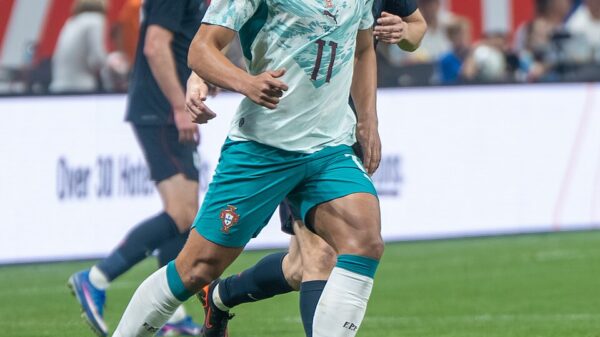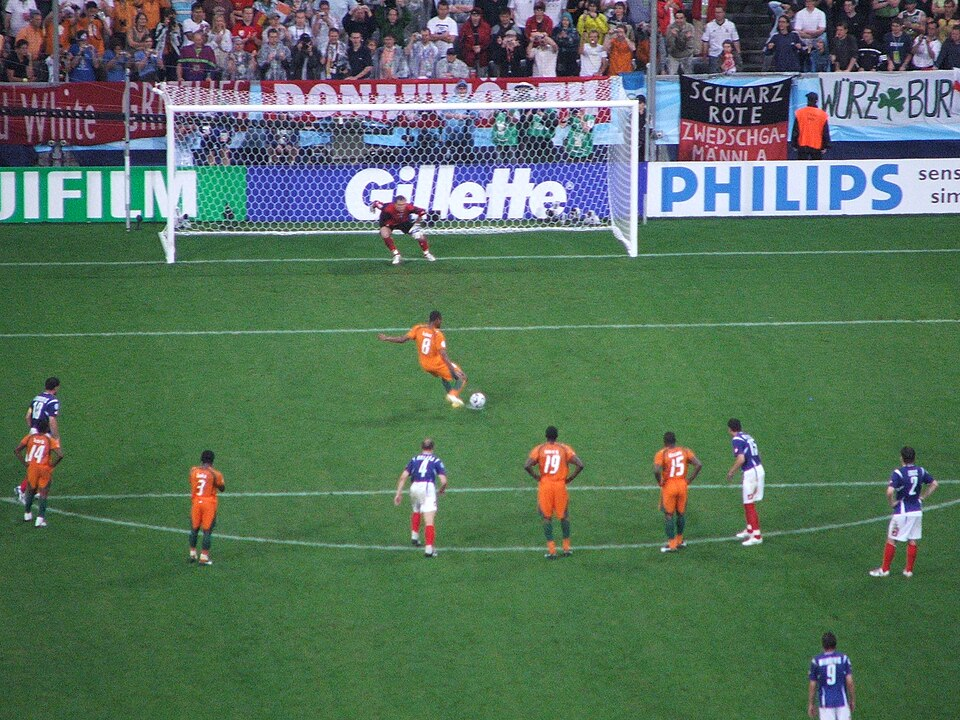
Staff writer Guy de Basto takes a deep dive into penalty shootouts.
Gareth Southgate steps up. Wembley Stadium is deafeningly silent in the way that only 75,000 people holding their breath could be. The English centre-back has scored countless penalties before. He will go on to score penalties again in training, hundreds of times, without a second thought. But on 26 June 1996, something in him just gave way. The ball is saved, Germany are through and Southgate is left standing alone in the kind of silence that follows a man for decades.
What I present is the paradox at the heart of the penalty kick. Statistically, it is the closest thing to a guaranteed goal that football offers. Conversion rates for the world’s best tend to hover around 75-80% across top European leagues and the goalkeeper, often guessing wrong, can barely cover a third of the goal.
The odds are overwhelmingly in the taker’s favour. And yet the penalty produces some of the most visceral collapses in sport. One can reasonably conclude, therefore that a penalty kick is not a test of ability. It is a test of character and crucially, those are not and cannot be the same thing.
The Illusion of Simplicity
The penalty exists, ostensibly, as a punishment. A foul inside the box, a denial of a clear goal-scoring opportunity and thus the offending team is made to stand back and watch as their opponents shoot at an almost unguardable target. The rules are designed to make scoring easy. In isolation, they do.
Ask any semi-decent footballer to take a penalty in training and they will convert it nine times out of ten with zero problems. No one doubts that the technique isn’t too complicated: pick your spot, commit, finish. This is something footballers (and likely you) have done since childhood. People sometimes forget, however, that the penalty is never taken in isolation. It is taken in front of tens of thousands of people, often at the end of ninety minutes of exhaustion (both physical and mental), with all of a nation’s expectations compressed into a single strike.
This is where the illusion of simplicity clearly collapses. The penalty does not test whether you can hit a ball, in which case it would almost certainly be a guaranteed goal. It tests whether you can still be yourself, technically, mentally, physically, when the conditions are designed to make that as difficult as possible.
The Dismal Science of Choking
The true dismal science. Sports psychologists have a name for what happens when pressure dismantles performance: explicit monitoring. Under ‘normal’ conditions or as normal as they can be, skilled athletes execute complex movements automatically. The penalty run-up, the plant foot, the strike. None of these requires conscious thought. Years upon years upon years of practice have made them instinctive.
Under extreme pressure, the brain begins to monitor those automatic processes deliberately, essentially interrupting them. The result is what researchers call “paralysis by analysis”: the footballer who thinks too hard about where to put his foot places it wrong, or the one who thinks about breathing patterns strikes the ball at the wrong time. You might have experienced it before, when a friend asks whether you breathe in or out when hitting a serve or bowling a cricket ball.
Prominent Norwegian sports scientist Geir Jordet has spent years studying penalty behaviour at major tournaments. He found that players who rush their preparation, averting their gaze, speeding through their run-up, miss at significantly higher rates than those who take their time and commit fully to their decision. A clear example is Mbappe’s miss against Switzerland, which knocked France out of Euro 2020.
The data suggest that hesitation is not caution. It is the visible symptom of a mind losing its battle with itself. What fails in those moments is not technique. It is the ability to access the technique and that distinction matters enormously.
The Keeper’s Impossible Game
The goalkeeper’s position is, statistically speaking, nearly hopeless. By the time a well-struck penalty reaches the line, there is (effectively) zero time to react. A keeper who waits to see where the ball is going will (almost) never save it and will inevitably be tasked with fetching the ball from the back of the net. So keepers dive early, committing to a corner before the ball is struck, gambling on instinct and research. The problem is that this strategy succeeds only around 20-25% of the time. Standing still and reacting, paradoxically, yields similar or better results against certain takers.
And yet almost no keeper stands still. Because diving and failing look like effort. Standing still and failing look like cowardice. The goalkeeper, like the taker, is not making a purely rational decision. They are making a decision shaped by how failure will be perceived. Both actors in this drama are prisoners not just of physics and probability, but of ego and reputation. The penalty, in this sense, is a theatre of psychology as much as it is a contest of football.
What Separates the Elite
Not everyone collapses. Some players step up in shootouts with a stillness that borders on unnerving and it is worth asking what separates them from those who do not.
The answer is rarely physical. Andrea Pirlo’s Panenka against England at Euro 2012 was not improvised. He chipped it softly down the middle as Joe Hart dived away, a decision made long before he walked to the spot. Pirlo had studied Hart’s tendencies extensively and settled on his approach before the shootout began. When he placed the ball down, the outcome was, in his mind, already decided and his vision became ecstasy.
Research into elite penalty takers consistently shows that the best performers focus on execution cues, the specific mechanics of their technique, rather than on outcomes. They are not thinking about scoring. They are thinking about striking the ball in a particular way and trusting that the goal will follow. This capacity, to shrink the moment down to its component parts and execute under pressure, is vanishingly rare. It can be trained at the margins, but it cannot be drilled into existence. In the end, it is a character trait.
Character as the Hidden Variable
You likely didn’t expect this section, but I think it’s crucial. Every player who steps up in a shootout has the technical ability to score (if they didn’t, they wouldn’t step up). The gap between those who do and those who do not is not found in their feet. Forgive me for being philosophical, but the ancient Greeks had a concept – arete. It translates roughly as excellence, but carries a deeper meaning: the total, fullest expression of one’s nature and function. A knife that cuts perfectly without fault has arete. A soldier who holds the line with passion and dedication has arete. A penalty taker who, under the weight of an entire nation, strikes the ball exactly as they intended. Not close to perfect, but actually perfectly. They have arete too.
The penalty does not reveal who the better footballer is. It reveals who can be, for eleven seconds, the most completely themselves.
Decades on
Gareth Southgate spent the better part of thirty years living with that miss at Wembley. He became England manager, took them to a World Cup semi-final and guided them through two major tournament shootouts. He won one and lost one. Whether that arc represents redemption is a matter of opinion. What it represents, beyond any doubt, is character.
The penalty does not lie. It never has.
About the author