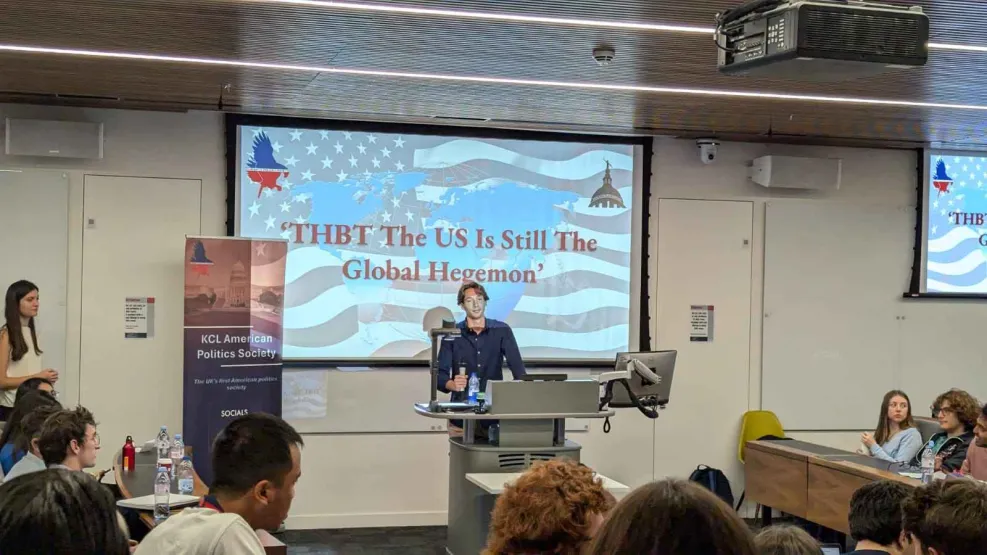
On Monday 7 October, a crowd of students gathered in Bush House Lecture Theatre 1 to listen to the King’s College London (KCL) Politics and American Politics Societies’ student debate on the motion: ‘This House Believes That The US Is Still The Global Hegemon’.
The debate was co-moderated by the President of the American Politics Society, Patrick Schnecker, and Vice-President of the Politics Society, Diana Potra. Patrick and Diana began by introducing their respective societies and establishing the framework for the debate. Following the British Parliamentary style, each debater began with five-minute speeches introducing their position. The first and last minute of each speech was considered protected time, and Points of Information (POIs) and Points of Clarification (POCs) from the other side were acceptable. Debaters were encouraged to accept at least one of these in their speeches.
Six students, three for the proposition and three for the opposition, participated in the debate. Debating in favour of the proposition was Kian Donovan, Benjamin Evans and João Levy Melancia. Debating for the opposition were Baron Ayguven, Livia Fordellone and Ved Shivakumar.
Once these introductions were complete, it was time for the first speaker of the proposition to begin his case.
The proposition began by asserting that current international politics was not experiencing a “modern cold war” and that morality was overwhelmingly connected to liberal democratic beliefs. Even China, Donovan argued, relied on the democratic language that US policymakers had popularised in order to poorly disguise its authoritarian practices. When asked in a POI if the American tendency to engage in war did not conflict with its moral values, Donovan disagreed and said they were not mutually exclusive.
When opposition took to the stage, they emphasised the multipolarity of current international politics. Ayguven argued that ongoing conflict in the Middle East reflected the inability of the US to fully control the behaviour of other nations or even its allies. The fact that UN decisions on key issues sometimes varied from those of the US seemed to highlight this fact in clear detail. He also looked to the Middle East to exemplify this, but he also cited the war in Ukraine to highlight the disagreements between the US and Russia. Once again, he looked to the Middle East, but also to the war in Ukraine to highlight the disagreements between the US and Russia.
Then it was time for the second speakers on both sides. This was perhaps the most fiery part of the debate, as it got to the crux of the motion. The overarching point of contention was over how to define “hegemony”: whilst the proposition argued that hegemony owed a large portion of its meaning to moral and ideological influence, the opposition emphasised the primacy of economic influence.
For proposition, Evans referenced the thinking of Michel Foucault on controlling discourses and ideas, drawing a comparison to the tentacled reach of the US in so many aspects of our lives across the world. In contrast, Fordellone displayed an impressive array of statistics to demonstrate how economic power was shifting to other regions in the world and that more countries are increasingly seeking trade deals with partners that are not the US.
The final speaker for the proposition, Melancia, reiterated key points. He then invited the audience to raise a hand if they had not used any American products or consumed any American media that day. Only one person’s hand went up, to whom he jokingly congratulated but remarked was ‘non-representative’. He concluded his point by saying that only Japan and Korea were comparable in such influence, both of whom were US allies anyways.
Shivakumar closed for the opposition, once again going on the defensive for an economic-based hegemony and the importance of multipolarity. In addition, he made a powerful case for the contradictions that existed in US foreign policy and the importance of moral respectability as a requisite for continued hegemonic status, something the US increasingly lacks on the global level.
The winners of the debate were determined twice: firstly by a judge, Charlie-Joe Ackland, and then by audience vote. When both of the results were finalised, the judge and audience were in agreement: the proposition won.
Click the linked text to follow the KCL American Politics Society and KCL Politics Society on Instagram for future events, opportunities and positions.
About the author