Historically, economics has made music-making a vocation primarily on an earn-as-you-go basis. As Roy Hargrove said in 2012, “You have to love it and breathe it and—It’s your morning coffee. It’s your food. That’s why you become an artist. Art is a mirror of society, you know…â€
Eight years later and his words ring truer than ever before, as the performing arts are in a dire state. Most musicians are freelance, and freelancers have been the worst impacted, with financial and mental health hugely challenged. Musicians and other freelancers have not been furloughed. Millions have received no income since March, when the venues of live sound across the land fell silent. The music stopped, save for Zoom calls and live streams. As lockdown started, unions set up a new hub for support, www.coronamusicians.info/. As it eased, the group ExcludedUK, representing those who have fallen between the cracks, set up a ‘Fighting Fund.’
As one music teacher said, “Why are cinemas allowed to have an audience, but not concert halls? Makes me so cross. String groups and small recitals could easily be performing.†Another teacher chimed, “I want to see something in place [such as temperature checks and masks] that allows us to rehearse and perform safely.â€
In the absence of a vaccine or working contact tracing app, a ‘Hear out to help out’ scheme could incentivise concert-goers to help venues get back on their feet, especially when there is less disposable income. A scientific institute in Berlin said that, in theory, classical venues could return to capacity. It then had to correct media reports to the tune that they were advocating a full return at capacity, by pointing out that it depended on infection risks. And indeed, classical audiences tend to be older and so more at risk. Or the idea of attending concerts isn’t very appealing to people – despite, or perhaps because of, the extra hygiene measures.Â
When concerts do restart, that doesn’t necessarily mean that musicians will be able to get work or earn as before. Kenneth Knussen is, or was, until mid-March, a busy freelance orchestral double bass player. He worries that orchestras will decrease the size sections to comply with social distancing measures (which evidently need changing in any case) and be forced to programme smaller scale works. As a result, extras and deputy players will be seriously reduced in numbers, if used at all for the foreseeable future. “No Mahler or Bruckner or Richard Strauss, for instance. And will the audiences come back? Not in the numbers required for some time.†As a result, he worries he has been retired.
“It is a sorry time for the profession,†Kenneth says, alluding to younger colleagues looking elsewhere. Some have not met the criteria for a self-employed income grant (for him, SEISS was a “godsendâ€). He thinks “it is time to acknowledge that self-employment needs more security.â€
The Royal Opera House, his primary employer in recent years, reimbursed freelance musicians for six weeks of cancelled works, including performances of La Traviata and Jenufa. All other projects were cancelled without pay. To him and many others, Covid-19 has exposed the “inadequacy†of arts funding in the UK. “British orchestras rely on audiences and ticket sales. When they stop everything begins to collapse.â€
One lifelong professional violinist has three children and two elderly parents, with the help of a carer. Because Universal Credit “doesn’t even cover anywhere near the mortgage,†she and her husband, also a self-employed musician, “are facing losing our home.â€
Nicola, a violinist of 25 years, is planning to start some work in the private care sector in order to make ends meet. She says that “being cut off from the only life you’ve ever known is like a sentence.†On her music colleagues returning, she says, “I don’t see why, with the right measures in place, audiences shouldn’t enjoy live music again if we all use common sense.â€Â
The Treasury plans to wind down the Self-Employed Income Support (SEISS) and the furlough scheme in the last quarter of the year. However, there will be areas where there is no opportunity to work, and risks leaving even more without any financial support.Â
I have witnessed the worry and exasperation play out all summer, and it is my impression that there is a lack of understanding, listening and communication between the Treasury and freelancers in England who are excluded from the support it offers. Part of the media’s job is to close that gap.
The package of emergency loans and grants via Arts Council England, announced in July, has already prevented 135 grassroots venues from being bought up, repurposed or shut. This was part of a Culture Recovery Fund, amounting to £1.57 billion.Â
One theatre director, however, pointed out that this fund goes to “unavoidable†expenses, such as paying rent and maintaining buildings (which, for now, are all but empty). However, to their confusion and exasperation, “unavoidable†spending does not include the many freelancers who they wanted to support.Â
Geli, having worked as a DJ, programmer, and composer, has made a life out of music. When a part-time employer did not pay her despite promising her job was secure, “panic hit.†She “fell through the cracks†of the government initiatives. She successfully claimed universal credit and artist emergency grants, including for her Community Interest Company, which covered her rent. However, she says that as she is over 60, diabetic, at high risk of COVID-19, she will be “in crisis unless I can work from home.â€Â
All musicians I heard from, of all ages and genres, echoed what David, a retired choir member, summed up: “More financial support from the Government, Local Authorities, and the business community, to enable us to continue,†and, crucially, to “help find new audiences and members.†The Public Campaign for the Arts says local cultural venues must be protected, too.
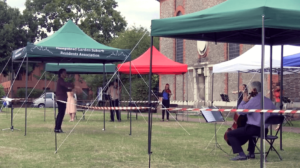
Echo Outdoors concert, the final piece, ‘Nimrod’ by Elgar. Credit: Echo Ensemble
Earlier this month, a socially distanced orchestra gathered in a field in North London, with tables spread out in front of the ‘stage.’ The Echo Ensemble’s Noah Max said that the concert “serves a greater purpose, which is to inspire hope… In my world, every emotion has a soundtrack, and I think it’s fair to say this final piece we are going to perform for you is the sound of hope.†Before giving the downbeat to Elgar’s ‘Nimrod,’ he thanked the audience: “We couldn’t do it without you, you complete the circuit.â€
The video was captioned ‘The Music Makers,’ which Elgar wrote for an amassed gathering of orchestra and choir. The text of the work is from ‘Ode’ by Arthur O’Shaughnessy: “We are the music makers,/ And we are the dreamers of dreams,/ Wandering by lone sea-breakers,/ And sitting by desolate streams; —/ World-losers and world-forsakers,/ On whom the pale moon gleams:/ Yet we are the movers and shakers/ Of the world for ever, it seems.â€
About the author