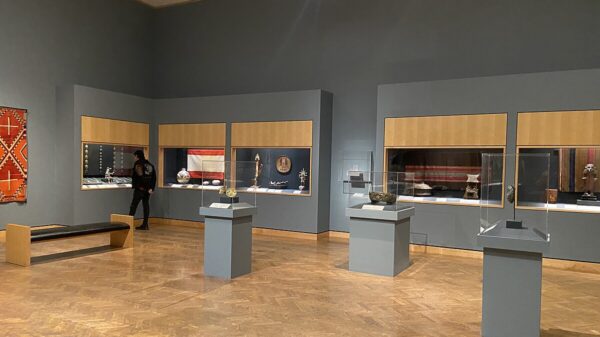
Birth Rites, a collection of contemporary art displayed at KCL’s Guy’s Campus, tackles the subject of childbirth. The works range from photographs through videos to sculptures, portraying the act and the aftermath of childbirth as multifaceted and worth examining.
The exhibition is available through virtual tours. They take place in the form of a Zoom meeting, where Helen Knowles, its curator, takes us through each work, and shares information regarding the artists and contexts of the pieces.
Apart from being portrayed as dramatic and painful in the media, childbirth in culture is often associated with fear, or even danger. In the film Sexmission, babies are born in incubators, without any male interference, while in The Handmaid’s Tale, childbirth represents slave labour under the guise of a miracle. The act can exemplify both the power and the submission of women, but it is often used as a mean to shock the audience in one way or another.
Whether due to the vehement nature of it, the complexities around gender essentialism, or the uncertainty of life’s beginnings (and corresponding ends), childbirth is still, to a large extent, a taboo subject. The reality is, however, that it’s the most natural thing in existence, and exhibitions such as the Birth Rites Collection attempt to break the stigma around it.
One of the reasons why the topic might be so often avoided is the discomfort around the human body, a woman’s body in particular. However, the exhibit’s works, frequently centred around female reproductive organs, vary in execution and in meaning, evoking the multitudinous nature of physicality and life itself.
Ana Casas Broda’s work, ‘Kinderwunsch,’ consists of 28 photos, disclosing the first seven years of the artist’s life with her children. As the pictures are primarily taken in dark rooms, and the figures have no clothes on, this presents a certain secrecy within familial intimacy. How does a body change depending on who’s watching? And how does our perception of it shift when it belongs to the framework of child’s play?
The identity of a mother is also being questioned in some of the works. Lauren McLaughlin’s piece, ‘A Conflict of Interest,’ is a neon sign of the word Mother, which introduces maternal identity as one embedded in language. The work picks apart various words encapsulated in the word mother – ‘me’ as well as ‘other’ – defining the self as double, detached, daring to question itself. What makes the work even more ambiguous is the use of neon, which brings to mind the red light district and sex work, creating a juxtaposition between a woman’s self and its others.
A detachment of the self is often a result of post-natal depression, also explored as part of the collection. Some of the mental health oriented art works present the woman as separated from her experience of childbirth, almost as if she wasn’t really there. For instance, Jenny Lewis’s ‘One Day Young‘ consists of photos of women with their babies the day after they gave birth. It shows a range of moods and expressions: some women are smiling broadly, while others look as if they’re holding back tears. Such works remind us that childbirth often creates new identities and relationships, not just of mothers with their babies, but within their own selves.
Those are only a few examples of the variety of works and representations of childbirth. Some artists use traumatic experiences of miscarriages to create therapeutic art. Others focus on the encounters with families and the past to search for meaning in life and the deaths within it. Some works play around with the KCL campus spaces themselves, e.g. Billy Bond’s ‘A Link with the Past,’ where sculptures of pregnant women are situated across from those of exclusively male King’s alumni.
The exhibition shows us that we are still only scratching the surface of this complex topic. One of its objectives, as stated by the curator, is to make the collection interdisciplinary. The works touch upon sexuality, motherhood, mental health, even neuroscience, and try to expand the lens through which we look at childbirth.
Despite the overall success of the collection, some viewers were bothered by the explicit nature of it. One negative comment expressed the inappropriateness of discussing childbirth in a university setting, claiming that it creates a ‘hostile and uncomfortable environment.’ In spite of this, I believe that this is a sign of art pushing boundaries and moving people in numerous ways.
Art is not meant to be pretty or comfortable. Rather, it is meant to showcase life at its most raw and vulnerable; and there is nothing closer to life than the very dawn of it.
The Birth Rites Collection is free for all KCL students. You can sign up for a virtual tour of it here.
About the author