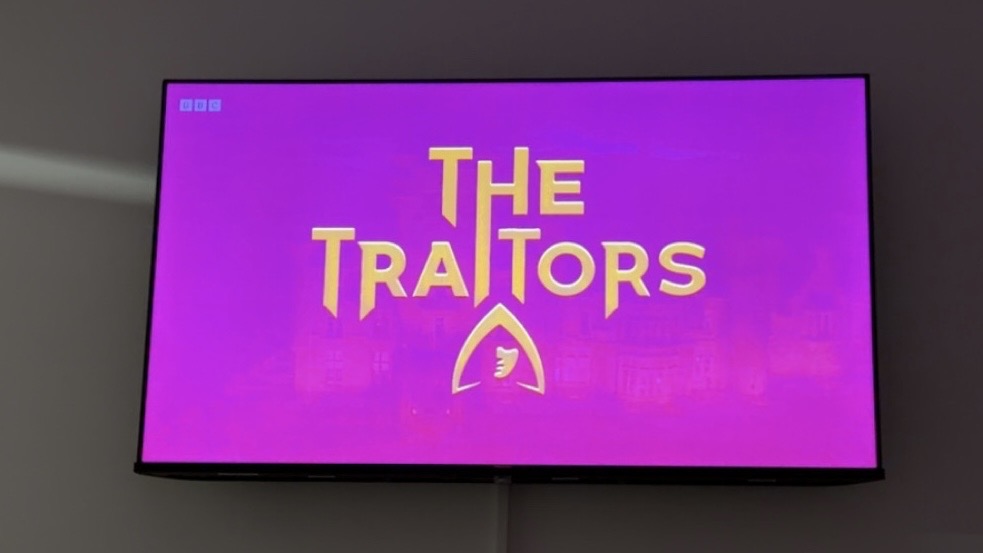
Associate Editor Rayhan Hussain examines how The Traitors has become a rare national TV event and why the BBC’s breakout hit could be its clearest argument for relevance, trust, and the licence fee in the streaming era.
There’s a particular kind of British solidarity that only appears in January – when the nights are long, the post-Christmas wallets empty, and the country collectively decides it can’t bear another hour alone with its own thoughts. This year, that solidarity has come dressed in tartan, torchlight and paranoia. At 8pm, as our kettles boil, group chats light up – people in offices, uni flats and pubs all ask the same urgent question: who’s the secret Traitor?
That question has turned The Traitors into something we barely have anymore – a national TV event. It’s not just a show people like, it’s a show that we organise our miserable January weeks around. The numbers are absurdly good in a way modern, linear television rarely is.
The current series has consistently pulled audiences above 11 million, with the launch episode on New Year’s Day watched by 11.9 million. Even the celebrity spin-off averaged 13.3 million and peaked at 14.9 million.
It matters because Britain’s viewing culture has been atomised. The rise of streaming services has altered the way we all watch television. We used to live in a world where The X Factor final felt like a public holiday, where Big Brother could swallow an entire summer, and where soap storylines became national folklore. Can you remember who killed Lucy Beale?
At its peak, an EastEnders Christmas Day episode in 1986 drew in more than 30 million viewers. Those days are gone. But The Traitors has found a loophole because it’s bingeable enough for iPlayer, but structured enough to make us watch live. If you don’t, you’ll be sure to avoid social media until you’ve caught up (I know I certainly do that).
Part of the genius of The Traitors is that it’s a reality show that doesn’t pretend to be aspirational. It’s not influencers in bikinis selling a fantasy of “love” and brand deals. It’s ordinary people under pressure, and the result is far more human and far more revealing.
The show underpins moral psychology with a £120,000 prize pot. Trust, suspicion, loyalty, vengeance – all strangely addictive and compulsive human quantities. You can watch someone’s morals collapse in real time, then watch them insist, with complete sincerity, that they’re still a ‘faithful’. It’s strangely comforting.
In a period of cost-of-living anxiety and geopolitical fragmentation, it’s a reminder that most of us are muddling through the same fundamentals. Who do you really trust? And what do you do when that trust is broken?
Crucially, it feels British. Not in the empty flag-waving sense, but in the BBC-at-its-best sense. The casting itself is one of the quiet triumphs. The contestants are people with actual jobs, actual accents, actual lives, from all four corners of the UK. That matters because the BBC lives and dies by reflecting and representing the nations and regions of the United Kingdom. It is refreshing to see the show’s mix of backgrounds creating an aura of authenticity that viewers can relate to.
Which brings us to the uncomfortable point – the BBC needs this success. Our national broadcaster has had a torrid few years. The criminal case of former BBC presenter Huw Edwards, the man who announced the death of Queen Elizabeth II to millions of viewers across Britain and around the world and sentenced after pleading guilty to offences relating to indecent images of children, was a reputational gut-punch.
The Gregg Wallace saga fed the sense of an institution too slow to police its own culture. Then there was the BBC’s Gaza documentary controversy, where an internal review found an accuracy breach over omitted information about the child narrator’s background.
And in late 2025, the crisis engulfing the BBC looked existential. The resignations of Director General Tim Davie and CEO of BBC News Deborah Turness after a row over editing in a Panorama documentary involving a Trump speech was a stark reminder that trust, once lost, is very hard to regain.
All of this lands at the worst possible moment, when the BBC’s funding model is once again under scrutiny. The government has formally launched the BBC Charter review ahead of the current Charter expiring on 31 December 2027. Meanwhile, licence-fee evasion has risen to an estimated 12.52%. When millions aren’t paying, it becomes harder to argue that the licence fee is a shared stock and questions its very sustainability.
This is why The Traitors feels like more than a hit. It shows the BBC’s route to relevance isn’t chasing Netflix, or pumping out endless irrelevant dramas, or even relying on heritage programming alone. It’s making distinctive, high-quality, culturally sticky shows that travel across platforms and spark conversations. Auntie’s most persuasive argument for its future has never been that it is perfect. It’s that, at its best, it creates shared experiences that commercial logic doesn’t reliably supply.
As a nation, we are starved of a shared culture. That’s what the Traitors boom is really telling us. In a fractured media world, the BBC still has the reach and the civic purpose to give the country something to gather around. And fundamentally, it proves that public service broadcasting still matters.

Rayhan Hussain is the Associate Editor at Roar News, having been the paper’s Comment Editor and Staff Writer between 2023 and 2025. During that time, he studied Politics at King’s College London and is currently undertaking an MA in Government Studies at King’s. Rayhan has also gained experience with The Times and The Telegraph - and recently interned at Edelman, the world's largest communication firm. At Roar, Rayhan has reported on high-profile campus stories, shaped student discourse through his editorial work, and moderated events with prominent journalists.