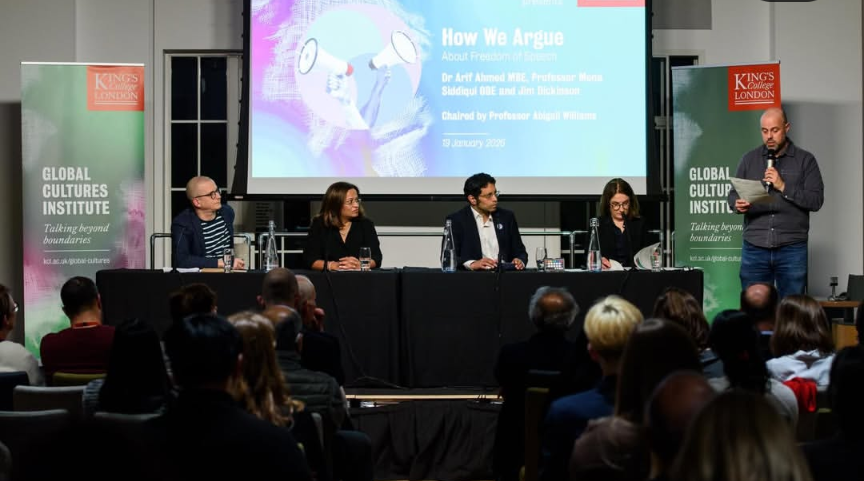
Staff Writer Emma Bishop attended King’s How We Argue: About Freedom of Speech panel, which looked at the place of freedom of speech in our current contentious times.
Universities have become one of the most contested battlegrounds for free speech as fears of online judgement, institutional power and social harm increasingly shape what can – and cannot – be said. These tensions were at the centre of How We Argue: About Freedom of Speech, a panel hosted at Bush House on 19 January.
It brought together Dr Arif Ahmed MBE (Director for Freedom of Speech and Academic Freedom at the Office for Students), Professor Mona Siddiqui OBE (Professor of Religion and Society at King’s) and Jim Dickinson (Associate Editor at higher education website Wonkhe). All are key figures in the debate around freedom of speech. The panel was chaired by KCL’s newly-appointed Executive Dean of the Faculty of Arts & Humanities, Professor Abigail Williams.
The discussion comes amid growing political scrutiny of universities’ handling of freedom of speech with institutions increasingly caught between legal obligations, student activism and reputational risk.
With the Higher Education (Freedom of Speech) Act 2023 coming into force on 1 August 2025, freedom of speech in universities have now spread to a national level. The legislation introduces new mechanisms for promoting, scrutinising and enforcing compliance of free speech in universities.
Introductions
The talk opened with a brief overview of the Global Cultures Institute, the King’s organisation hosting the event. It presented freedom of speech as a right, albeit with heavily policed borders, which the panel would attempt to understand – and undermine. In addition, both in-person and online contexts of freedom of speech were discussed.
Dr Arif Ahmed noted that someone can believe in freedom of speech even if they do not support a specific side of the debate.
He continued that currently freedom of speech must be understood as a space where everyone can have opposing opinions. Dr Ahmed concluded that freedom of speech means students need to incorporate everyone’s views, even if they do not align with their own. For surely it would not be freedom of speech if people felt restrained from speaking their opinion?
Professor Mona Siddiqui followed a similar thread to Dr Ahmed: that freedom of speech is “foundational, not conditional”. With a particular focus on social media, she argued that freedom of speech can become a performative act under societal strain. The rise of social media platforms to express one’s views means that those who speak out are often targeted by the public.
Indeed even those that stay silent are still targeted, she continued; perhaps some seek validation through social media, using it as a microphone for freedom of speech where otherwise they feel held back. She urged listeners to speak out and question who controls the boundaries of freedom of speech; should we trust these people and institutions with such authority?
Jim Dickinson shared his personal anecdotes relating to freedom of speech. One example he shared was a report from the Equality and Human Rights Commission which found that, pre-pandemic, microaggressions were more common than direct harassment of individuals. Responding to this report after the pandemic, the University of Sheffield brought in training for its staff on how to identify microaggressions.
That very evening a civil servant tweeted that “taxpayers’ money should not be spent on divisive, harmful doctrines like microaggressions. Universities should be places of high standards and not woke ideology”. With that response Dickinson questions whether everyone in the free speech debate is arguing in good faith. Like Siddiqui, the authority of who decides who gets freedom of speech was important to him.
“Is it possible to detach the discussion about free speech from the very heated issues it’s attached to?”
A reccurring theme throughout the discussion of this question, posed by Professor Williams, was the impact of scrutiny on academic speech, especially in universities.
Dr Ahmed presented polling carried out by the Office for Students, which found that one in five academics felt constrained about what they could say, with the majority of those who felt constrained being non-white or women. One in four who felt constrained in their teaching cited fear of physical attack as a factor.
“If people feel afraid to speak out or lack the confidence to speak out because they fear racial stereotyping, for instance, or because they’re subjects of racial discrimination, that absolutely is a free speech issue and it’s something that we’re very keen for universities to address.”
Dr Arif Ahmed MBE
According to Jim Dickinson, our modern fear of being judged means that when many post online they make an extra effort to be “uncontroversial”. He listed problems that may arise when people are not controversial: many lose the desire to think critically, share ideas and get things wrong.
For Dickinson, universities give students a place to explore controversial ideas face to face, which encourages the sharing of original, organic thought. He also reminded us that universities should be the place to explore wrong ideas, which Dr Ahmed encouraged.
“Everything is now summative, there aren’t many formative moments anymore…because everything is summative in terms of the possibility of other people recording it, judging it, commenting on it and so on.”
Jim Dickinson
Professor Siddiqui sees the classroom as the best place for debate and character formation via freedom of expression. She framed this as a key purpose of universities in contemporary society, alongside education.
What are universities’ roles in a world that is discarding forms of institutional power and decision making?
The panellists offered differing views on the issue, considering whether free speech should be encouraged in light of the harm it could bring to individuals.
Dickinson stated that universities have “diversified” compared to 40 years ago – in the past, students were mainly white and middle class with similar beliefs and ideas. Now, different people – with different ideas – can intermingle, which unsurprisingly can cause issues where freedom of speech is involved.
Dr Ahmed argued that people have opinions which protect themselves, their loved ones, their community and others. These opinions are often heightened under threat. Anti-free speech campaigners struggle to understand the utility of free speech because they struggle to understand all perspectives.
Professor Siddiqui took an alternative view: should academics censor themselves to avoid harming people’s feelings when their role as an academic is to discuss a topic in its rawness?
Dr Ahmed rebutted, arguing that freedom of speech has a spectrum of impact on a person, ranging from mild discomfort to threat. He ultimately agreed, however, that the university should be an environment where students learn how to overcome the challenges and objections they may face in later life.
While the panel offered no easy solution, it was clear that universities sit at the centre of a widening struggle over who gets to speak and who feels safe to listen. Ultimately, however, they also decide where those boundaries of free expression lie.

Currently in my second year of English BA. I completed A-Levels in English Literature, Classical Civilisation and Psychology. Hobbies include going to the gym, taking my dog for walks and reading. I am very interested in all news and like to keep up to date with everything local and global.